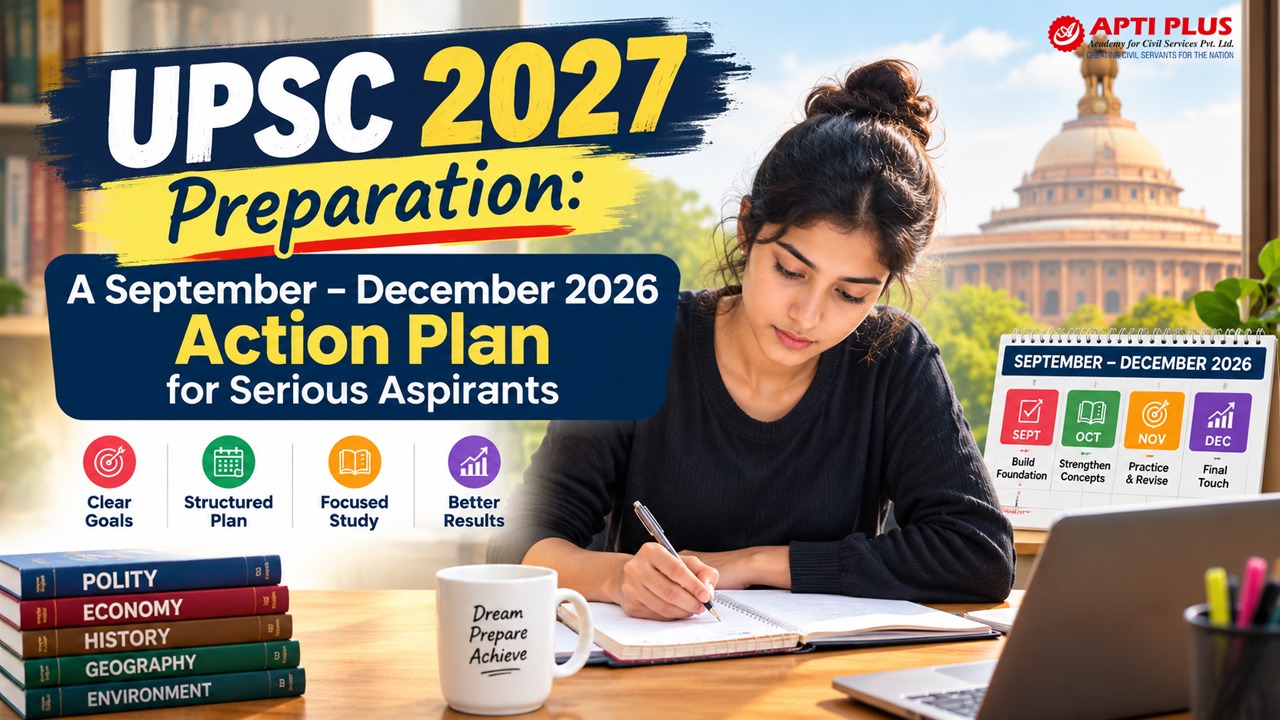
If you are planning to sit for the Civil Services Examination 2027, the next four months matter more than any other stretch in your preparation calendar. The UPSC 2027 notification is expected around 13th January 2027, applications close by early February, and UPSC Prelims 2027 is scheduled for 23rd May 2027, with UPSC Mains 2027 beginning 20th August 2027. Real UPSC 2027 preparation is built between September and December 2026 - not after the notification, when everyone else starts too.
This blog is not a generic to-do list. It gives you dated milestones, exact reading loads, and revision methods you can start using today - the same discipline that separates a first-attempt clear from a third or fourth attempt. A structured UPSC coaching environment like APTI PLUS is built around exactly this kind of timeline.
Why September–December 2026 Is the Real Starting Line for UPSC 2027
You have roughly 16-17 weeks with no application pressure, no admit card anxiety, and no exam-week distraction. This is the only window in your entire UPSC CSE cycle where you can build the static syllabus, lock the optional subject, and start Mains answer writing without competing against Prelims-week panic. Waste it on passive reading, and you enter January already behind schedule.
Step 1: Run a 100-Day Static Syllabus Sprint (1 Sept – 10 Dec)
Don't just "read NCERTs" - set page targets and read with a filter.
- Month-wise split: September = Polity (Laxmikanth) + Ancient & Medieval History; October = Modern History (Spectrum) + Geography (NCERT + G.C. Leong); November = Economy (Ramesh Singh/Sriram's notes) + Environment; December = Science & Tech, Art & Culture, and your first full revision pass.
- PYQ-first reading: Before you open a chapter, spend 10 minutes marking which parts of it have actually been asked in the last 10 years of Prelims. Read that portion twice; skim the rest once. This alone cuts wasted reading time by nearly half.
- Daily page target: 25-30 pages of static text a day clears a standard reference book roughly every three weeks - enough to finish four to five core books by mid-December.
- One-Page-Per-Chapter (OPC) method: After finishing a chapter, condense it into a single A4 page of keywords, flowcharts, and numbers only - no full sentences. This is what you'll actually revise in April 2027, not your original book.
- Sunday cumulative test: Every Sunday, attempt 25 MCQs covering everything read that week. Passive reading without weekly self-testing is the single biggest reason static revision fails later.
Step 2: Lock Your Optional in 45 Days, not 4 Months
Your optional subject carries 500 Mains marks - too much to decide on gut feeling in February.
- By 15 September: Shortlist three optionals based on genuine interest and syllabus overlap with GS (Public Administration overlaps with Polity and Governance; Sociology and Anthropology overlap with GS1 Society).
- 16–30 September: For each shortlisted subject, attempt one full Paper-I question from a recent year's UPSC PYQ, under real timed conditions, without prior preparation. This "cold attempt" test reveals natural aptitude far better than reading a syllabus on paper.
- By 15 October: Finalise based on which cold attempt felt most natural, cross-checked against UPSC's own published marks data for successful candidates by optional.
- A useful reference point here is Ritika Rath, AIR 48 in UPSC CSE 2024, a classroom student at APTI PLUS Academy, who picked Philosophy - one of the shortest optional syllabi in the Mains, often finishable in under two months - because she had genuine grounding in it from an introductory college course, not because it was trending.
Step 3: Run a 72-Hour Current Affairs Loop, not a Diary
A 100-page monthly compilation that never gets revised is worthless. Do this instead:
- Daily (30-45 min): Read one source - The Hindu, Indian Express, or PIB - and log only items with static relevance, in this exact three-line template: Issue → Static link → Likely Prelims/Mains angle. Cap each entry at 60 words; if you can't compress it, you haven't understood it yet.
- Every 3rd day: Re-read the last two days' entries before adding new ones. This "72-hour loop" ensures nothing sits unrevised for more than three days, which is roughly the retention window for unstructured notes.
- Track four recurring buckets monthly: government schemes in the news (ministry, launch year, one-line objective), reports and indices (releasing body, India's rank or score), places in the news (map-marked), and committees or panels constituted. These four buckets alone cover a disproportionate share of Prelims current-affairs questions.
- Watch the Winter Session (Nov–Dec 2026): Track bills introduced or passed via PRS Legislative Research - Parliamentary legislation is one of the most recycled Mains and interview themes.
Step 4: Mains Answer Writing - The 7-Minute Daily Discipline
Waiting for Prelims to finish before starting answer writing is the most expensive mistake in this phase.
- Daily target: One static + one current-affairs answer, 150 words each, written in exactly 7-8 minutes with a timer - five days a week. That's 25-30 evaluated-quality answers a month by December.
- Directive-word drill: Before writing, circle the directive word - Discuss, Examine, Critically Analyse, Elaborate. A well-written answer that ignores the directive word still loses marks; this single habit fixes a mistake most aspirants never notice in themselves.
- 3-dimension minimum: Every GS body paragraph must touch at least three of Social / Economic / Political / Environmental / Ethical dimensions - a one-dimensional answer reads thin regardless of how well it's written.
- Get one answer a week evaluated by a mentor or peer with written feedback. Self-graded practice plateaus fast; structured programmes like APTI PLUS Academy’s courses build this evaluation loop in from day one.
Ritika Rath's own preparation reflected a version of this discipline in Ethics (GS4). She built personalised notes with definitions, diagrams and real-life examples, including civil-servant examples, to keep answers practical rather than abstract. For aspirants starting this September, the takeaway is clear: build answer-ready notes now, focusing on examples, facts, keywords and recall - not just reading.
Step 5: Take Your First Full Mock by 10 December - Then Build an Error Log
A mock test without a proper post-mortem teaches you almost nothing.
- By 10 December: Sit for one full-length Prelims mock (100 questions, 2 hours, negative marking on).
- Sort every wrong answer into one of four buckets: Factual Gap, Conceptual Gap, Overconfidence Guess, or Elimination Failure.
- Revise only the "Conceptual Gap" and "Elimination Failure" buckets the following week - most aspirants waste revision time re-reading everything instead of fixing the two error types that actually cost marks under exam pressure.
- Repeat by 25 December and compare bucket-wise improvement, not just the overall score. A rising score with the same recurring bucket of errors means the fix hasn't worked yet.
A Realistic Weekly Rhythm for This Phase
6-7 focused hours daily: 2-3 hours static GS, 1-2 hours optional, 45 minutes current affairs (per the 72-hour loop above), 45-60 minutes answer writing (two answers), and 3 full mocks every week starting December.
Ready to Build Your UPSC 2027 Strategy the Right Way?
The gap between clearing the UPSC Civil Services Exam and falling short usually comes down to what aspirants did in these four quiet months before the rush begins. If you want a structured, mentor-guided path with built-in answer-writing evaluation and PYQ-based test series - explore the UPSC 2027 courses at APTI PLUS Academy in Kolkata and Bhubaneswar, and start your UPSC 2027 journey with a plan, not just intentions.