The Question Every Aspirant Asks
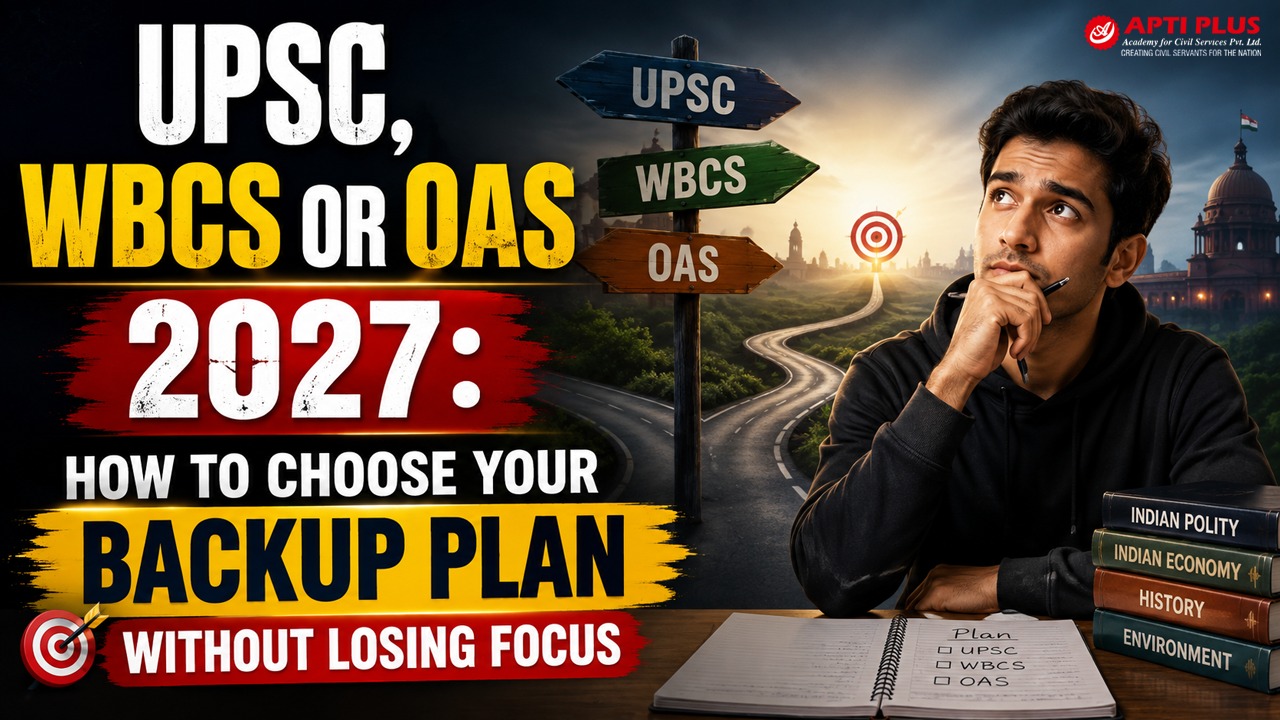
Should I write only UPSC, or should I write my state exam too?
Almost every aspirant asks this in the second year. The answers they get are not helpful. Some people say focus on one exam only. Others say keep all options open. Neither answer looks at your actual situation.
The right answer depends on three things. Where you are from. Which language you know. How much time you have left.
A backup plan is not a sign of weak confidence. It is a planning decision. You make it by looking at dates, at how much of the syllabus is common, and at how much extra work the second exam needs. That is the right way to think about your upsc exam preparation for 2027.
What the 2027 Calendar Already Tells You
UPSC released its 2027 calendar on 20 May 2026. The notification comes on 13 January 2027. The last date to apply is 2 February 2027. Prelims is on Sunday, 23 May 2027. Mains starts on 20 August 2027 and runs for five days.
Now look at the state exams. WBPSC held the WBCS Prelims on 14 June 2026. OPSC held the OAS Prelims on 7 June 2026. If 2027 follows the same pattern, both state Prelims will fall within three to four weeks of the UPSC Prelims.
This is good news, not bad news. Three weeks after the UPSC Prelims, your facts are still fresh. You do not want to open a new book, but you can easily write another paper. So wbcs exam preparation does not need a separate year. It needs a well-planned fortnight, placed at the right time.
The Mains exams do not clash either. UPSC Mains is in August. State Mains usually happen between November and February. So the written stages come one after the other, not together.
But this only works if you plan early. oas preparation includes an Odia paper and a large Odisha-specific section. You cannot finish that in five weeks. The decision has to be taken a year before, not a month before.
How Much of the Syllabus Is Common?
More than most aspirants think. History, Polity, Geography, Economy, Environment and General Science come in all three Prelims papers. National current affairs comes in all three too. If you are already reading NCERTs and a monthly current affairs magazine, most of the state Prelims is already done.
The differences start after that. The IAS exam pattern and syllabus now tests application, not memory. A common question type gives you four statements and asks how many are correct. Half-knowledge hurts you badly here.
The WBCS exam pattern works differently. Prelims is one objective paper of 200 marks and it is only qualifying. Mains has eight papers, and four of the six compulsory papers are MCQ-based. So a candidate trained only in descriptive answer writing has to build a second skill.
The OPSC OAS exam pattern is closer to UPSC. Prelims has two objective papers of 200 marks each. Paper II is qualifying at 33 per cent. There is a penalty of 0.33 marks for each wrong answer. Mains is descriptive across nine papers, and the Odia and English papers are of matriculation level and qualifying only.
Prepare Once, Sit for Two Exams
This is the part most aspirants miss. You do not have to prepare twice. If you are from West Bengal or Odisha, one properly planned course can cover both your state exam and UPSC.
If you are from Kolkata or West Bengal
The common portion between UPSC and WBCS is around 60 to 70 per cent. History, Polity, Geography, Economy and Current Affairs are almost the same. You only add the West Bengal portion and the language paper. This is why APTI PLUS runs a 1 Year UPSC + WBCS Integrated Course in Kolkata. It is a 12-month programme with 1100+ hours of classes by Delhi and West Bengal faculty, 57+ WBCS mocks and 70+ UPSC mocks, daily answer writing, the compulsory language paper and the optional subject, all in one timetable.
The results show it works. Rajdeep Ghosh cleared WBCS with Rank 72 in 2022 and then UPSC CSE with AIR 789 in 2024. Debjyoti Haler cleared WBCS with Rank 3 in 2023 and UPSC CSE with AIR 443 in 2025. Both came through the classroom system at the best ias coaching in kolkata, where the two exams are taught as one plan and not as two separate courses.
If you are from Bhubaneswar or Odisha
Here the overlap is even higher, close to 90 per cent. OAS Mains is descriptive, just like UPSC Mains, so your answer writing practice carries over almost fully. APTI PLUS runs a 1 Year Integrated Program for UPSC and OPSC in Bhubaneswar for exactly this reason. One 12-month programme covers NCERT to advanced level, Prelims, Mains and Interview for both exams, with separate Odisha-specific material for history, geography and current affairs.
The numbers also favour you. OPSC had 465 vacancies in the 2026 cycle, and the competition is from one state instead of the whole country. Students like Sai Raman Patra (AIR 285, 2025) and Vishal Pattanayak (OPSC 341, 2025) came through this route. Batches at the best oas coaching in bhubaneswar treat the Odisha portion as one extra subject, not as a separate course.
If you know both Bengali and Odia
A small number of candidates grow up with both languages. Families that have moved between the two states, or candidates who studied in one state and settled in the other, often fall in this group. For them, all three exams are open.
This is a real advantage, but use it carefully. The common General Studies base serves all three. What you add is two regional blocks and two language papers. That is heavy, so do not attempt all three in your first year. Build the GS base first, add your home state exam in year one, and bring in the third exam only after you have cleared one Prelims and know how you handle pressure.
If you do plan this, speak to a mentor before you enrol. The right sequence matters more than the number of forms you fill.
Three Things That Do Not Carry Over
Before you decide, be clear about what extra work a second exam brings.
• Language. WBCS needs the ability to read, write and speak Bengali. There is a narrow exemption for Nepali-speaking candidates from the Darjeeling hills. OAS needs Odia. If you did not grow up with the language, this is a big cost.
• Format. An MCQ Mains paper and a descriptive Mains paper need opposite skills. One needs speed and precision. The other needs structure and word limits. Practising only one weakens the other.
• State-specific portion. Each state commission asks about its own rivers, its own panchayat system, its own freedom fighters and its own budget. It is limited material, but it takes months, not weeks.
If all three are easy for you, the state exam costs you very little. If all three are hard for you, then it is not a backup plan. It is a second full preparation wearing the name of a backup.
The Three Exams Side by Side
The 2027 dates are not out yet for the state exams. The details below are based on how the 2026 cycles were held. Always check the current official advertisement before applying.
|
Parameter |
UPSC CSE 2027 |
WBCS (Exe.) 2027 |
OPSC OAS 2027 |
|
Conducting body |
Union Public Service Commission |
West Bengal Public Service Commission |
Odisha Public Service Commission |
|
Prelims format |
Two papers: GS-I (merit) and CSAT (qualifying, 33%) |
One objective General Studies paper, 200 marks, purely qualifying |
Two objective papers of 200 marks; Paper II qualifying at 33% |
|
Mains format |
Nine papers, 1750 marks counted, all descriptive |
Eight papers; four of the six compulsory papers are MCQ-based |
Nine papers, descriptive, 1750 marks counted |
|
Language requirement |
One Indian language paper, qualifying only |
Bengali proficiency is an eligibility condition |
Odia paper of matriculation standard, qualifying |
|
Optional subject |
Compulsory, two papers |
Two papers, only for Group A and B aspirants |
Two papers |
|
Typical vacancy scale |
933 posts in the 2026 cycle |
Several hundred posts across Groups A to D |
465 posts in the 2026 cycle |
|
Age window (general) |
21 to 32 years |
21 to 36 years |
Wider than UPSC; verify against the current advertisement |
Let One Mock Test Decide
There is a quick way to settle this question, and it is not more reading. Write one full paper of each exam in the same week, under exam conditions, before you decide anything. Two and a half hours will tell you more than two months of thinking.
If you score near the qualifying line on a cold attempt, the overlap is real for you. If you lose thirty marks on the state portion, you now know exactly what the backup will cost. The WBCS mock test series can be used this way, as a test of the decision itself, before you commit.
After that, the test series does its normal job. Every mistake is marked as a concept gap, a careless error or a wrong guess. Your accuracy is tracked against the number of questions you attempt. That is where most Prelims marks quietly leak away.
For Odisha, the opsc oas test series covers the descriptive Mains stage, with each answer checked on 25+ parameters. This is the stage where UPSC-trained students usually find that their writing is strong but their Odisha content is thin.
The Mistake That Spoils Backup Plans
The mistake is not choosing wrong. It is choosing late.
The pattern is very common. A student prepares for UPSC all year. In March, panic sets in. He fills the state form. April goes into reading state material. He walks into the UPSC Prelims without full revision and misses by four marks. Three weeks later he walks into the state Prelims having never written a single state-pattern paper. Two exams lost because of one delayed decision.
The fix is simple. Decide by August of the previous year. Write the decision down. Give the state portion a fixed slot every week instead of stealing hours from revision. Then stop asking the question again, because the thinking itself is what eats your time.
Conclusion
A backup plan does not mean you are less serious about UPSC. It means you have looked at the vacancies, the age limits and the calendar, and built a plan one person can actually follow. The problem is never the second exam. The problem is the decision you keep postponing.
Choose based on the three things that do not carry over. Test the overlap with one honest mock. Fix the decision before the year starts. A good ias academy will help you make that call in August instead of selling you a second course in March. The published list of selections across UPSC, WBCS and OAS is the proof that matters.
And if you are still unsure, ask one question to whoever is advising you. What happens to my UPSC timetable in the eight weeks after I add this exam? An institute that answers that clearly is doing the work that separates the best upsc coaching in india from a nice-looking brochure.