The Mains Result Is Out
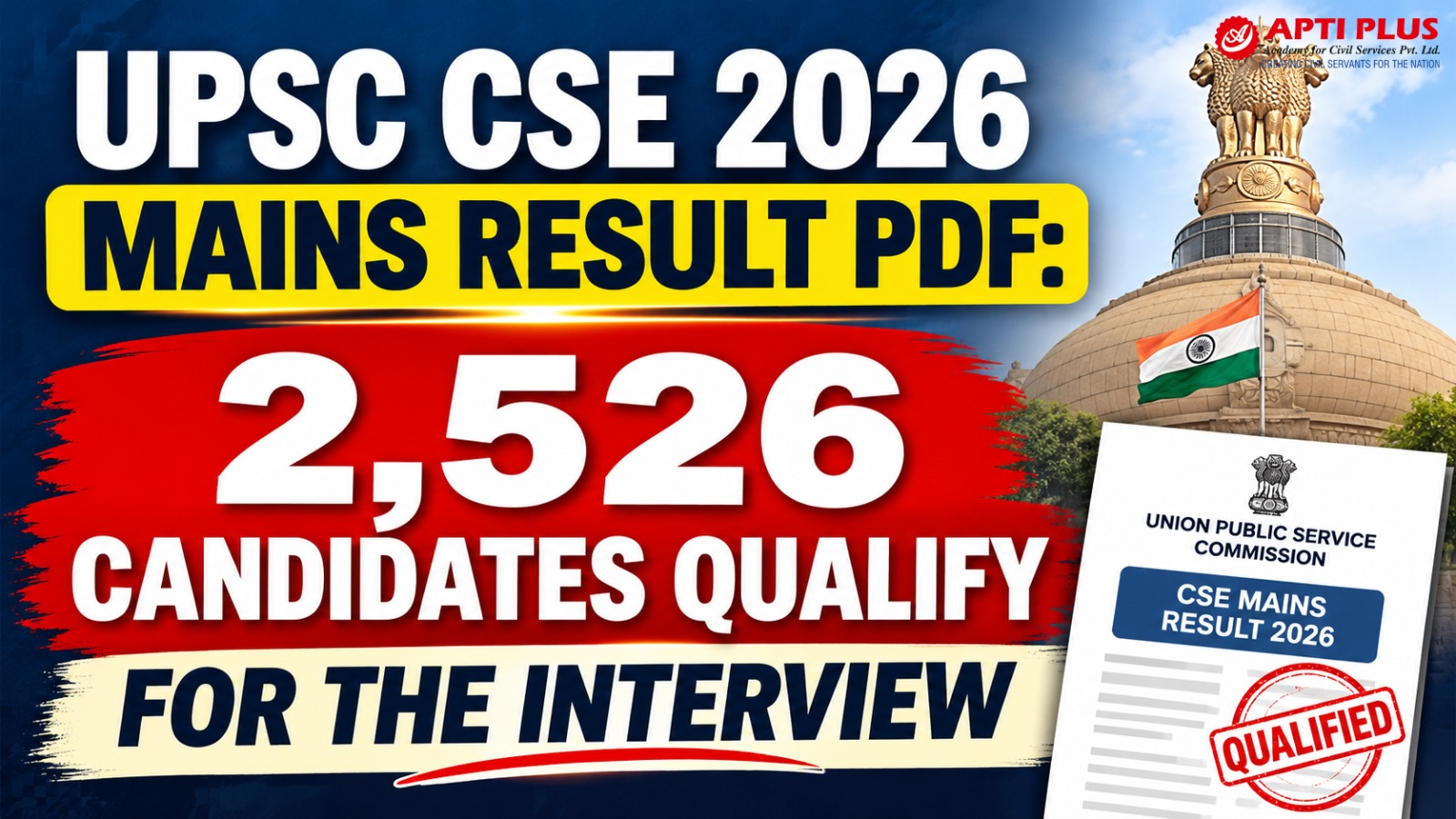
The Union Public Service Commission (UPSC) declared the result of the Civil Services (Main) Examination, 2026 on 5 November 2026. The Mains was held from 21 to 30 August 2026, so the result has come a little over two months after the last paper.
A total of 2,526 candidates have qualified for the Personality Test, which most people simply call the interview. You can download the official list here: UPSC CSE 2026 Mains Result PDF.
UPSC CSE 2026 Mains Result at a Glance
|
Detail |
Information |
|
Exam |
Civil Services (Main) Examination, 2026 |
|
Conducted by |
Union Public Service Commission |
|
Prelims held on |
24 May 2026 |
|
Candidates who qualified Prelims |
13,343 |
|
Mains held on |
21 to 30 August 2026 |
|
Result declared on |
5 November 2026 |
|
Candidates qualified for interview |
2,526 |
|
Vacancies (CSE 2026) |
933 |
|
DAF-II window |
11 to 25 November 2026, till 6:00 PM |
|
Interview venue |
Dholpur House, Shahjahan Road, New Delhi |
How to Check Your Name in the Result PDF
1. Open the result PDF from the link above, or visit upsc.gov.in and look for the Civil Services (Main) Examination, 2026 result under "What's New".
2. Download the PDF and save it on your phone or computer.
3. Press Ctrl + F on a computer, or tap "Find in page" on your phone.
4. Type your seven-digit roll number or your name as it appears on your admit card.
5. If it shows up, you have qualified for the interview. Keep a copy of the PDF safe.
The list runs to 99 pages and shows the serial number, roll number and name of each candidate.
The List Is Not a Rank List
This is a common mistake on results day. The names are arranged in order of roll number, not marks. The candidate at serial number 1 has simply the smallest roll number. Nobody has "topped" the Mains yet, because UPSC does not publish Mains marks until the final result is out.
What the Numbers Tell You
Out of 13,343 candidates who qualified for the Mains, only 2,526 made it to the interview. That is fewer than one in five. Last year, in CSE 2025, 2,736 candidates were called for the interview, so this year's list is about 210 names shorter.
With 933 vacancies, roughly one in every 2.7 interview candidates will be in the final list. The interview carries 275 marks out of a total of 2,025, and a good or poor interview can move a rank by several hundred places. Read the IAS exam pattern and syllabus once more to see how much weight this last stage carries.
Important Dates and Instructions from the Notice
Fill the DAF-II on time. All qualified candidates must log in to upsconline.nic.in between 11 and 25 November 2026, till 6:00 PM. You have to update details such as your address, higher education, achievements, job, service preference and home cadre, and then submit the form. If you miss this, no e-Summon Letter will be issued.
Submit even if nothing has changed. Candidates who uploaded everything earlier still have to log in, verify the details and finally submit the form.
Upload your degree proof if you were "appearing". If you were still a student at the time of Prelims, you must upload proof that you have passed the qualifying exam. Without it, your candidature will be cancelled.
Keep original certificates ready. You will need originals for age, education, category, EWS, PwBD and the TA Form at the interview. Reservation certificates must be issued on or before 27 February 2026, the last date of the Prelims application.
Watch for the e-Summon Letter. UPSC will not send any letter by post. The interview schedule and e-Summon Letters will be put on upsc.gov.in and upsconline.nic.in. Change of address or contact details must be sent to [email protected] within seven days of the notice.
Fill the Attestation Form. This is filled online on the DoPT website (cseplus.dopt.gov.in) between the start and the end of the interviews.
How to Start Interview Preparation
Begin with your DAF, not with a question bank. Most questions in the board come from what you write in the DAF: your name, district, state, college, job and hobbies. Fill the DAF-II carefully, because every line you write becomes a possible question.
Prepare each line of your form as a topic. Know your home district's problems, the basics of your graduation subject, the reason you left your job, and what your hobby really involves. Practise with a list of the most important UPSC interview questions that boards come back to again and again.
Stay in touch with the news. The board joins your profile to current issues. Read the daily current affairs every morning and keep short notes on topics linked to your state and your field.
Revise the big issues of the year. For quick revision of the year's major topics, a UPSC monthly magazine is easier to carry than months of newspaper cuttings.
Work on how you speak, not just what you say. Posture, pace, eye contact and calmness are part of the score. This guide on how to present yourself in the UPSC interview explains what the board notices.
Where Mock Interviews Help
You can prepare the content alone, but it is hard to judge your own delivery. A good IAS mock interview gives you a real panel, honest feedback and a sense of how the 30 minutes will actually feel.
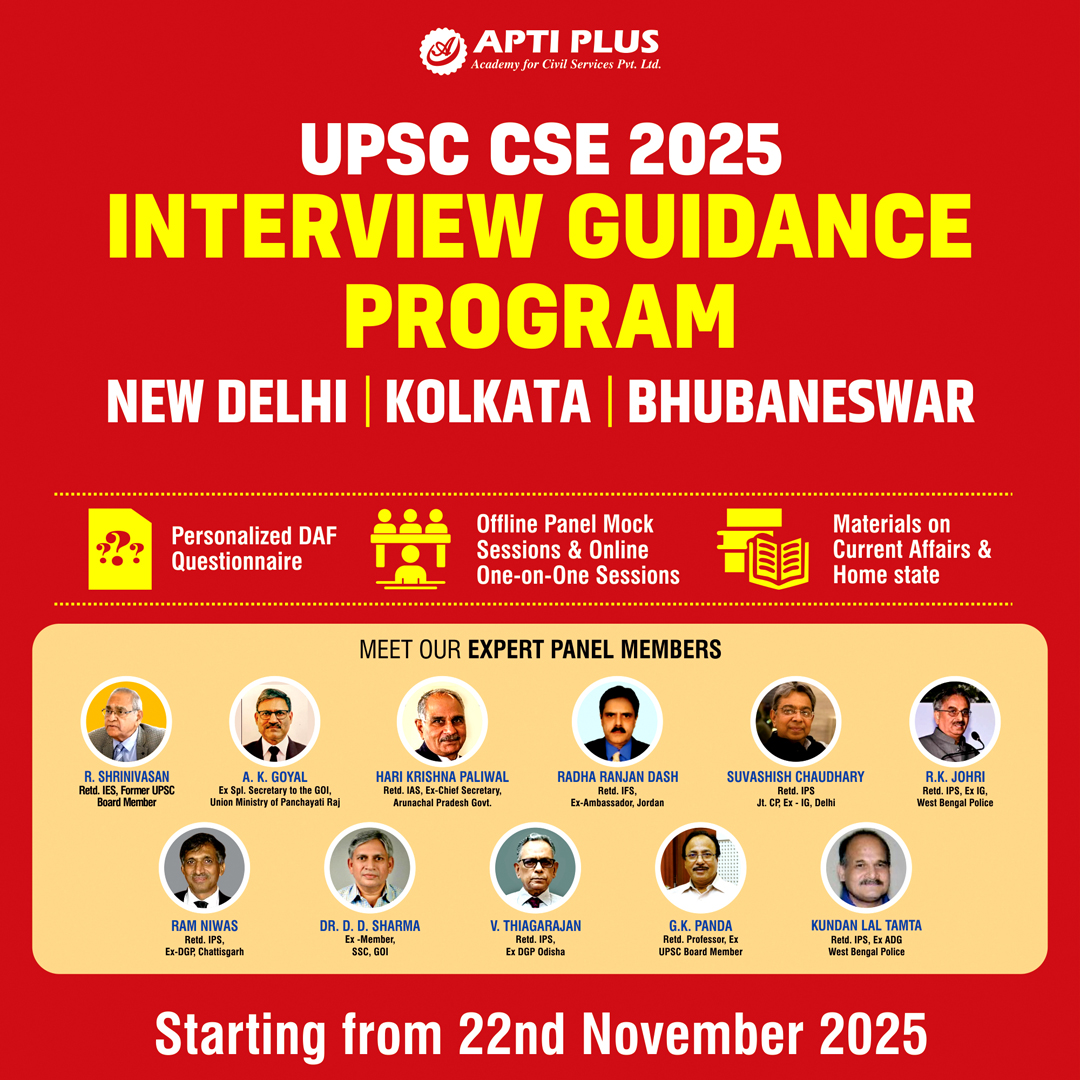
Several institutes run programmes for this stage. One of them is the APTI PLUS Interview Guidance Programme for UPSC for CSE 2026, which starts this month. It begins with a one-to-one review of every entry in your DAF and a set of likely questions built from it. After that come mock interviews with panellists who bring more than 40 years of experience between them, including retired bureaucrats, defence officers and senior faculty. The questions are asked in different styles, so you get used to both friendly and tough boards.
Offline sessions run at the Salt Lake and Bhowanipore centres in Kolkata and at the Bhubaneswar centre, and panel mocks are also held in New Delhi. Candidates who cannot travel can join online and face the same panellists. Registered candidates also get a free interview handbook on current affairs and common questions about hobbies, education and work, along with state-specific notes for their home region. After every session, you get feedback you can act on before the next one.
Past Results from the Programme
Several candidates who took interview guidance at APTI PLUS made it to the UPSC CSE 2025 final list. They included Debjyoti Halder (AIR 443), Debabrata Pramanik (AIR 467), Mohsina Bano (AIR 648) and Kirti Chowdhury (AIR 760).
Candidates from Odisha did well too. Sattwik Satyakam Devta (AIR 100), Ankit Agrawal (AIR 217), Sai Raman Patra (AIR 285) and Vishal Pattanayak (AIR 341) were all part of the same interview guidance.
The academy itself says that past results are not a promise, and no programme can guarantee a rank. Your own preparation still decides the outcome. More accounts from past candidates are on the UPSC success stories page.
If Your Name Is Not on the List
This hurts, especially after a full year of work. But reaching the Mains already puts you among a small group of serious aspirants. When UPSC releases the mark sheets after the final result, study your paper-wise marks closely. Find out whether you lost marks in the essay, in one GS paper or in the optional, and plan the next attempt around that weak spot.
Mistakes to Avoid Now
• Missing the DAF-II deadline. No submission means no e-Summon Letter.
• Writing a hobby you do not practise. The first follow-up question will expose it.
• Giving memorised answers. They sound flat, and the second question breaks them.
• Ignoring your own state and district. These are the easiest questions to prepare and the most embarrassing to miss.
• Waiting for the interview schedule to start. Use the weeks you have now.
Conclusion
Making it to the list of 2,526 is the result of a long and hard year. The interview is now the only stage left, and it is the one where the syllabus is your own life.
Students at the best IAS coaching in Kolkata usually begin DAF work and mock interviews right after the Mains result, because the interview dates come sooner than most people expect.
Fill your DAF-II with care, prepare every line of it, and practise speaking your answers aloud. Then walk into Dholpur House ready for a conversation, not an examination.