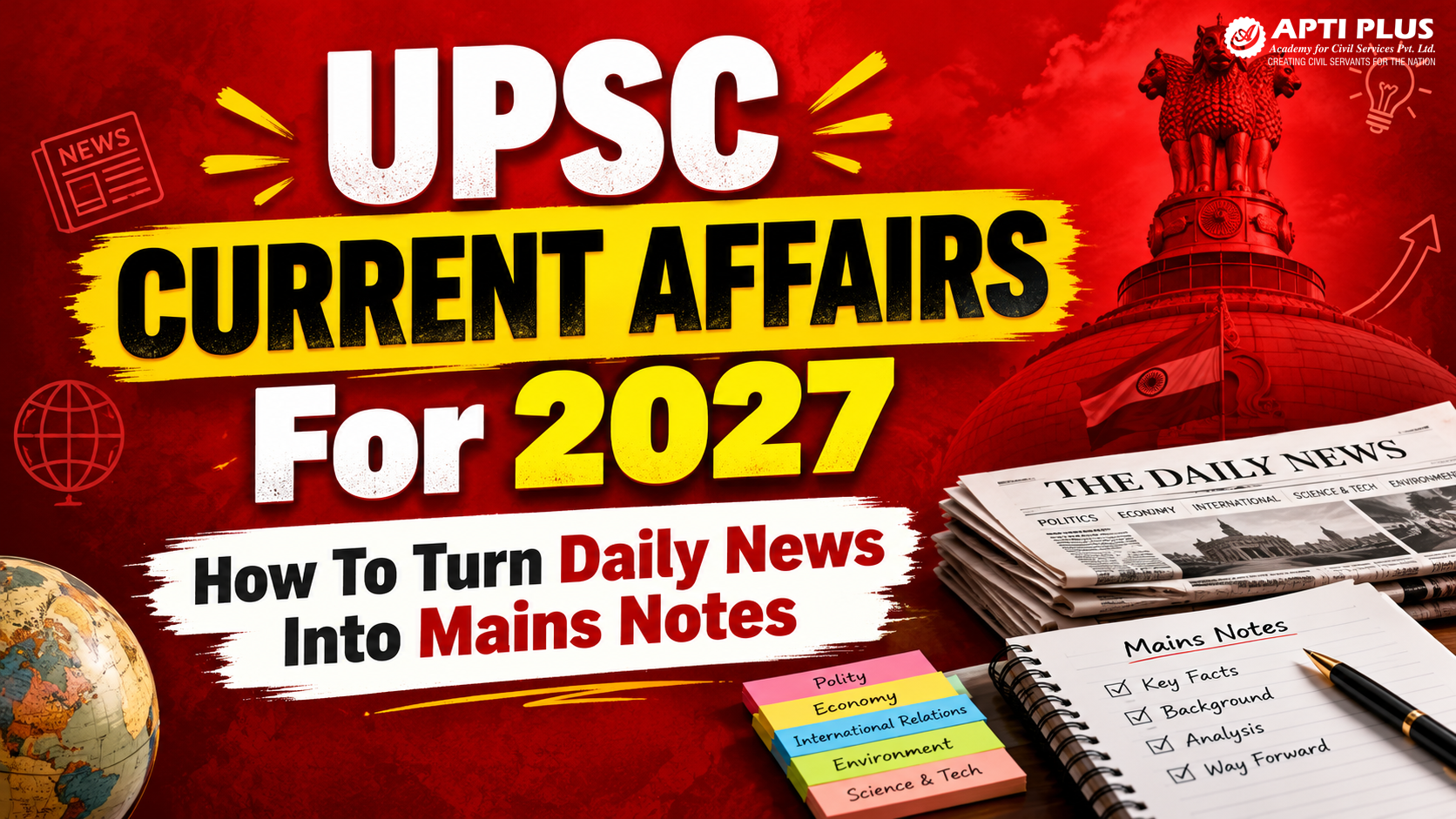
The Gap Between Reading the News and Writing the Answer
In the Mains hall you get about eight minutes for a 150-word answer. In those eight minutes you must define the issue, give three or four dimensions, support each with a fact, a report or an example, add the criticism, and finish with a way forward.
Now ask yourself a hard question. The editorial you read last Tuesday, can you produce four such points from it today, without looking at anything?
Most aspirants cannot. They read for a year and still write hollow answers. The reason is not weak memory. The reason is that they took reading notes when they should have taken answer notes. This guide shows you how to make the second kind.
A Mains Note Is Not a Summary
A summary tells you what the newspaper said. A Mains note hands you the raw material of an answer. The difference decides your marks.
A Summary Note |
A Mains Note |
|
Records the event |
Records why the event matters |
|
Is written by date |
Is written by theme |
|
Has information |
Has data, reports, examples and criticism |
|
Is read before the exam |
Is used inside the answer |
|
Grows longer each month |
Stays one page and gets tighter |
So from today, stop asking "what happened" when you read. Ask instead: "if UPSC frames a 150-word question on this, what will I write?"
Your Calendar for CSE 2027
Event |
Date |
|
Notification |
13 January 2027 |
|
Last date to apply |
2 February 2027 |
|
Prelims |
23 May 2027 |
|
Mains |
From 20 August 2027 |
Count backwards from 20 August 2027. The current affairs that will appear in that Mains run roughly from the middle of 2026 to July 2027. The news you are reading today, in October 2026, is already Mains material, and it will be gone from memory by next August unless you store it as answer material now.
Step 1: Place Every Item in a GS Paper Before You Note It
Current affairs have no syllabus of their own. They borrow one. If you cannot place a news item inside a General Studies paper, do not note it at all.
Paper |
What To Pick From the News |
|
GS Paper I |
Society, women, caste, urbanisation, population, culture, geography events |
|
GS Paper II |
Polity, governance, laws, judgments, schemes, health, education, foreign policy |
|
GS Paper III |
Economy, agriculture, infrastructure, environment, science, security, disasters |
|
GS Paper IV |
Ethical dilemmas in administration, integrity cases, real governance examples |
|
Essay |
Themes and quotable data that cut across several subjects |
Keep the IAS exam pattern and syllabus open beside you for the first month of this habit. After four weeks you will place each item in seconds, and your notes will stop filling up with news that can never be asked.
Step 2: Keep One Page per Theme, Not per Day
Date-wise notes are the most common mistake in Mains preparation. No question in August 2027 will ask about "the news of 12 October 2026". Questions are asked by theme.
So open one running page for each theme and keep adding to it through the year. A full year of news fits into roughly 25 to 30 themes, such as electoral reforms, centre-state relations, judicial accountability, India and its neighbours, multilateral groupings, inflation, agricultural marketing, employment and skilling, climate negotiations, disaster management, space and defence, health systems, women and children, tribal rights, urban governance and internal security.
By March your page on each theme will carry ten or twelve entries. That page is a ready answer. Three hundred loose headlines are not.
Step 3: Use a Six-Part Note Format That Matches an Answer
Write every entry in the same six parts, in the same order. The order is not random: it is the order of a Mains answer, so at the exam you only have to join the parts.
1. Context in one line: What happened and when. Two lines at most.
2. Why it matters: The significance for governance, the economy or society. This becomes your introduction.
3. Dimensions: Three or four angles such as economic, social, legal, environmental and federal. These become your body headings.
4. Evidence: One or two figures, a report name or a committee recommendation with the year.
5. The other side: The criticism, the risk or the dissenting view, so that you can write a balanced answer.
6. Way forward: Two practical suggestions in your own words.
Keep this to one page per theme per month. A long note is a note you will never revise, and a note you never revise never reaches an answer sheet.
Step 4: Harvest the Four Things That Actually Fetch Marks
Two candidates can write the same argument and score differently. The difference is almost always the supporting material. While you read, pull out these four and keep a short running list for each theme.
• Data: A percentage, a rank, a budget figure or a target, each with its source and year.
• Reports and indices: Economic Survey, NITI Aayog, NCRB, RBI, World Bank, IPCC and so on, with the one finding you will quote.
• Committees and judgments: The committee name and its main recommendation, or the case name and what the court held.
• Examples and case studies: A state model, a district initiative or an international practice, which works especially well in the way forward.
Four such items per theme are enough. Candidates who collect forty use none of them, because nothing can be recalled under exam pressure.
Step 5: Tie Every News Item to a Static Chapter
UPSC rarely asks pure current affairs in Mains. It asks a static topic wearing a current coat. A question on federalism hangs on a recent centre-state dispute. A question on the monsoon hangs on a recent flood. A question on ethics hangs on a real administrative failure.
So below every entry, write one line: which static chapter does this belong to? Over a year, this single habit is what converts a pile of news into answers, because in the exam you will recall the chapter first and the example will come with it.
Step 6: Convert the Note Into a Written Answer Every Week
This is the step most aspirants skip, and it is the only step that actually builds Mains ability. A note you have never written out is not yet yours.
Every week, pick two theme pages and write one 150-word and one 250-word answer from memory. Then compare what you wrote with the page and mark what you missed.
Three things to watch while writing:
• Obey the directive word. Discuss, examine, critically analyse and evaluate ask for different things. Most marks are lost here, not in content.
• Keep the structure visible. A short introduction, three or four sub-headings in the body, and a forward-looking conclusion.
• Place one piece of evidence in each body point. A report, a figure or an example, never all three in one line.
Reading model answers helps you see the standard you are writing against. The toppers answer copies section shows how selected candidates actually structured their answers and where they placed data and examples.
Step 7: Get the Answer Evaluated, Not Just Written
Writing without evaluation only makes your mistakes permanent. You cannot see your own repetition, your own vague conclusions or your own missing keywords. Somebody who has corrected hundreds of copies can see them in a minute.
This is why daily answer writing with checked copies sits at the centre of serious Mains preparation. At APTI PLUS, answers are evaluated by faculty members and qualifiers who mark structure, content, presentation and the use of current examples, and return the copy with a model answer for comparison.
Closer to the exam, the practice has to move to full papers under three-hour conditions. The Mains test series does this with sectional, full-length and essay papers, three-stage evaluation, All India ranking and feedback within seven days, so you find out whether your theme pages actually survive exam pressure.
How APTI PLUS Cuts Half of This Work for You
Building all of this from a blank page every morning is slow. Most toppers do not do it alone. They start from a ready daily layer and add their own thinking on top. Much of this layer is open to everyone, not only to enrolled students.
1. Daily News Analysis: what to read from The Hindu and Indian Express
The hardest question each morning is not what the news says, but which news matters. The daily current affairs page picks the exam-relevant items from The Hindu, The Indian Express and gives each one its background and syllabus link. You read a filtered page in twenty minutes instead of scanning eighteen pages of newsprint.
2. Daily Editorial Analysis in answer format
Editorials are where Mains content lives, but reading four of them daily can eat four hours. The daily news analysis and editorial section breaks each important editorial into background, significance, challenges and way forward. That is almost exactly the shape of a Mains answer, so these can be lifted straight into your theme pages.
3. Daily material shared on Telegram
The same daily analysis, editorial notes and PDFs are pushed to students on Telegram every day. This matters more than it sounds. A file you must go and search for is forgotten, while a file that arrives on your phone at a fixed hour becomes a habit, and habit is the whole game in current affairs.
4. Daily current affairs notes in the classroom
Classroom and online students receive daily current affairs notes along with their regular classes, already tagged to the General Studies paper they belong to. The sorting work is done, so the student spends the saved time on writing answers rather than arranging files.
5. Weekly current affairs videos and sessions
Once a week, the week’s news is taken up again in a video session where mentors connect the stories, drop the ones that will not be asked, and show how a question could be framed from each. This weekly repetition is what moves current affairs from short-term memory into Mains-ready memory.
6. Monthly revision through the IAS Gazette
At the end of each month, the IAS Gazette on the UPSC monthly magazine page lets you check your theme pages against a clean compilation and fill whatever you missed. Merging the two is itself a revision round.
7. Mains-focused current affairs revision
As the Mains approaches, current affairs must be squeezed into answer-ready form. Mains Xpress revises the important topics of the year in exactly that shape, with mock tests built around them.
8. Report summaries and the yearly compilation
Nobody has time to read original government and global reports, yet their findings are what lift an answer. The important reports section condenses them into usable points.
For the big revision rounds in April and July, the annual compilation brings the entire year together in one place.
Mistakes That Waste a Whole Year
• Date-wise notes. They cannot be used in an answer and cannot be revised.
• Copying paragraphs from the editorial. If you cannot revise an entry in one minute, it is too long.
• Collecting from five sources. One newspaper, one daily analysis and one monthly magazine are enough.
• Only highlighting, never writing. Highlighted text feels like progress and produces nothing.
• Saving PDFs you never open. Downloading is not studying.
• Leaving all revision for the last month. Current affairs need three rounds, not one.
Your Plan From Today to the Mains
|
Period |
What To Do |
|
Oct to Dec 2026 |
Build theme pages daily, write two answers a week |
|
Jan to Mar 2027 |
Continue notes, raise answer writing to four a week |
|
Apr to May 2027 |
Prelims mode, keep notes running with light revision |
|
Jun to Jul 2027 |
Full Mains mode, revise all theme pages, write full papers |
|
Aug 2027 |
Final revision of one-page themes only, no new material |
Conclusion
Current affairs do not reward the person who reads the most. They reward the person who can produce four solid points, with one figure and one example, eight minutes after seeing the question.
That ability comes from themes instead of headlines, a six-part note instead of a summary, and a written answer every week instead of another highlighted article.
Start today with three theme pages and one 150-word answer. By January, when the notification comes, you will be revising answers while others are still collecting PDFs. Classroom students at the best IAS coaching in Kolkata follow exactly this cycle: filtered analysis in the morning, notes in class, an answer in the evening, and a video round-up every week.
Several rank holders have said that organised current affairs notes and regular evaluated answer writing were what finally lifted their Mains score, and their accounts are on the UPSC success stories page.