Why In News?
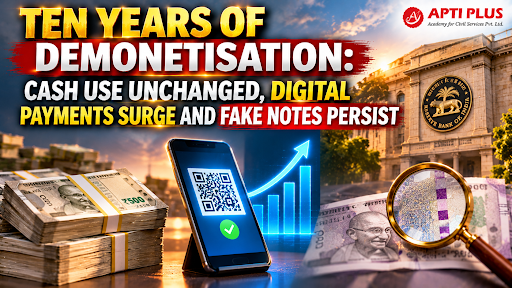
An analysis of Reserve Bank of India (RBI) data shows that cash with the public, as a share of GDP, has stayed about the same as before the demonetisation, while detection of fake ₹500 notes has risen.
What Was Demonetisation?
On 8 November 2016, the Prime Minister announced that ₹500 and ₹1,000 notes would cease to be legal tender from midnight.
-
Scale: These "Specified Bank Notes" made up about 86% of the currency in circulation by value, around ₹15.41 lakh crore.
-
New Notes: The government introduced a new series of ₹500 notes and a new ₹2,000 note with improved security features.
Legal Basis
-
RBI Act, 1934: The notification was issued under Section 26(2), which allows the government, on the RBI's recommendation, to declare notes of any series as no longer legal tender.
-
Specified Bank Notes (Cessation of Liabilities) Act, 2017: Ended the government's and RBI's liability on the old notes.
-
Earlier Demonetisations: India had demonetised high-value notes in 1946 and 1978.
Stated Objectives
-
Curbing Black Money And Corruption: The Prime Minister linked high cash circulation to corruption, inflation and hawala trade.
-
Ending Counterfeit Currency: He cited the use of fake currency by terror groups across the border.
-
Less-Cash Economy: Encouraging digital payments and reducing reliance on cash.
What Does The Data Show After Ten Years?
Cash In Circulation
|
Indicator |
2015–16 (Before) |
2025–26 (After) |
|
Currency with the public (% of GDP) |
11.9% |
12.1% |
|
UPI transaction value (% of GDP) |
Near zero (2016–17) |
Nearly 91% |
- Cash Remains Steady: Cash with the public, relative to GDP, has returned to and slightly exceeded its pre-2016 level.
-
Digital Boom: At the same time, UPI usage exploded, showing that digital and cash use have both grown.

Return Of Old Notes
-
Almost All Returned: The RBI reported that about ₹15.31 lakh crore, nearly 99.3% of the demonetised notes, came back into the banking system. Critics argued this showed little black money was held as cash.
Counterfeit Notes
|
Indicator |
Earlier |
2025–26 |
|
Fake notes detected per crore notes (all denominations) |
70.1 (2015–16) |
13.4 |
|
Fake ₹500 notes per crore ₹500 notes |
0.3 (2016–17) |
20.1 |
- Overall Improvement: Counterfeits across all notes have fallen sharply.
-
Rise In Fake ₹500 Notes: Detection of fake ₹500 notes has risen steadily since the new series was introduced.
-
Unclear Cause: Higher detection may reflect more counterfeiting, better detection, or both. The data does not show which.
-
₹2,000 Notes: The RBI began withdrawing ₹2,000 notes in May 2023, and detection of fake ₹2,000 notes rose as they were returned.

What Are The Assessments Of Demonetisation?
Arguments That It Had Benefits
-
Digital Payments Push: Supporters argue that demonetisation jump-started India's digital payments revolution, together with Unified Payments Interface (UPI), launched by the Unified Payments Interface (UPI) in 2016.
-
Wider Tax Base: The government reported increases in income tax returns filed and the formalisation of savings in the years that followed.
-
Action On Shell Companies: Authorities used deposit data to identify suspicious transactions and deregister lakhs of shell companies.
-
Part Of A Broader Strategy: It was accompanied by measures such as the Black Money Act, 2015, the Benami Transactions (Prohibition) Amendment Act, 2016 and GST (2017).
Arguments That Its Costs Outweighed Gains
-
Cash Not Reduced: Critics point to cash-to-GDP returning to pre-2016 levels as evidence that the less-cash goal was not met.
-
Economic Disruption: Many economists linked the sudden cash shortage to a slowdown in growth and hardship for the informal sector, farmers and small businesses.
-
Costs Of Printing: The RBI's currency printing costs rose sharply in 2016–17.
Judicial View
-
Vivek Narayan Sharma v. Union of India (2023): A Constitution Bench of the Supreme Court upheld the decision by a 4:1 majority, finding the process lawful.
-
Dissent: Justice B.V. Nagarathna held that such a major step should have been taken through legislation passed by Parliament, not by notification.
Why Does Cash Remain Popular In India?
-
Informal Economy: A large share of workers and businesses operate informally, where cash is common.
-
Precautionary Savings: Households keep cash for emergencies, especially in rural areas.
-
Trust And Convenience: Cash is universally accepted, private and does not require internet or smartphones.
-
Digital Gaps: Many people still lack digital literacy or reliable connectivity.
What Are The Key Challenges?
Persistent Cash Dependence
-
Cash Paradox: Despite the UPI boom, cash in circulation relative to GDP has not fallen, showing that digital payments add to cash use rather than replace it.
-
Rural And Informal Reliance: Cash remains dominant in rural areas and informal markets.
Rising Counterfeiting Of New Notes
-
Fake ₹500 Notes: Rising detection of fake ₹500 notes shows that new security features have not ended counterfeiting.
-
Cross-Border Networks: Fake Indian Currency Notes (FICN) have historically been smuggled across borders to fund crime and terror.
Black Money Takes New Forms
-
Shift Away From Cash: Black money is often held in real estate, gold, shell companies and offshore accounts, which demonetisation did not target.
-
Global Investigations: Leaks have shown how wealth is hidden abroad.
-
Example: The Panama Papers (2016) and Pandora Papers (2021) revealed how wealthy individuals worldwide, including Indians, used offshore entities to hide assets, showing that black money is not mainly held as cash.
Economic Disruption And Its Lessons
-
Shock To The Informal Sector: The sudden withdrawal of cash disrupted wages, trade and farm sales.
-
Global Comparison: Abrupt currency changes elsewhere have caused similar turmoil.
-
Example: In 2023, Nigeria's sudden currency redesign caused severe cash shortages and protests. Its Supreme Court ordered that old notes remain legal tender for longer, showing the risks of abrupt currency changes.
Digital Payment Risks
-
Cyber Fraud: The rise of digital payments has brought a sharp increase in UPI frauds and scams.
-
Concentration Risk: Heavy dependence on a few payment apps and systems raises operational risks.
Digital Exclusion
-
Unequal Access: Elderly people, women in rural areas and those without smartphones are less able to use digital payments.
Measuring Policy Outcomes
-
Unclear Data: It is difficult to separate the effects of demonetisation from other factors such as GST, COVID-19 and the global rise of fintech.
-
Lack Of Independent Evaluation: There has been no comprehensive official evaluation of the policy's costs and benefits.
What Is The Way Forward?
Make Digital Payments Inclusive
-
Offline And Feature-Phone Options: Expand UPI 123PAY for feature phones and UPI Lite for small offline payments.
-
Digital Literacy: Scale up programmes such as PMGDISHA for rural digital literacy.
Tackle Counterfeiting
-
Upgrade Security Features: Regularly update note designs and security features.
-
Coordinated Enforcement: Strengthen the Fake Indian Currency Note Coordination Group (FCORD) Coordination Group under the Ministry of Home Affairs and the National Investigation Agency's work against counterfeit networks.
-
Better Detection: Equip banks and businesses with advanced note-sorting and detection machines.
Target Black Money At Its Source
-
Real Estate And Gold: Strengthen property registration, digital land records and tracking of high-value purchases.
-
International Cooperation: Use automatic exchange of tax information under the OECD Common Reporting Standard to track offshore wealth.
-
Expert Guidance: Act on recommendations of the Special Investigation Team on black money, set up in 2014 under Justice M.B. Shah.
Strengthen Cybersecurity
-
Fraud Prevention: Use AI-based fraud detection, transaction limits and quick refund mechanisms.
-
Awareness: Run public campaigns on avoiding digital scams.
Develop A Digital Rupee Carefully
-
CBDC: Expand the RBI's e-rupee (Central Bank Digital Currency), piloted since 2022, as a safe digital alternative to cash.
-
Learn From Others: Some countries have moved towards low-cash economies gradually.
-
Example: Sweden became one of the world's least cash-dependent economies through gradual adoption of digital payments, while its central bank studies an e-krona. It also introduced rules to protect people who still need cash.
Formalise The Economy Gradually
-
Incentives Over Shocks: Encourage formalisation through GST simplification, easy credit and digital invoicing, rather than abrupt measures.
-
MSME Support: Help small businesses adopt digital tools at low cost.
Evidence-Based Policymaking
-
Independent Evaluation: Commission independent studies of major economic policies, with transparent data.
-
Consultation: Major monetary decisions should involve wider consultation, as highlighted in the dissent in Vivek Narayan Sharma (2023).
Conclusion
Ten years on, demonetisation's record is mixed. Cash with the public relative to GDP is back to pre-2016 levels, and fake ₹500 notes are being detected more often, even as overall counterfeiting has fallen and UPI has transformed payments. The lesson is that lasting change in black money, counterfeiting and cash use requires sustained, targeted reforms, digital inclusion and evidence-based policy, rather than one-time shocks.
Source: THEHINDU
|
PRACTICE QUESTION Q. Digital payments have grown alongside cash, not instead of it. Examine this paradox and suggest measures to promote a less-cash economy in India. (15 Marks, 250 Words) |