Why In News?
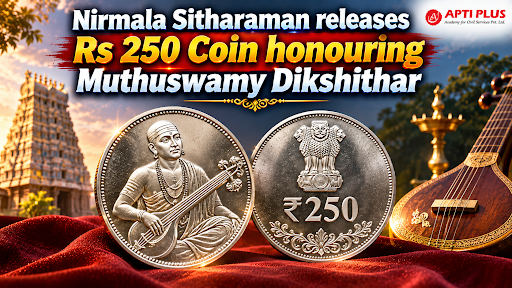
The Union Finance Minister released a ₹250 commemorative coin marking the 250th birth anniversary of Muthuswami Dikshitar, a member of the Trinity of Carnatic music.
Who Was Muthuswami Dikshitar?
Life
-
Birth: He was born in 1775 at Tiruvarur, Tamil Nadu.
-
Family: His father, Ramaswami Dikshitar, was a noted musician and composer.
-
In Kashi: He spent about five years in Varanasi with his guru Chidambaranatha Yogi, where he was exposed to Hindustani music, especially Dhrupad.
-
Death: He died in 1835 at Ettayapuram, Tamil Nadu.
Musical Contributions
-
Language: He composed mostly in Sanskrit, unlike Tyagaraja, who composed mainly in Telugu.
-
Signature: His compositions carry the mudra (signature) "Guruguha", a name of Lord Murugan.
-
Instrument: He was an accomplished veena player, which shaped his slow-tempo, majestic style.
-
Large Body Of Work: He composed several hundred kritis, rich in philosophy, temple lore and Tantric symbolism.
Famous Compositions
|
Composition Group |
Feature |
|
Navagraha Kritis |
Nine songs on the nine planets |
|
Kamalamba Navavarana Kritis |
Songs on the Goddess Kamalamba, based on the Sri Chakra |
|
Nottuswaram |
Compositions set to Western (European) tunes |
|
Vibhakti Kritis |
Songs using different grammatical cases of a deity's name |
Cultural Synthesis
-
North And South: He blended Hindustani elements into Carnatic music.
-
East And West: His Nottuswaram pieces used European melodies he heard near Fort St. George in Madras.
What Is The Trinity Of Carnatic Music?
|
Composer |
Period |
Main Language |
Signature |
|
Tyagaraja |
1767–1847 |
Telugu |
"Tyagaraja" |
|
Muthuswami Dikshitar |
1775–1835 |
Sanskrit |
"Guruguha" |
|
Syama Sastri |
1762–1827 |
Telugu and Sanskrit |
"Syama Krishna" |
-
Same Birthplace: All three were born in Tiruvarur.
-
Golden Age: Their lifetimes are seen as the golden age of Carnatic music.
-
Earlier Foundation: Purandara Dasa (15th–16th century), called the "Father of Carnatic Music", laid the foundation of systematic teaching before the Trinity.
How Are Commemorative Coins Issued In India?
Legal Framework
-
Coinage Act, 2011: The Government of India has the sole power to design and mint coins.
-
Minting: Coins are minted by the Security Printing and Minting Corporation of India (SPMCIL) at government mints in Mumbai, Kolkata, Hyderabad and Noida.
-
Role Of RBI: The RBI distributes coins put into circulation but does not issue them.
Commemorative Coins
-
Purpose: They honour people, events or institutions of national importance.
-
Collector's Items: High-value commemorative coins such as the ₹250 coin are mainly sold to collectors and are not meant for everyday circulation.
Source: THEHINDU
|
PRACTICE QUESTION Q. Consider the following statements: 1. Muthuswami Dikshitar composed mainly in Telugu. 2. Muthuswami Dikshitar used the signature (mudra) "Tyagaraja" in his compositions. 3. Commemorative coins in India are issued by the Reserve Bank of India under the RBI Act, 1934. How many of the statements given above are correct? (a) Only one (b) Only two (c) All three (d) None Answer: (d) Explanation: Statement 1 is incorrect: Muthuswami Dikshitar composed his musical works predominantly in Sanskrit, unlike his contemporaries Tyagaraja and Syama Sastri, who composed primarily in Telugu. He only composed a few pieces in Manipravalam (a mixture of Tamil and Sanskrit). Statement 2 is incorrect: Muthuswami Dikshitar used "Guruguha" as his signature (mudra) in all of his compositions, paying homage to Lord Subramanya. "Tyagaraja" was the name of one of his fellow members of the Carnatic Music Trinity, not his mudra. Statement 3 is incorrect: Coins in India (including commemorative coins) are minted and issued by the Government of India under the Coinage Act, 2011. The Reserve Bank of India (RBI) only acts as an agent to distribute and put these coins into circulation on behalf of the Central Government. |