Why In News?
The proposed 11,200 MW Siang Upper Multipurpose Project (SUMP) has triggered opposition among sections of the Adi tribal community over possible displacement, loss of ancestral land, agricultural livelihoods and cultural heritage.
Who Are the Adi Tribes?
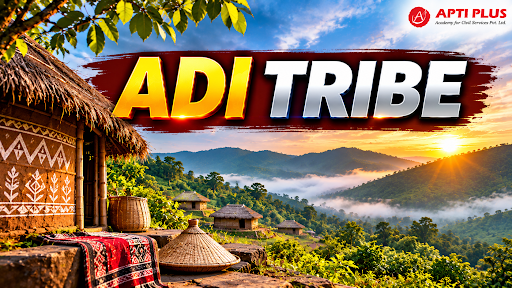
The Adi are among the major indigenous tribal communities of Arunachal Pradesh. The term Adi is commonly interpreted as hill people.
-
Geographical Distribution: They primarily inhabit the Siang region, including East Siang, Upper Siang and West Siang, and parts of Lower Dibang Valley, particularly Roing and Dambuk.
-
Ethnic Composition: The Adi community comprises several closely related groups, including Padam, Minyong, Pasi, Milang, Shimong, Karko, Komkar, Bokar, Bori and Palibo.
-
Cultural Identity: These groups share closely related linguistic, social and cultural traditions.
-
Historical Tradition: The Adis trace their ancestry to Abo Tani, an important ancestral figure in Tani community traditions.
What Are the Major Features of Adi Society?
-
Village Administration: The Kebang is the traditional village council responsible for resolving disputes, maintaining social order and addressing community affairs.
-
Traditional Institutions: The Dere or Mosup serves as a community space for discussing social and cultural matters.
-
Social Organisation: Adi society follows a clan-based kinship system, which influences marriage relations, social obligations and community identity.
-
Family Structure: The family traditionally functions as the basic unit of social organisation, with a predominantly patrilineal and patriarchal structure.
-
Housing: Traditional houses use bamboo and wood, with elevated floors known as Chang, supported by wooden or bamboo stilts.
-
Language: The Adi language belongs to the Tibeto-Burman branch of the Sino-Tibetan language family, with regional variations.
What Are the Major Livelihoods and Cultural Practices of the Adis?
-
Agriculture: Wet-rice cultivation and shifting cultivation form important parts of traditional livelihoods.
-
Forest-Based Livelihoods: Forest products, fishing and other natural resources supplement household food and income.
-
Handicrafts: Adi communities practise traditional cane and bamboo craftsmanship, producing baskets, mats, trays, hats and other household articles.
-
Women and Weaving: Adi women are known for traditional weaving, textile designs and handloom practices.
-
Religion: Donyi-Polo, associated with the Sun and Moon, forms an important part of traditional Adi belief systems. Christianity is also followed by sections of the community.
-
Traditional Spiritual Practices: The Miri performs important ritual and spiritual functions in traditional religious practices.
Which Festivals and Dances Are Associated with the Adis?
-
Solung: An important agricultural festival associated with prosperity, agricultural productivity and community well-being.
-
Etor: A traditional festival celebrated in May.
-
Aaran (Aran): A traditional festival celebrated in March.
-
Ponung: A popular group dance, generally performed by women and accompanied by a lead singer.
-
Delong and Yakjong: Traditional community dances.
-
Tapu: A traditional war dance reflecting the historical martial traditions of the community.
What Is the Siang Upper Multipurpose Project?
-
Project Location: The proposed project is located on the Siang River in Arunachal Pradesh, which forms the upper course of the Brahmaputra after entering India.
-
Multipurpose Objective: It aims to combine electricity generation with water-flow regulation, flood management and strategic water security.
-
Strategic Significance: The Siang originates in Tibet, where it is known as the Yarlung Tsangpo, before entering Arunachal Pradesh and flowing into Assam as part of the Brahmaputra system.
-
Current Status: The government is undertaking a Preliminary Feasibility Report (PFR) to assess technical feasibility, suitable locations and project parameters.
What Are the Major Challenges Associated with the Siang Upper Multipurpose Project (SUMP)?
Displacement and Loss of Ancestral Land
Land Alienation: Large dams can submerge agricultural land, forests and settlements, weakening customary land relationships and intergenerational ownership.
-
Example: Sections of the Adi community have expressed concerns about potential displacement and loss of ancestral land in the Siang Valley.
Threat to Indigenous Cultural Heritage
Cultural Discontinuity: Indigenous identity depends on ancestral landscapes, traditional institutions, sacred places, oral histories and community practices. Physical relocation may weaken these cultural connections.
-
Example: The Kebang village council and traditional community spaces such as Dere/Mosup form important parts of Adi social organisation. Their functioning may face disruption if communities are fragmented.
Ecological and Hydrological Impacts
-
River Ecosystem Disruption: Large dams can alter natural river flows, sediment transport, aquatic habitats and downstream ecological processes.
-
Seismic Vulnerability: The Eastern Himalayan region has significant seismic activity. Dam safety requires detailed geological, seismic and reservoir-induced seismicity assessments.
-
Example: The Siang basin lies in the seismically active Eastern Himalayan region, making geological and seismic investigations essential before any final project decision.
Livelihood and Food Security Concerns
-
Agricultural Disruption: Submergence of agricultural land and changes in river ecology can affect wet-rice cultivation, fishing and forest-based livelihoods.
-
Traditional Knowledge Loss: Displacement may weaken indigenous knowledge related to agriculture, biodiversity, medicinal plants and natural resource management.
-
Example: Adi communities practise wet-rice cultivation, shifting cultivation, fishing and traditional handicrafts. These activities depend on access to local natural resources.
India-China Transboundary Water Concerns
-
Upstream Water Management: The Siang originates as the Yarlung Tsangpo in Tibet, where China has developed hydropower infrastructure and proposed additional projects.
-
Strategic Water Security: India has concerns about upstream infrastructure, hydrological information sharing and possible changes in downstream water flows.
-
Example: The proposed SUMP has been discussed in the context of India's need to assess potential upstream water-related risks and improve water-flow management.
Trust Deficit and Governance Challenges
-
Inadequate Public Confidence: Technical surveys, security deployment and disagreements over project information can increase distrust between communities and government institutions.
-
Meaningful Participation: Consultation must allow affected communities to understand project alternatives, environmental risks and rehabilitation arrangements before irreversible decisions.
-
Example: The Adi Baane Kebang Youth Wing and Adi Students' Union raised concerns about the project, prompting discussions with the state government in October 2026.
What Is the Constitutional and Legal Framework for Protecting Adi Tribal Rights?
Constitutional Safeguards
-
Article 29(1): Protects the right of citizens having a distinct language, script or culture to conserve it.
-
Article 46: Directs the State to promote the educational and economic interests of Scheduled Tribes and protect them from social injustice and exploitation.
-
Article 244: Provides the constitutional framework for administration of Scheduled Areas and tribal areas under the Fifth and Sixth Schedules, respectively.
-
Article 338A: Establishes the National Commission for Scheduled Tribes (NCST) to safeguard and investigate matters concerning Scheduled Tribe rights.
-
Article 371H: Provides special constitutional provisions for Arunachal Pradesh, including the Governor's special responsibility concerning law and order. It does not independently confer customary land ownership rights.
Statutory Safeguards
-
Forest Rights Act, 2006: Recognises individual and community forest rights, including access to traditional forest resources and community forest resource management, subject to statutory eligibility.
-
Land Acquisition, Rehabilitation and Resettlement Act, 2013: Provides for social impact assessment, rehabilitation and resettlement safeguards and applicable consent requirements.
-
Environment (Protection) Act, 1986: Provides the statutory basis for environmental protection and environmental clearance regulations.
-
Biological Diversity Act, 2002: Supports biodiversity conservation, sustainable use and equitable benefit-sharing.
What Measures Can Balance Hydropower Development with Indigenous Rights?
Ensure Meaningful Community Participation
-
Prior Informed Consultation: Explain project design, displacement estimates, environmental risks and alternative locations in the Adi language.
-
Traditional Institutions: Involve Kebang, village elders, Adi organisations, women and youth in consultation and decision-making.
-
Example: The Arunachal Pradesh Government has indicated that information about SUMP should also be disseminated in the Adi language to improve community understanding.
Conduct Independent Environmental and Social Assessments
-
Environmental Impact Assessment (EIA): Examine biodiversity loss, river-flow changes, sedimentation, downstream impacts and cumulative effects of hydropower projects.
-
Social Impact Assessment (SIA): Identify affected households, customary land rights, livelihood losses and cultural heritage sites.
-
Cumulative Basin Assessment: Assess the combined impact of dams and other infrastructure across the Siang-Brahmaputra basin.
-
Example: The state government has stated that detailed EIA and SIA processes will follow if the project progresses beyond the preliminary feasibility stage.
Strengthen Rights-Based Rehabilitation
-
Community-Centred Rehabilitation: Design rehabilitation packages that protect customary land relationships, livelihood systems and community institutions.
-
Livelihood Restoration: Provide agricultural land where feasible, skill development, employment opportunities and compensation for livelihood losses.
-
Cultural Heritage Protection: Document and protect sacred landscapes, traditional knowledge and culturally significant sites.
-
Example: The Forest Rights Act, 2006 recognises community forest resource rights and supports community participation in forest governance.
Improve Technical and Institutional Transparency
-
Independent Technical Review: Subject dam design, geological stability, seismic risks and hydrological projections to independent expert assessment.
-
Public Disclosure: Publish findings, environmental studies, rehabilitation plans and responses to community objections.
-
Grievance Redressal: Establish an accessible mechanism involving district administration, tribal representatives and independent experts.
-
Example: The Arunachal Pradesh Cabinet constituted an empowered high-level committee in September 2026 to coordinate activities and community engagement.
Adopt a Sustainable Development Approach
-
Alternative Assessment: Compare large storage dams with smaller hydropower projects, decentralised renewable energy and other water-management options.
-
Benefit Sharing: Ensure that local communities receive a fair share of project-related employment, infrastructure and economic benefits.
-
Ecological Safeguards: Maintain environmental flows and protect riverine biodiversity.
-
Example: The UN Declaration on the Rights of Indigenous Peoples (UNDRIP), 2007 emphasises indigenous participation in decisions affecting their lands, territories and resources.
Conclusion
The Siang project highlights the complex relationship between energy security, national strategic interests and indigenous rights. Development in the Eastern Himalayas must combine scientific assessment, meaningful community participation and protection of ancestral cultural landscapes.
Source: TIMESOFINDIA
|
PRACTICE QUESTION Q. With reference to the Adi tribe of Arunachal Pradesh, consider the following statements:
Which of the statements given above is/are correct? (a) 1, 2 and 3 only (b) 1 and 4 only (c) 2, 3 and 4 only (d) 1, 2, 3 and 4 Answer: (a) 1, 2 and 3 only Explanation: Statement 1 is correct: The Adi community primarily inhabits parts of the Siang region (such as East Siang, Upper Siang, Siang) and Lower Dibang Valley in Arunachal Pradesh. Statement 2 is correct: Kebang is the traditional village council of the Adi community (along with alternatives like Dere or Mosup). Statement 3 is correct: Solung is a major agricultural/harvest festival celebrated by the Adi tribe. Statement 4 is incorrect: The Adi language belongs to the Tibeto-Burman language family (Tani linguistic branch), not the Dravidian language family. |