Why In News?
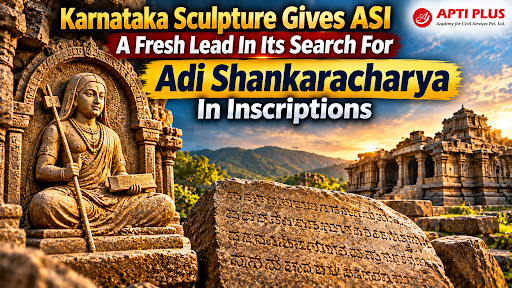
A sculpture recovered from an ancient brick structure in a Karnataka village has given the Archaeological Survey of India (ASI) a fresh lead in its effort to trace references to Adi Shankaracharya across thousands of inscriptions.
Who Was Adi Shankaracharya?
Adi Shankaracharya (c. 8th century CE) was an influential Indian Vedic scholar-monk, philosopher, and teacher who is widely recognized as the principal consolidator of Advaita Vedanta.
-
Birthplace: According to tradition, he was born at Kalady, on the banks of the Periyar (Purna) river in Kerala.
-
Period: He is commonly dated to about 788–820 CE, though his exact dates are debated, and some traditions place him much earlier.
-
Guru: He studied under Govinda Bhagavatpada on the banks of the Narmada, traditionally placed at Omkareshwar.
-
Final Days: Tradition holds that he attained samadhi at Kedarnath in the Himalayas.
Philosophy
-
Advaita Vedanta: He taught non-dualism, stating that Brahman (the ultimate formless, infinite reality) is the sole truth, the material and instrumental cause of the universe, and that the individual soul (jiva) is fundamentally non-different from Brahman.
-
Maya: He explained that the physical world appears real due to Maya (illusion or cosmic superimposition), and true liberation (Moksha) comes from realizing this underlying oneness.
-
Literary Works: He wrote foundational commentaries on the Brahma Sutras, the Bhagavad Gita, and the major Upanishads, alongside composing philosophical treatises (Vivekachudamani, Upadesasahasri) and devotional hymns (Bhaja Govindam, Soundarya Lahari, Nirvana Shatakam)
Major Works
-
Prasthanatrayi Commentaries: He wrote commentaries (bhashyas) on the three foundational texts of Vedanta: the Brahma Sutras, the principal Upanishads and the Bhagavad Gita.
-
Devotional And Teaching Works: Works such as Vivekachudamani and Bhaja Govindam are traditionally attributed to him.
The Four Mathas:
To preserve the traditions and organize ascetics, he established four cardinal monastic centers (mathas) across India:
|
Matha |
Location |
Direction |
|
Sringeri Sharada Peetham |
Chikkamagaluru district, Karnataka |
South |
|
Dwarka Sharada Peetham |
Gujarat |
West |
|
Govardhana Matha |
Puri, Odisha |
East |
|
Jyotirmath |
Near Badrinath, Uttarakhand |
North |
Dashanami Order: He is credited with organising the Dashanami order of monks.
Unifying Role: Through his travels across India and his mathas at its four corners, he is seen as a unifier of India's cultural and spiritual traditions.
Passing: According to tradition, he lived a short life of about 32 years, passing away near Kedarnath in the Himalayas.
Source: NEWINDIANEXPRESS
|
PRACTICE QUESTION Q. Consider the following statements: 1. The Sringeri Sharada Peetham is located in Karnataka. 2. Adi Shankaracharya was born at Kalady in Kerala. 3. The Epigraphy Branch of the Archaeological Survey of India is headquartered in Mysuru. How many of the statements given above are correct? (a) Only one (b) Only two (c) All three (d) None Answer: (c) Explanation: Statement 1 is correct: The Sringeri Sharada Peetham is located in the town of Sringeri in the Chikkamagaluru district of Karnataka. It is the southern-most monastery (Dakshinamnaya Peetham) established by Adi Shankaracharya. Statement 2 is correct: Adi Shankaracharya was born in Kalady, which is a village located on the banks of the Periyar River near Kochi in Kerala. Statement 3 is correct: The Epigraphy Branch of the Archaeological Survey of India (specifically the Sanskrit and Dravidian inscriptions branch) is headquartered in Mysuru (Mysore), Karnataka. It initially came into existence in Bangalore in 1886, moved to Ooty in 1903, and was finally shifted to Mysuru in 1966. |