Why In News?
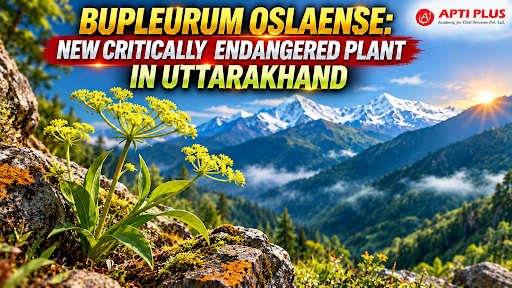
Botanists from the Botanical Survey of India (BSI) have discovered a new plant species, Bupleurum oslaense, in Uttarakhand.
What Is Bupleurum Oslaense?
-
New Species: Bupleurum oslaense is a newly described plant from the temperate forests of the Western Himalaya.
-
Family: It belongs to the family Apiaceae (the carrot or umbellifer family), which also includes coriander, cumin and fennel.
-
Closest Relative: It shares genetic and structural similarities with Bupleurum petiolulatum, a relative native to China.
Habitat
-
Location: It was found at about 2,550 metres in the Govind Pashu Vihar National Park and Sanctuary, Uttarakhand.
-
Ecosystem: It grows in temperate Himalayan forests, which host many range-restricted plants.
Key Features
-
Size: The plant grows up to 80 cm tall, with a sturdy, stout habit.
-
Leaves: It has narrower lower leaves and broader upper leaves with distinct red-tinged margins.
-
Flowers: It has larger bracts (three to five) and flower clusters (umbellules) with 10 to 20 flowers each.
Conservation Status
-
Critically Endangered: Following IUCN guidelines, the species has been assessed as "Critically Endangered", the highest risk category before extinction in the wild.
About Govind Pashu Vihar National Park
-
Location: The park lies in Uttarkashi district, Uttarakhand, in the upper catchment of the Tons River, a tributary of the Yamuna.
-
Landscape: It includes the scenic Har Ki Dun valley, a popular trekking destination.
-
Wildlife: It is home to species such as the snow leopard, Himalayan black bear and bearded vulture.
-
Conservation Projects: The Gangotri–Govind landscape is one of the focus areas of the SECURE Himalaya project, run by the MoEFCC with United Nations Development Programme (UNDP) and the Global Environment Facility (GEF) support to protect high-altitude ecosystems.
About Botanical Survey Of India
The Botanical Survey of India (BSI) is the apex research organization under the Ministry of Environment, Forest and Climate Change for carrying out taxonomic and floristic studies on the country's wild plant resources.
-
Founded: February 13, 1890 (Reorganized in 1954)
-
Headquarters: Kolkata, West Bengal
Main Mandates & Functions
-
Floristic Surveys: Undertaking intensive explorations to document the occurrence, distribution, ecology, and economic utility of plants across India.
-
Taxonomic Research: Conducting research on plant groups, including angiosperms, gymnosperms, cryptogams (algae, fungi, bryophytes, pteridophytes), and lichens.
-
Herbarium & Collections: Acting as the custodian of authentic plant specimens. It manages the Central National Herbarium in Howrah (housing millions of sheets) and the Acharya Jagadish Chandra Bose Indian Botanic Garden.
-
Conservation: Identifying threatened and endangered species, managing gene banks, and contributing to IUCN red-listing and recovery proposals.
-
Documentation: Publishing national, state, and district-level floras alongside digital archives like the Indian Virtual Herbarium.
Source: RESEARCHMATTERS
|
PRACTICE QUESTION Q. Consider the following statements about Bupleurum oslaense: 1. It belongs to the family Apiaceae. 2. It was discovered in the Govind Pashu Vihar National Park in Uttarakhand. 3. It has been assessed as "Endangered" under IUCN guidelines. How many of the statements given above are correct? (a) Only one (b) Only two (c) All three (d) None Answer: (b) Explanation: Statement 1 is correct: Bupleurum oslaense is a perennial herb belonging to the carrot/parsley family, Apiaceae. Statement 2 is correct: Discovered by botanists from the Botanical Survey of India, the species was found near Osla village at an elevation of approximately 2,550 metres within the Govind Pashu Vihar National Park and Sanctuary in Uttarakhand. Statement 3 is incorrect: Following standard IUCN Red List guidelines, the species has been formally assessed as Critically Endangered (CR)—not merely "Endangered"—due to its extremely restricted distribution and tiny mature population. |