Why In News?
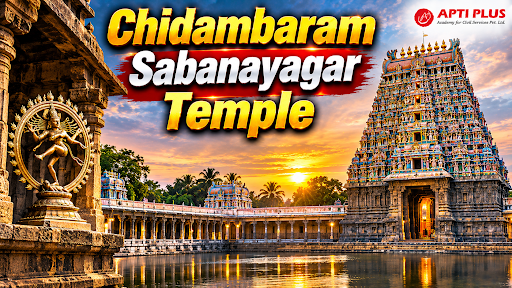
The Madras High Court set up a five-member Board of Management to run the Chidambaram Sabanayagar (Nataraja) Temple.
About Chidambaram Sabanayagar Temple
-
Location: The temple, also called the Thillai Nataraja Temple, stands in the temple town of Chidambaram in Cuddalore district, Tamil Nadu.
-
Presiding Deity: It is dedicated to Nataraja, Lord Shiva in his form as the cosmic dancer performing the Ananda Tandava.
-
Pancha Bhoota Sthalam: It is one of the five Pancha Bhoota Sthalams, representing Akasha (space or ether).
-
Sacred Hymns: It is praised in the Tevaram hymns of the Nayanmar saints and in Manikkavasagar’s Tiruvasagam.
History
-
Ancient Origins: A Shiva shrine likely existed here before the 7th century CE, when the town was called Thillai.
-
Chola Patronage: The Cholas, who revered Nataraja as their family deity, expanded the temple in the 10th century. Parantaka I is credited with its golden roof.
-
Royal Gifts: Rajaraja Chola I, Kulothunga Chola I, Kundavai II and Vikrama Chola made major offerings to the shrine.
-
Later Patrons: The Vijayanagara rulers, Madurai Nayakas, Sethupathis, the Maharaja of Pudukkottai and even the British made donations.
-
Existing Structure: Most of the present layout dates to the late 12th and early 13th centuries.
Key Architectural Features
-
Vast Complex: The temple covers about 40 acres and is a fine example of Dravidian architecture.
-
Four Prakarams: The complex sits within four prakarams (enclosed courtyards).
-
Nine Gopurams: Nine gateway towers link the courtyards. The four main gopurams face the cardinal directions.
-
Golden Sanctum: The roof of the sanctum is covered with gold plates.
-
108 Karanas: The gopuram walls show all 108 karanas (dance postures) from Bharata Muni’s Natya Shastra. These form the foundation of Bharatanatyam.
Five Sabhas (Halls)
|
Sabha |
Significance |
|
Chit Sabha |
Sanctum where Nataraja resides |
|
Kanaka Sabha |
Golden hall in front of the sanctum |
|
Nritta Sabha |
Hall of dance, linked to the dance contest legend |
|
Deva Sabha |
Hall of the gods |
|
Raja Sabha |
Thousand-pillared hall |
The “Magnetic Equator” Claim
Popular Belief Versus Science: The temple is often popularly described as lying on the world’s magnetic equator. However, India’s geomagnetic equator runs much further south, near Thumba in Kerala, where ISRO set up its rocket launch station for this reason. The claim is a belief rather than a scientific fact.
What Did The Madras High Court Order?
-
Heritage Damage: The Court found that the temple’s ancient structures had been damaged and poorly maintained under the Dikshitars’ management.
-
Unaudited Assets: It noted that the temple’s movable and immovable properties had not been properly accounted for or audited. The Dikshitars had retained the temple’s income for over 12 years without a full account.
Key Safeguards
-
Rituals Untouched: The Podhu Dikshitars keep exclusive authority over daily rituals and festivals, which must follow established customs.
-
Monthly Accounts: The Dikshitars’ Secretary must submit accounts to the Board by the 5th of every month.
-
Temporary Arrangement: The Board will run the administration “till the ill is cured”, with support from the Revenue and Public Works departments and ₹10 lakh for contingency expenses.
-
Origin Of The Case: The order came on petitions, including one by the Dikshitars, challenging a State order that allowed devotees to climb the Kanaka Sabha for darshan.
Framework For Temple Administration In India
Constitutional Provisions
-
Article 25(2)(a): The State may regulate economic, financial, political or other secular activities connected with religious practice.
-
Article 26: Every religious denomination has the right to manage its own religious affairs. Under Article 26(d), it may administer its property, but only “in accordance with law”.
-
State Law: The Tamil Nadu Hindu Religious and Charitable Endowments (HR&CE) Act, 1959 governs most Hindu temples in the State.
Judicial Intervention
-
Shirur Mutt Case (1954): The Supreme Court held that the State can regulate the secular administration of religious institutions, but not their essential religious practices.
-
Subramanian Swamy vs State of Tamil Nadu (2014): The Supreme Court set aside a 2009 Madras High Court order that had upheld an HR&CE Executive Officer at the temple. It recognised the Podhu Dikshitars as a religious denomination entitled to manage the temple. It also held that any government supersession for mismanagement must be temporary.
Source: THEHINDU
|
PRACTICE QUESTION Q. Consider the following statements about the Chidambaram Sabanayagar (Nataraja) Temple: 1. It is one of the Pancha Bhoota Sthalams and represents the element Akasha (space). 2. Its gopurams depict the 108 karanas described in Bharata Muni’s Natya Shastra. 3. It is part of the UNESCO World Heritage Site “Great Living Chola Temples”. How many of the statements given above are correct? (a) Only one (b) Only two (c) All three (d) None Answer: (b) Explanation: Statement 1 is correct: The Chidambaram Nataraja Temple is one of the five holiest Shiva temples representing the classical elements (Pancha Bhoota Sthalams). It specifically represents Akasha (space/sky), signified by the Chidambara Rahasya (formless/empty space). Statement 2 is correct: The gateways (gopurams) of the temple, particularly the East and West gopurams, feature sculptural carvings illustrating all 108 karanas (dance poses) from Bharata Muni's Natya Shastra. Statement 3 is incorrect: The UNESCO World Heritage Site “Great Living Chola Temples” consists of only three temples:
The Chidambaram Nataraja Temple is not included in this UNESCO grouping. |