Why In News?
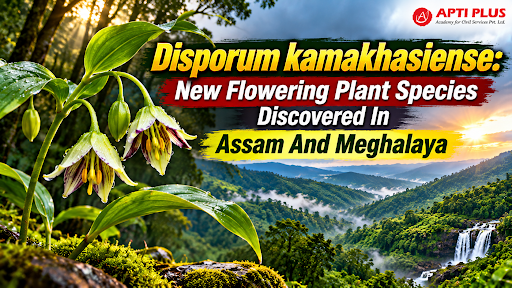
A new species of flowering plant, Disporum kamakhasiense, has been discovered in the forests of Assam and Meghalaya.
What Is Disporum kamakhasiense?
Identity
-
New Species: Disporum kamakhasiense is a newly described perennial herb.
-
Family: It belongs to the family Colchicaceae.
-
Closest Relative: Its closest known relative is Disporum calcaratum.
Meaning Of The Name
-
Two Regions In One Name: The name combines "Kama" for Kamrupa, the ancient name of Assam, and "khasi" for the Khasi Hills of Meghalaya, the regions where the plant was first collected.
Habitat
-
Forest Type: It grows in semi-evergreen forests.
-
Altitude: It occurs at about 200 to 1,100 metres above sea level.
-
Micro-Habitat: It was found mainly on cliffs beneath bamboo forests, growing alongside other plant species.
Features
Comparison With Its Closest Relative
|
Feature |
D. kamakhasiense |
D. calcaratum |
|
Height |
Up to 180 cm |
About 100 cm |
|
Leaves |
Smooth, glossy |
Differ in texture |
|
Flower stalks |
Longer |
Shorter |
|
Stamens |
Shorter and thicker |
Longer and thinner |
Other Features
-
Branching: It has extensively branched stems.
-
Flowers: Its flowers are white, star-shaped and carry distinctive straight spurs.
-
Leaves: Its leaves are dark green and glossy, with seven prominent parallel veins.
-
Life Cycle: It flowers in June–July and bears fruit in July–August.
Source: INDIATODAYNE
|
PRACTICE QUESTION Q. Consider the following statements about Disporum kamakhasiense: 1. It belongs to the family Colchicaceae. 2. It grows in semi-evergreen forests at elevations of about 200 to 1,100 metres. 3. Its name refers to Kamrupa, the ancient name of Assam, and the Khasi Hills of Meghalaya. How many of the statements given above are correct? (a) Only one (b) Only two (c) All three (d) None Answer: (c) Explanation: Statement 1 is correct: It is a newly discovered perennial herb that belongs to the Colchicaceae family. Statement 2 is correct: The species grows in semi-evergreen forests mainly on cliffs beneath bamboo forests, at elevations ranging from 200 to 1,100 metres. Statement 3 is correct: Its specific epithet kamakhasiense is a combination of references to Kamrupa (the ancient name of Assam) and the Khasi Hills of Meghalaya, denoting the regions where the plant was collected. |