Why In News?
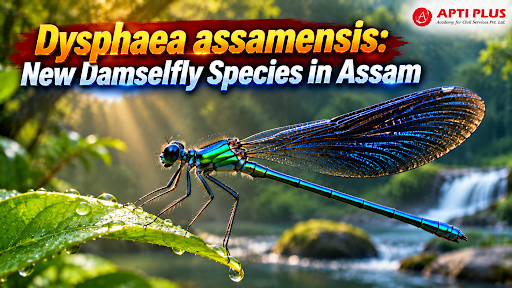
Researchers have formally described a new damselfly species, Dysphaea assamensis, from Karbi Anglong district of Assam.
What Is Dysphaea assamensis?
-
Scientific Name: Dysphaea assamensis.
-
Taxonomic Family: Euphaeidae.
-
Suborder: Zygoptera (damselflies).
-
Order: Odonata.
-
Location: Karbi Anglong district, Assam
-
Distinctive Feature: It has an extensive and intricate blue dorsal pattern across its abdominal segments, which helps distinguish it from related species.
-
Global Significance: Its formal description brings the recognised number of species in the genus Dysphaea to ten.
-
Habitat: It is associated with shaded forest streams and relatively undisturbed freshwater habitats in Northeast India.
What Are Damselflies?
-
Classification: Damselflies are predatory insects belonging to the suborder Zygoptera within the order Odonata.
-
Body Structure: They generally have slender bodies, large separated eyes and two pairs of similarly shaped, net-veined wings.
-
Habitat: They are commonly found near freshwater habitats such as streams, ponds, wetlands and lakes.
-
Feeding Behaviour: Both adult damselflies and their aquatic larvae are predators, feeding on smaller insects and other small aquatic organisms.
-
Flight: Most damselflies are relatively weak fliers compared with dragonflies.
-
Ecological Role: They help regulate populations of small insects and form part of freshwater food webs.
How Are Damselflies Different from Dragonflies?
|
|
Damselflies |
Dragonflies |
|
Suborder |
Zygoptera |
Anisoptera |
|
Body |
Generally slender |
Generally robust |
|
Wings |
Forewings and hindwings are similar |
Hindwings are usually broader at the base |
|
Eyes |
Usually widely separated |
Usually close together or touching |
|
Flight |
Generally weaker and fluttering |
Generally stronger and more agile |
|
Resting posture |
Usually hold wings together over the abdomen |
Usually hold wings outspread |
Source: ASSAMTRIBUNE
|
PRACTICE QUESTION Q. With reference to damselflies, consider the following statements:
Which of the statements given above are correct? (a) 1 and 2 only (b) 1, 2 and 3 only (c) 2, 3 and 4 only (d) 1, 2, 3 and 4 Answer: (b) 1, 2 and 3 only Explanation: Statement 1 is correct: Damselflies belong to the suborder Zygoptera under the order Odonata, whereas dragonflies belong to the suborder Anisoptera. Statement 2 is correct: Unlike dragonflies (whose hindwings are broader at the base than their forewings), damselflies have forewings and hindwings that are similar in size and shape. Statement 3 is correct: Damselfly nymphs (naiads) are aquatic and actively predatory, feeding on small aquatic invertebrates, mosquito larvae, and even tiny fish. Statement 4 is incorrect: While most damselflies fold their wings back along or over the abdomen at rest, not all do. Members of the family Lestidae (commonly called spreadwing damselflies) and flatwings perch with their wings spread partially outward. |