Why In News?
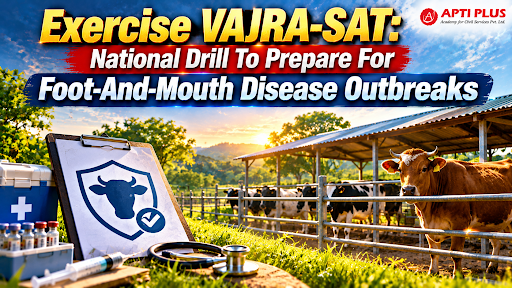
The Department of Animal Husbandry and Dairying (DAHD) concluded "VAJRA-SAT" to strengthen India's preparedness for Foot-and-Mouth Disease (FMD).
What Is Exercise VAJRA-SAT?
Purpose
-
Preparedness Drill: VAJRA-SAT is a national exercise to test how prepared India's veterinary system is to detect and respond to an FMD outbreak.
-
Simulation Exercises: Simulation exercises recreate an outbreak scenario so authorities can practise detection, reporting, containment, vaccination and coordination before a real emergency.
Likely Objectives
-
Rapid Detection: Test surveillance and laboratory confirmation of suspected cases.
-
Containment: Practise quarantine, movement restrictions and ring vaccination.
-
Coordination: Improve coordination between the Centre, States, laboratories and field veterinarians.
-
Communication: Test how quickly farmers and the public are informed.
Global Practice
-
Common Worldwide: Countries such as Brazil, Australia and members of the European Union regularly hold FMD simulation exercises, reported to the World Organisation for Animal Health (WOAH).
What Is Foot-And-Mouth Disease?
-
Cause: FMD is caused by a virus of the Aphthovirus genus (family Picornaviridae).
-
Animals Affected: It affects cloven-hoofed animals, such as cattle, buffaloes, sheep, goats and pigs.
-
Symptoms: Fever, blisters in the mouth and on the feet, drooling, lameness and a sharp fall in milk yield.
-
Highly Contagious: It spreads through direct contact, contaminated feed and equipment, and even through the air.
-
Not A Human Threat: FMD is not considered a public health threat, as human infection is very rare.
-
Serotypes: The virus exists in seven distinct serotypes: O, A, C, SAT 1, SAT 2, SAT 3, and Asia 1 (with O, A, and Asia 1 being the most prevalent in India).
Why Does FMD Matter For India?
Economic Impact
-
Heavy Losses: FMD reduces milk yield, causes abortions and infertility, weakens draught animals and causes deaths in young animals.
-
Largest Dairy Sector: India is the world's largest milk producer, so FMD threatens the livelihoods of millions of farmers.
Trade Impact
-
Export Barriers: Countries without FMD-free status face restrictions on exports of meat and dairy products.
-
Buffalo Meat Exports: India is a leading exporter of buffalo meat, so FMD control is vital for trade.
Livelihood Impact
-
Small Farmers Hit Hardest: Most livestock owners are small and marginal farmers, for whom losing even one animal is a major setback.
How Is India Controlling FMD?
National Animal Disease Control Programme (NADCP)
-
Launch: Launched in 2019 at Mathura, Uttar Pradesh.
-
Target Diseases: It targets FMD and brucellosis.
-
Fully Centrally Funded: The Centre bears 100% of the cost.
-
Goals: Control FMD through vaccination and eventually eradicate it.
-
Mass Vaccination: It aims to vaccinate cattle, buffaloes, sheep, goats and pigs every six months.
Livestock Health And Disease Control Programme (LHDCP)
-
Umbrella Scheme: NADCP now forms part of the broader LHDCP, which supports vaccination, mobile veterinary units and affordable veterinary medicines.
Research Institutions
-
ICAR–National Institute on Foot and Mouth Disease: Located in Bhubaneswar, it leads FMD research, diagnosis and vaccine strain selection.
One Health Approach
-
Integrated Preparedness: India is linking human, animal and environmental health through a One Health approach.
-
Example: In August 2024, India conducted "Vishanu Yuddh Abhyas", a national One Health mock drill in Ajmer, to test response to a zoonotic disease outbreak. This shows a growing culture of preparedness drills.
What Are The Key Challenges?
Vaccination Gaps
-
Incomplete Coverage: Reaching every animal every six months is difficult, especially in remote areas.
-
Cold Chain: FMD vaccines must be kept cold, which is hard to maintain in rural areas.
Animal Movement
-
Uncontrolled Movement: Animals are moved across districts and States for trade and grazing, which spreads infection.
Surveillance And Reporting
-
Under-Reporting: Farmers may not report sick animals quickly, fearing losses or restrictions.
-
Lab Capacity: Some regions lack quick diagnostic facilities.
Staff Shortage
-
Few Veterinarians: India has a shortage of veterinarians and para-vets relative to its huge livestock population.
Lessons From Outbreaks
-
Severe Costs Of Failure: Weak preparedness can turn an outbreak into a national crisis.
-
Example: The 2001 FMD outbreak in the United Kingdom led to the culling of millions of animals and cost the economy billions of pounds, showing why drills like VAJRA-SAT are valuable.
What Is The Way Forward?
Strengthen Vaccination
-
Full Coverage: Ensure timely six-monthly vaccination of all susceptible animals, with digital tracking through animal identification (ear tagging).
-
Improve Cold Chain: Upgrade vaccine storage and transport in rural areas.
Better Surveillance
-
Early Warning: Expand disease surveillance networks and rapid testing.
-
Digital Reporting: Use digital platforms for real-time reporting by veterinarians and farmers.
Build FMD-Free Zones
-
Zone-Based Approach: Create FMD-free zones recognised by World Organisation for Animal Health (WOAH) to boost exports while working towards national eradication.
Regular Drills And Capacity Building
-
Periodic Exercises: Hold exercises like VAJRA-SAT regularly at State and district levels.
-
Train Staff: Expand training for veterinarians and para-vets.
Conclusion
Exercise VAJRA-SAT reflects India's move from reacting to outbreaks to preparing for them in advance. Combined with mass vaccination under NADCP, stronger surveillance and a One Health approach, such drills can protect India's livestock, farmers' incomes and export markets from FMD.
Source: PIB
|
PRACTICE QUESTION Q. Consider the following statements about Foot-and-Mouth Disease (FMD): 1. FMD is caused by a virus. 2. It affects cloven-hoofed animals such as cattle, buffaloes and pigs. 3. It is a major zoonotic disease that commonly spreads to humans. How many of the statements given above are correct? (a) Only one (b) Only two (c) All three (d) None Answer: (b) Explanation: Statement 1 is correct: Foot-and-Mouth Disease (FMD) is caused by a virus (specifically of the genus Aphthovirus, family Picornaviridae). Statement 2 is correct: It affects cloven-hoofed (split-hoofed) animals, including cattle, buffaloes, sheep, goats, deer, and pigs. Statement 3 is incorrect: FMD is not a major zoonotic disease and is not readily transmissible to humans. Human infections are extremely rare and usually mild, unlike Hand, Foot, and Mouth Disease (HFMD) which commonly affects children. |