Why In News?
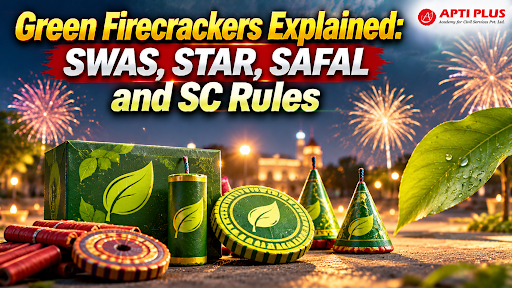
The Supreme Court relaxed the blanket ban on firecrackers in Delhi-NCR and allowed limited use of certified green crackers.
What Are Green Firecrackers?
-
Definition: Green firecrackers are fireworks with smaller shells, no ash and additives such as dust suppressants that reduce emissions, especially particulate matter.
-
Developer: They were developed in 2018 by CSIR’s National Environmental Engineering Research Institute (CSIR-NEERI), Nagpur, following a Supreme Court direction.
-
Lower, Not Zero, Pollution: They emit about 30–40% less particulate matter than conventional crackers, but they are not pollution-free.
Key Differences From Conventional Crackers
|
Feature |
Conventional Crackers |
Green Crackers |
|
Barium salts |
Often used (for green colour) |
Not used |
|
Particulate emissions |
High |
About 30–40% lower |
|
Noise |
Around 160 decibels |
About 110–125 decibels |
|
Certification |
None specific |
CSIR-NEERI logo and QR code |
What Are The Main Types Of Green Crackers?
Three Approved Variants
-
SWAS (Safe Water Releaser): Releases water vapour that suppresses dust and dilutes harmful gases, cutting emissions by about 30%.
-
STAR (Safe Thermite Cracker): Uses a reformulated mixture with reduced potassium nitrate and sulphur, lowering gas and noise emissions.
-
SAFAL (Safe Minimal Aluminium): Uses minimal aluminium and more magnesium, cutting metallic dust.
Certification
-
Two-Step Approval: CSIR-NEERI certifies the formulation, while the Petroleum and Explosives Safety Organisation (PESO) licenses manufacturers.
-
Identification: Genuine green crackers carry a green CSIR-NEERI logo and an encrypted QR code that buyers can scan to check authenticity.
How Firecrackers Pollute?
-
Metal Salts For Colour: Firecrackers use metal salts to produce colours, which release toxic particles when burnt.
-
Barium gives green, strontium gives red, copper gives blue and sodium gives yellow.
-
Oxidisers And Fuels: Compounds such as potassium nitrate, sulphur and aluminium produce gases like sulphur dioxide and nitrogen oxides, along with fine dust.
-
Fine Particles: PM2.5 and PM10 from firecrackers enter the lungs and can worsen asthma and heart disease.
-
Noise: Loud bursts can harm hearing, especially in children, the elderly and animals.
-
Winter Smog: Diwali falls in October–November, when low winds, cold air and stubble burning already trap pollutants over north India. Firecracker emissions add to this load.
Regulatory Framework On Firecrackers
-
Article 21: The Supreme Court reads the right to life to include the right to a clean environment and clean air.
-
Key Laws: Firecrackers are regulated under the Explosives Act, 1884, the Environment (Protection) Act, 1986 and the Noise Pollution (Regulation and Control) Rules, 2000.
Key Court Rulings
-
Arjun Gopal vs Union of India (2018): The Supreme Court banned barium salts in firecrackers and directed the development of green crackers. It allowed bursting only during fixed time slots.
-
National Green Tribunal (2020): In November 2020, the NGT imposed a near-total ban on firecrackers during the Diwali season in Delhi-NCR and other highly polluted cities.
-
Supreme Court Order (October 2025): The Court allowed the sale and bursting of green crackers in Delhi-NCR from 18 to 21 October 2025. Bursting was limited to 6–7 am and 8–10 pm, only QR-coded, NEERI-certified crackers were allowed, and e-commerce sales were banned.
What Are The Key Challenges With Green Crackers?
Still Polluting
-
Reduced, Not Removed: Even green crackers emit fine particles and gases. In an already polluted city, a 30% cut may not stop air quality from turning severe.
Weak Enforcement
-
Fake Green Crackers: Conventional crackers are often sold with fake “green” labels or smuggled in from other States.
-
Example: While relaxing the ban in October 2025, the Supreme Court observed that crackers smuggled into Delhi-NCR cause more damage than green crackers. It ordered that sellers found with crackers from outside the region would lose their licences.
-
Poor Compliance: Bans and time limits are often ignored.
-
Example: In November 2024, after Diwali, the Supreme Court remarked that the firecracker ban had hardly been implemented in Delhi and pulled up the Delhi government.
Livelihoods And Safety
-
Industry Dependence: Thousands of workers, especially in Sivakasi in Tamil Nadu, the hub of India’s firecracker industry, depend on this sector. Sudden bans hurt their livelihoods.
-
Factory Accidents: Unsafe working conditions in firecracker units often lead to deadly explosions.
Way Forward
Cleaner Celebrations
-
Community Displays: Licensed, community-level fireworks displays can replace scattered private bursting and are easier to regulate.
-
Example: Singapore banned the private use of firecrackers in 1972 for safety reasons and allows only licensed public displays. Its celebrations continue without widespread private bursting.
-
Modern Alternatives: Laser shows and drone light shows can offer festive spectacle with almost no air pollution.
Stronger Regulation
-
Strict Certification: Expand QR-code checks and random testing to stop fake green crackers.
-
Better Formulations: CSIR-NEERI and industry should keep improving formulations to cut emissions further.
Protecting Livelihoods
-
Skilling And Transition: Train firecracker workers in safer green manufacturing and offer alternative livelihoods in clusters like Sivakasi.
-
Link To Clean Air Goals: Firecracker policy should be part of wider clean-air plans such as the National Clean Air Programme (NCAP), which aims to cut particulate pollution in cities by up to 40% by 2025–26.
Conclusion
Green firecrackers offer a middle path between tradition and clean air, but they reduce pollution rather than remove it. A lasting solution needs strict enforcement, cleaner alternatives such as community and light shows, and fair support for workers in the industry.
Source: THEHINDU
|
PRACTICE QUESTION Q. Consider the following pairs:
How many of the pairs given above are correctly matched? (a) Only one (b) Only two (c) Only three (d) All four Answer: (c) Explanation: Barium -> Green: Correct. Barium compounds (such as barium chloride) produce a bright green flame. Strontium -> Red: Correct. Strontium salts (such as strontium carbonate) produce a vibrant red/crimson flame. Copper -> Blue: Correct. Copper compounds (such as copper chloride) produce a blue flame. Sodium -> Violet: Incorrect. Sodium compounds produce a bright golden-yellow color, not violet (potassium or rubidium is typically used for violet/purple flames). |