Why In News?
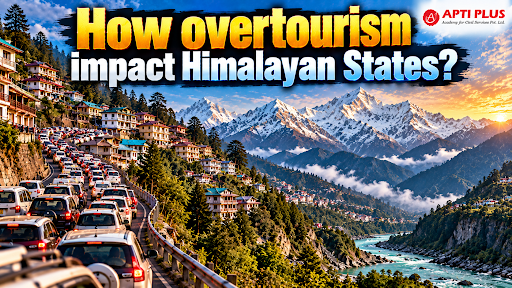
The Central Empowered Committee (CEC) submitted a report to the Supreme Court, recommending mandatory carrying capacity assessments for tourism hubs, highway expansions, and multi-storey construction across Himachal Pradesh and the Indian Himalayan Region (IHR).
What Is Urban Carrying Capacity?
It is the upper threshold of human population, physical built-up area, and tourist footfall that an urban ecosystem can sustain without causing irreversible environmental degradation, infrastructure breakdown, or a severe decline in resident quality of life.
Methodology: UCC is evaluated through a three-tiered mathematical framework—Physical Carrying Capacity (PCC) (spatial area available per individual), Real Carrying Capacity (RCC) (PCC adjusted for topographic, climatic, and bio-physical correction factors), and Effective Carrying Capacity (ECC) (RCC adjusted for administrative management capacity and infrastructure availability).
Quantification Framework: A study by the National Institute of Urban Affairs (NIUA) revealed that while Nainital has a Physical Carrying Capacity (PCC) of 8,34,184 persons per day, its Real Carrying Capacity (RCC) drops to 1,49,230 persons per day due to steep slopes and forest constraints, and its Effective Carrying Capacity (ECC) plummets to just 8,422 persons per day due to critical water and sanitation bottlenecks.
URDPFI Guidelines 2014 Compliance: Application of the Urban and Regional Development Plans Formulation and Implementation (URDPFI) Guidelines, 2014 issued by the Ministry of Housing and Urban Affairs (MoHUA) demonstrates that unmanaged visitor density depresses Effective Carrying Capacity (ECC).
Why Is Carrying Capacity Evaluation Critical For Himalayan Towns?
Infrastructural Demand-Supply Mismatch: Peak seasonal tourist footfalls overload municipal utilities designed for static resident populations, triggering acute urban stress and severe water scarcity during lean summer months.
Water Resource Depletion & Extraction Rates: Excessive surface water abstraction from lakes like Naini Lake and unmonitored groundwater extraction endanger hydrological sustainability.
-
In Nainital, municipal water supply infrastructure can support a maximum of 35,736 persons per day, while district groundwater extraction stands at 52% against the 70% safe limit prescribed by the Central Ground Water Board (CGWB).
Wastewater Processing Deficit: Untreated liquid waste discharge directly threatens fragile aquatic ecosystems and public health.
-
Used water treatment capacity in Nainital supports a maximum of only 2,445 visitors per day beyond the resident population of 45,791 persons (existing STP capacity is 2.5 MLD against 6.12 MLD generated), whereas peak tourist inflows surge between 35,000 to 1,50,000 visitors per day.
Public Sanitation & Lodging Standards: Under CPHEEO Guidelines (Central Public Health and Environmental Engineering Organization, 2018), existing public toilet infrastructure supports up to 25,200 users per day, but lodging capacity supports only 7,226 visitors per day and parking supports merely 2,740 users per day.
What Is The Current Status Of Tourism Pressure Across Indian Himalayan States?
Extreme Visitor Saturation: Over 160 lakh tourists visit Himachal Pradesh annually—exceeding double the state's total resident population of 70 lakh—with intense concentration in Shimla, Manali, Dharamshala, and Dalhousie.
Pilgrimage & Investment In Uttarakhand: Uttarakhand recorded 70 million tourist arrivals in 2023 and 84 million in 2024, actively targeting ₹20,000 crore in tourism investments across 100 Public-Private Partnership (PPP) projects by 2030.
Comparative Vulnerability Matrix: Comparative analysis published in the ISRG Journal of Economics, Business & Management (2026) ranks Uttarakhand and Himachal Pradesh at Near Critical overall carrying capacity status with High Environmental Pressure.
-
Ladakh is classified as Environmentally Sensitive due to low infrastructure capacity and extreme ecological fragility, whereas Sikkim maintains a Relatively Sustainable status through regulated eco-tourism policies and community governance.
What Challenges Exacerbate Overtourism In Hill Towns?
Unregulated Linear Infrastructure Expansion: Road projects and highway widenings approvals lack cumulative impact assessments, leading to unscientific vertical slope cutting, catastrophic landslides, and mountain subsidence.
-
Example: Central Empowered Committee (CEC) Report (2026), site investigations on the Kiratpur-Manali highway corridor identified 44 landslide and erosion locations caused by slope engineering failures, compelling the National Highways Authority of India (NHAI) to allocate ₹825 crore solely for slope restoration.
Haphazard Urbanization And Geo-Hydrological Stress: Commercial multi-storey hotel construction on steep, unstable slopes exceeds soil load-bearing capacity and obstructs natural springs, amplifying disaster risk in Seismic Zone IV and V regions.
-
Example: Joshimath Land Subsidence Crisis (2023) / Supreme Court Order (2025), uncontrolled commercial construction and drainage failure induced widespread slope collapse, prompting the Supreme Court in Pristine Hotels vs State of Himachal Pradesh to strictly uphold 'green area' building bans under the Himachal Pradesh Town and Country Planning Act, 1977.
Absence Of Integrated Mobility Plans: Over-reliance on private motorized transport combined with severe parking deficits causes arterial traffic jams, high carbon emissions, and acute public space degradation.
-
Example: Perception of Overtourism Study in Shimla (2024), revealed severe vehicular gridlocks, inflated taxi rates, and public space cluttering that alienated local residents and degraded the tourist experience.
Institutional Fragmentation And Enforcement Failure: Urban local bodies and tourism departments operate in administrative silos, issuing building permissions without legally binding carrying capacity limits.
-
Example: Despite NGT orders directing carrying capacity zoning in Nainital, municipal approvals continued following static building bylaws rather than dynamic Effective Carrying Capacity (ECC) thresholds, resulting in wastewater generation exceeding treatment capacity by over 1,000%.
Way Forward
Legally Binding Carrying Capacity Zoning: Transition from traditional permission-based building approvals to a scientific system where Effective Carrying Capacity (ECC) assessments dictate master plans under the Environment (Protection) Act, 1986 and URDPFI Guidelines.
-
Example: Himachal Pradesh Eco-Tourism Policy 2024 (HPFD Initiative), establishes the Himachal Pradesh Ecotourism Society (HP ECOSOC) as a Special Purpose Vehicle under the Societies Registration Act, 1860 to enforce mandatory visitor and vehicular carrying capacity ceilings across forest divisions under the Van (Sanrakshan Evam Samvardhan) Adhiniyam, 1980.
Decentralized Tourism Diversification: Redirect tourist flows away from congested urban cores toward rural homestays, nature parks, and eco-circuits to distribute economic gains and relieve urban infrastructure.
-
Example: Tirthan Valley Community Eco-Tourism Model (Kullu, Himachal Pradesh), joint administrative stewardship between the Forest Department and local Panchayats restricted commercial hotel construction and promoted regulated homestays, achieving sustainable rural employment and low-impact nature conservation.
Demand-Side Mobility Management: Deploy clean public transit shuttles, satellite parking lots at town entry boundaries, dynamic congestion pricing, and mandatory digital registration systems.
-
Example: Madras High Court E-Pass Model for Ooty and Kodaikanal (Tamil Nadu), judicial enforcement of mandatory e-passes for incoming tourist vehicles successfully capped vehicular inflows within ecological thresholds and eliminated urban gridlocks during peak tourist seasons.
Circular Water And Sanitation Utilities: Expand decentralized Fecal Sludge and Septage Management (FSSM) and non-sewer sanitation systems under AMRUT 2.0 and Swachh Bharat Mission - Urban (SBM-U 2.0) to achieve 100% wastewater recycling and zero untreated discharge.
-
Example: European Protected Area Sustainable Tourism Charter Model, deployment of smart trail counters, automated water metering, and reinvestment of local user charges directly into municipal wastewater processing and landscape restoration.
Conclusion
Adopting a scientifically regulated carrying capacity stewardship framework under Articles 21, 48A, and 51A(g) of the Constitution is essential to safeguard fragile Himalayan ecosystems and ensure urban water and sanitation security.
Source: INDIANEXPRESS
|
PRACTICE QUESTION Q. Unplanned infrastructure expansion in ecologically sensitive mountain regions converts natural hazards into severe human disasters. Discuss. 150 words |