Why In News?
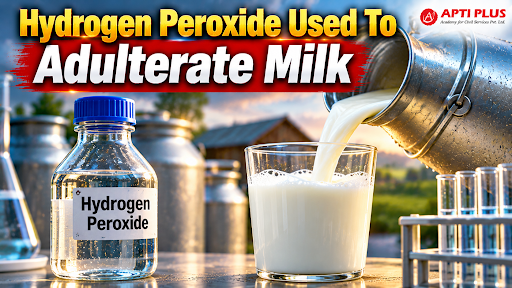
Telangana police raided a unit in Pocharam village, seizing hydrogen peroxide allegedly used for milk adulteration.
What Is Milk Adulteration?
-
Definition: Adulteration is adding cheaper, inferior or harmful substances to food, or removing valuable parts, so that its quality, safety or nutritional value falls.
-
Motive: Adulterators increase volume, extend shelf life or make low-quality milk appear normal, for higher profits.
Common Milk Adulterants
Adulterant |
Purpose |
Health Risk |
|
Water |
Increase volume |
Lower nutrition; contamination risk |
|
Milk powder |
Make diluted milk look thick |
Lower quality; often mixed with other agents |
|
Hydrogen peroxide |
Extend shelf life |
Gut damage, destroys nutrients |
|
Urea |
Increase apparent protein (SNF) |
Kidney damage |
|
Detergent |
Add froth and whiteness |
Stomach disorders |
|
Starch |
Thicken milk |
Digestive problems; risky for diabetics |
|
Formalin |
Preserve milk |
Toxic, potentially carcinogenic |
|
Neutralisers (e.g., sodium bicarbonate) |
Hide sourness of spoiled milk |
Disturbs body chemistry |
Why Is Hydrogen Peroxide Added To Milk?
Its Misuse
-
Fake Freshness: Hydrogen peroxide (H₂O₂) kills bacteria, so adulterators add it to stop milk from spoiling, especially during long transport without refrigeration.
-
Covering Poor Hygiene: It hides the effects of poor handling and lack of cold storage.
Not Permitted
-
Banned In Milk: Indian food standards do not allow preservatives such as hydrogen peroxide in milk.
Health Effects
-
Digestive Damage: It can irritate and damage the lining of the stomach and intestines.
-
Nutrient Loss: It can destroy vitamins and other nutrients in milk.
-
High Risk For Children: Children, who drink the most milk, are the most vulnerable.
|
Hydrogen Peroxide (H₂O₂)
|
What Is The Legal Framework Against Food Adulteration?
Food Safety And Standards Act, 2006
-
FSSAI: The Act set up the Food Safety and Standards Authority of India (FSSAI), under the Ministry of Health and Family Welfare, to set food standards and regulate food safety.
-
Replaced Older Laws: It replaced the Prevention of Food Adulteration Act, 1954 and several other food laws.
-
Penalties: Selling unsafe food that causes death can lead to imprisonment of at least seven years, extending to life, and a fine of at least ₹10 lakh.
Criminal Law
-
Bharatiya Nyaya Sanhita, 2023: Sections 274 and 275 punish adulterating food or drink meant for sale and selling noxious food or drink.
Why Does Milk Safety Matter For India?
|
What Are The Key Challenges?
Widespread And Organised Adulteration
-
Large Networks: Adulteration is often run by organised groups that move milk across districts and States.
-
Repeated Cases: Seizures like the one in Telangana show that the problem continues despite raids.
-
Example: In January 2023, under "Operation Ksheera", Kerala's food safety officials seized a tanker carrying thousands of litres of milk containing hydrogen peroxide at the Aryankavu border checkpost, coming from a neighbouring State.
Weak Testing Infrastructure
-
Too Few Labs: Many districts lack accredited food testing laboratories.
-
Slow Results: Delays in test reports allow adulterated products to be sold and consumed before action is taken.
Shortage Of Food Safety Officers
-
Understaffing: States face a shortage of Food Safety Officers, which limits regular inspections.
-
Large Informal Sector: A large share of milk is sold through unorganised vendors and small units that are hard to monitor.
Low Conviction Rates
-
Weak Prosecution: Many adulteration cases end in fines or acquittals because of poor evidence and long delays.
-
Judicial Concern: Courts have called for stronger action.
-
Example: In Swami Achyutanand Tirth vs Union of India (2016), the Supreme Court expressed concern over synthetic milk and urged the government to consider stricter punishment, including life imprisonment, for milk adulteration.
Gaps In The Cold Chain
-
Poor Refrigeration: The lack of chilling centres in rural areas pushes some traders to use chemical preservatives.
Low Consumer Awareness
-
Hard To Detect: Many adulterants cannot be seen, smelled or tasted, so consumers do not notice them.
-
Price Over Quality: Cheaper loose milk attracts poorer buyers, who face the greatest risk.
Global Lessons On The Cost Of Failure
-
Severe Consequences: Weak regulation can turn adulteration into a public health disaster.
-
Example: In China's 2008 melamine scandal, milk and infant formula were laced with melamine to fake protein content. About 3 lakh infants fell ill and at least six died, showing how deadly milk adulteration can be.
What Is The Way Forward?
Strengthen Testing Infrastructure
-
More Labs: Set up accredited food testing labs in every district.
-
Mobile Testing: Expand "Food Safety on Wheels" mobile labs to test milk on the spot in villages and markets.
Increase Inspections And Staffing
-
Recruit Officers: Fill vacancies of Food Safety Officers and train them in modern testing.
-
Surprise Checks: Conduct regular surprise checks at collection centres, transport points and State borders.
Ensure Strict And Speedy Punishment
-
Fast-Track Cases: Set up special courts or fast-track procedures for food adulteration cases.
-
Stronger Penalties: Act on the Supreme Court's 2016 observations by considering stricter punishment for serious milk adulteration.
Build The Cold Chain
-
Bulk Milk Coolers: Expand bulk milk chilling centres in villages, so that preservatives are not needed.
-
Support Through Schemes: Use the National Programme for Dairy Development (NPDD) and Rashtriya Gokul Mission to strengthen dairy infrastructure and quality.
Strengthen The Organised Dairy Sector
-
Cooperative Model: Expand organised, quality-tested milk procurement.
-
Example: The Amul cooperative model in Gujarat, built under Operation Flood, tests milk at the village collection point and pays farmers based on quality. This shows how organised procurement can reduce adulteration.
Empower Consumers
-
Home Tests: Promote FSSAI's DART (Detect Adulteration with Rapid Test) guide, which lets people check milk for water, starch and detergent at home.
-
Awareness Campaigns: Use the Eat Right India movement to spread awareness about safe food.
Use Technology For Traceability
-
Track And Trace: Use digital records and QR codes to trace milk from farm to consumer.
-
Data-Driven Action: Use results from national milk surveys to target high-risk areas.
-
Example: FSSAI's National Milk Safety and Quality Survey (2018) tested thousands of samples across India and found that most were safe, but some contained adulterants such as hydrogen peroxide, detergent and urea, helping identify where action was needed.
Conclusion
The seizure of hydrogen peroxide meant for milk adulteration is a reminder that food fraud remains a serious threat to public health. Better testing, more food safety officers, strict punishment, a strong cold chain and informed consumers are essential to ensure safe milk for every household.
Source: THE HINDU
|
PRACTICE QUESTION Q. Why does food adulteration persist in India despite a strong legal framework? (10 Marks, 150 Words) |