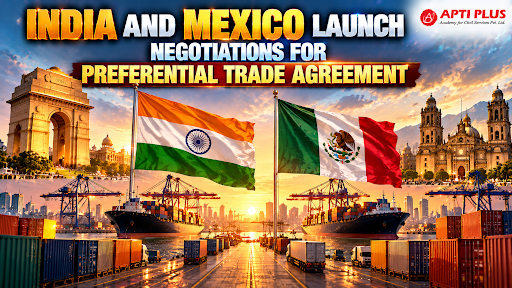
Why In News?
India and Mexico officially signed the Terms of Reference (ToR) on October 26–28, 2026 in Mexico City to formally launch negotiations for a Preferential Trade Agreement (PTA).
What Is a Preferential Trade Agreement?
It is an international trade pact where two or more countries agree to lower or reduce customs duties and tariffs on a specific, agreed-upon list of products (known as a positive list) rather than eliminating tariffs on all goods.
In the spectrum of economic integration, a PTA represents the most basic and lowest level of economic cooperation.
Key Features of a PTA
-
Partial Tariff Reduction: Unlike a Free Trade Agreement (FTA) or Customs Union, duties are only reduced or concessional (ranging from a small percentage reduction down to zero), not completely abolished across the board.
-
Positive List Approach: Countries explicitly list the specific products eligible for tariff concessions; goods not on this list remain subject to standard Most Favoured Nation (MFN) tariff rates.
-
Independent External Tariffs: Participating countries retain their own individual tariff structures and trade policies for non-member third countries, unlike a Customs Union which uses a Common External Tariff.
-
Stepping Stone: PTAs often act as a foundational building block or pilot phase that may later evolve into deeper economic pacts like FTAs, Comprehensive Economic Cooperation Agreements (CECAs), or Comprehensive Economic Partnership Agreements (CEPAs).
-
WTO Context: Under World Trade Organization (WTO) terminology, PTAs can also refer to non-reciprocal preferential arrangements—such as the Generalized System of Preferences (GSP)—where developed nations unilaterally grant lower tariffs to developing countries.
Hierarchy of Economic Integration (Ascending Order)
-
Preferential Trade Agreement (PTA): Reduced/concessional tariffs on a selected positive list of goods (e.g., India-MERCOSUR PTA or India-Afghanistan PTA).
-
Free Trade Agreement (FTA): Elimination of most tariffs across a broad range of goods and services using a negative list approach (e.g., India-ASEAN FTA).
-
Customs Union: Free trade among members plus a Common External Tariff (CET) applied to non-members.
-
Common Market: A Customs Union plus the free movement of labor and capital.
-
Economic Union: The highest level, combining a common market with unified or harmonized economic and monetary policies (e.g., the European Union).
Advantages and Limitations
-
Advantages:
-
Lowers entry barriers and production costs for specific domestic exporters.
-
Promotes South-South trade cooperation without forcing complete market exposure for sensitive domestic sectors (like agriculture or dairy).
-
Limitations:
-
Limited scope and narrow product coverage restrict massive trade expansion.
-
Administrative hurdles like Rules of Origin (RoO) can make compliance complex relative to the small margin of preference gained.
-
Risk of trade diversion (shifting imports from a more efficient non-member producer to a less efficient PTA member due to tariff margins).
Background & Trigger for the India and Mexico PTA
Mexican Unilateral Tariffs: On January 1, 2026, Mexico implemented import tariffs ranging from 5% to 50% (mostly capped around 35%) on 1,455 to 1,463 tariff lines from countries without an active Free Trade Agreement (FTA) with Mexico, which notably includes India and China.
At-Risk Indian Exports: Indian estimates indicated that nearly $2 billion worth of India’s merchandise exports—particularly automobiles, auto parts, textiles, footwear, plastics, steel, chemicals, and toys—were threatened by these duties.
Political Catalyst: The decision to explore a trade framework followed an understanding reached between Prime Minister Narendra Modi and Mexican President Claudia Sheinbaum on the sidelines of the G7 Summit in Canada in June 2025.
ToR Signing: Commerce Secretary Rajesh Agrawal and Mexico's Undersecretary of Foreign Trade Luis Rosendo Gutiérrez Romano signed the ToR in October 2026 to outline the scope, framework, modalities, and roadmap for the upcoming talks.
The ToR establishes negotiations across key areas:
-
Market Access for Goods: Mutual tariff reductions or eliminations on agreed-upon product lists.
-
Rules of Origin (RoR): Criteria used to determine the national source of a product to prevent third-party countries from transshipping goods to bypass tariffs.
-
Customs Procedures & Trade Facilitation: Streamlining border clearance and reducing administrative delays.
-
Sanitary and Phytosanitary (SPS) Measures: Food safety and plant/animal health regulations.
-
Technical Barriers to Trade (TBT): Harmonizing industrial standards, testing, and certification.
-
Dispute Settlement & Trade Remedies: Mechanisms to handle trade grievances, anti-dumping, and countervailing duties.
Economic & Strategic Significance
Bilateral Trade Profile
-
Total Merchandise Trade: Valued at approximately $7.83 billion in fiscal year 2025–26.
-
Indian Exports to Mexico: 5.72–5.73 billion (led by automobiles, pharmaceuticals, engineering goods, and auto parts).
-
Imports from Mexico: $2.10 billion, heavily anchored by crude petroleum.
-
Trade Balance: India maintains a healthy trade surplus with Mexico.
Strategic and Geopolitical Relevance
-
Gateway to North America (USMCA): Mexico serves as a crucial manufacturing and assembly hub with preferential access to the United States and Canada through the USMCA (United States-Mexico-Canada Agreement). Indian companies view Mexico as a springboard into North American supply chains.
-
Latin American Pivot: This move fits into India's broader strategy of diversifying its trade partners across Latin America (alongside expansion talks like the India-Mercosur PTA).
-
High-Potential Sectors: Automotive, electronics, chemicals, pharmaceuticals, agri-food, critical minerals, and medical devices.

Source: PIB
|
PRACTICE QUESTION Q. Consider the following statements:
Which of the statements given above are correct? (A) 1 and 2 only (B) 1 and 3 only (C) 2 and 3 only (D) 1, 2, and 3 Answer: (B) 1 and 3 only Explanation: Statement 1 is correct: In international trade, a Preferential Trade Agreement (PTA) operates on a positive list approach, meaning tariffs are reduced or eliminated only for specific products explicitly listed in the agreement. In contrast, a Free Trade Agreement (FTA) aims at near-total tariff elimination across substantially all trade, typically using a negative list approach where duties are removed on all items except a few excluded goods. Statement 2 is incorrect: The definition is reversed. Under World Trade Organization (WTO) rules, Sanitary and Phytosanitary (SPS) measures deal exclusively with human, animal, and plant health safety (such as food safety and quarantine restrictions to prevent pests or diseases). Technical Barriers to Trade (TBT) govern technical regulations, standards, product specifications, and compliance/labeling requirements (like electronic safety standards or toy safety regulations). Statement 3 is correct: Mexico was indeed the first country in Latin America to recognize independent India and formally establish diplomatic relations in the year 1950. |