Why In News?
The International Union for Conservation of Nature (IUCN) released the first global assessment under the IUCN Red List of Ecosystems at the 17th Conference of the Parties (COP17) to the UN Convention on Biological Diversity (CBD) in Yerevan, Armenia.
What Is The Current Status Of Global Coral Reefs?
The IUCN assessment evaluated 188,362 km² of warm, shallow-water coral reefs spanning 127 tropical and subtropical ecoregions across more than 80 countries and territories.
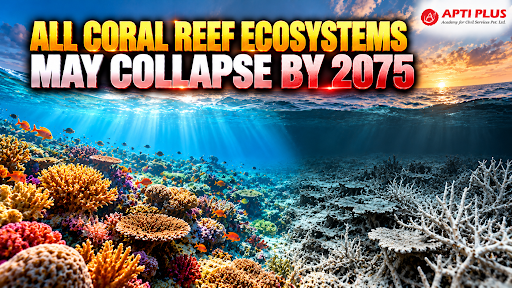
Out of 127 ecoregions, 122 (96%) are classified as Critically Endangered, 4 remain Data Deficient, and 1 ecoregion (Western Galápagos Islands) has been classified as Collapsed since the 1982–83 El Niño event.
|
Parameter |
IUCN Global Assessment 2026 Finding |
|---|---|
|
Global Reef Area Assessed |
188,362 km² across 127 ecoregions (80+ countries) |
|
Critically Endangered Share |
96% (122 out of 127 ecoregions) under future climate projections |
|
Current Historical Status |
24% Critically Endangered based solely on past 50-year observations |
|
Ecosystem Collapse Timeline |
Projected complete collapse by 2075 under unmitigated warming |

Ecological Significance
Marine Biodiversity Hotspots: Although coral reefs occupy less than 0.2% of the ocean floor, they support over 25% of all marine species.
-
Major global hotspots—including the Great Barrier Reef, the Coral Triangle, the Mesoamerican Barrier Reef System, and the Red Sea reefs—are all classified under the highest threat level of Critically Endangered.
Coastal Protection: Submerged reef crests function as self-repairing breakwaters that absorb and dissipate up to 97% of incident wave energy, shielding coastal infrastructure, low-lying atoll nations, and shoreline communities from storm surges and erosion.
Blue Economy & Livelihood Security: Reef ecosystems support subsistence protein security and commercial income for hundreds of millions of people worldwide through artisanal fisheries, coastal aquaculture, and marine eco-tourism.
Biomedical Discoveries: Coral organisms yield critical biochemical compounds utilized in modern pharmaceuticals, including anti-cancer drugs, anti-viral agents (such as Ara-A), and bone-graft substitute matrices.
Key Drivers & Ecological Threats
Climate Change & Marine Heatwaves: Heat stress from human-induced climate change is the single most dominant driver of reef decline.
-
Thermal spikes sever the metabolic bond between coral polyps and photosynthetic zooxanthellae algae, triggering mass bleaching and coral mortality.
-
Marine heat stress currently threatens 77% of global reef ecoregions.
Overfishing & Grazer Depletion: Overexploitation of herbivorous grazer fish (e.g., parrotfish) and predatory groupers affects 63% of coral reef ecoregions (particularly across East Asia, the Western Indian Ocean, the Caribbean, and Brazil), allowing fast-growing turf algae to smother live coral recruits.
Local Pollution & Coastal Stressors: Agricultural runoff, untreated municipal sewage, coastal port dredging, excessive tourism, industrial pollution, severe storms, freshwater flooding, and Crown-of-Thorns Starfish outbreaks cause severe ecological degradation.
Policy Recommendations
Ambitious Decarbonization: Localized interventions cannot prevent long-term collapse without rapid global greenhouse gas emission reductions under updated 2035 Nationally Determined Contributions (NDCs).
Protecting Thermal Refugia: Identifying and granting non-extractive Marine Protected Area (MPA) status to naturally heat-tolerant reef tracts—such as the Northern Red Sea, Bermuda, and mesophotic reefs—secures critical larval stocks.
Enforcing Herbivore Fishing Bans: Formulating strict fisheries regulations to protect parrotfish and surgeonfish preserves top-down algal control and boosts post-bleaching recovery.
Technological & Global Initiatives: Scaling up Biorock mineral accretion, micro-fragmentation outplanting, larval seeding, and gamete cryobanking supports the Kunming-Montreal Global Biodiversity Framework (30x30 target) and the $12 billion Coral Reef Breakthrough initiative.
Source: THEHINDU
|
PRACTICE QUESTION Q. With reference to 'Scleractinian Corals' and reef ecosystem dynamics, consider the following statements: Answer: (c) 1 and 3 only Statement 1 is correct: Scleractinian (stony) corals are major autogenic ecosystem engineers. By undergoing calcification and accreting large structures of calcium carbonate, they physically modify the environment and establish complex 3D frameworks. Although coral reefs cover less than 1% of the ocean floor, they provide critical shelter, nurseries, and feeding grounds for over 25% of all marine species. Statement 2 is incorrect: Mass coral bleaching is primarily triggered by elevated sea surface temperatures (thermal stress) rather than ocean acidification. While prolonged ocean acidification severely impairs a coral's ability to build and maintain its calcium carbonate skeleton (reducing calcification and causing structural vulnerability), it does not independently cause complete bleaching events on its own. Statement 3 is correct: Extensive global meta-analyses have demonstrated that healthy coral reefs are extraordinarily effective at shoreline protection. A healthy coral reef system can dissipate up to 97% of incident wave energy, with the reef crest alone absorbing approximately 86% of that energy before it reaches the coast, thereby significantly reducing coastal erosion and storm hazards. |