Why In News?
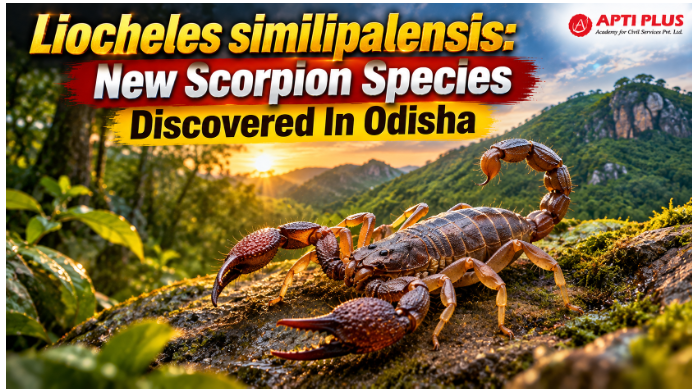
Researchers have discovered a new species of scorpion, Liocheles similipalensis, in Odisha’s Similipal Tiger Reserve.
What Is Liocheles Similipalensis?
Liocheles similipalensis is a newly discovered species of scorpion belonging to the family Hormuridae.
-
Discovery: Found in the tropical moist deciduous forests of the Similipal Tiger Reserve in Mayurbhanj district, Odisha.
-
Significance: It marks the first confirmed record of the genus Liocheles in the state of Odisha.
-
Global Count: This discovery brings the total number of recognized species under the genus Liocheles to seven (with four species now recorded in India).
-
Physical Characteristics:
-
Length ranges between 44 mm and 53 mm (around 5 cm).
-
Possesses a predominantly dark black body with a glossy, iridescent bluish sheen.
-
It is lithophilic (rock-loving), typically found inhabiting rock crevices and sheltering under rocks at elevations of around 1,000 metres above sea level.
-
Taxonomic Identification: Classified under Liocheles due to the presence of specialized tiny hair-like structures (setae) beneath tarsomere II on its legs. It was jointly described by researchers from the Thackeray Wildlife Foundation (TWF) and officials from the Similipal Tiger Reserve.
What Are Scorpions?
Scorpions are predatory arachnids belonging to the phylum Arthropoda, class Arachnida, and order Scorpiones.
-
Taxonomy: They are closely related to spiders, mites, and ticks (not insects or crustaceans), possessing 8 legs, 2 modified pedipalps (grasping pincers), and chelicerae.
-
Anatomy: Their body is divided into a cephalothorax (prosoma) and an abdomen (opisthosoma), which splits into a pre-abdomen and a post-abdomen (metasoma or tail) ending in a venomous stinger (telson).
-
Evolutionary History: Scorpions are ancient marine-to-terrestrial organisms dating back over 430 million years (Silurian Period).
-
Habitat & Distribution: Found worldwide on all continents except Antarctica; while commonly associated with deserts, they also inhabit forests, grasslands, caves, and mountains.
-
Special Features:
-
Their exoskeleton glows blue-green under ultraviolet (UV) light.
-
They are viviparous (give birth to live young) rather than laying eggs, and young scorpions ride on the mother's back.
-
They have a very low metabolism and can survive for months without food.
-
Medical Significance: Out of over 2,500 species, only about 25 to 50 possess venom potent enough to be medically significant or lethal to humans (such as the Indian red scorpion).
About Similipal National Park
Similipal National Park is located in the Mayurbhanj district of Odisha.
-
Location: Situated in the Eastern Ghats and Chota Nagpur Plateau transition zone. An area of 845.70 sq km is notified as a rights-free National Park, while the broader 2,750 sq km area functions as a Wildlife Sanctuary and Tiger Reserve.
-
Designations:
-
Declared a Tiger Reserve under Project Tiger.
-
Part of the UNESCO World Network of Biosphere Reserves (since 2009).
-
Part of the Mayurbhanj Elephant Reserve (along with Hadgarh and Kuldiha wildlife sanctuaries).
-
Name Origin: Named after the Simul (red silk cotton) tree.
-
Topography & Peaks: Features high plateaus and hills, with the highest points being the twin peaks of Khairiburu and Meghasani (approx. 1,158 m – 1,178 m).
-
Waterfalls & Rivers: Home to major waterfalls like Barehipani and Joranda, and drained by rivers including the Budhabalanga, Salandi, Deo, and Khairi.
-
Flora & Fauna:
-
Dominated by tropical moist deciduous forests with sal trees, tropical semi-evergreen patches, and grasslands.
-
Globally famous as the world’s only wild habitat for pseudo-melanistic (black/melanistic) tigers.
-
Supports a thriving population of Asian elephants, leopards, gaurs, sambar, and a growing population of mugger crocodiles (monitored via the Ramtirtha breeding center).
-
Tribal Communities: Inhabited by indigenous groups including the Kolha, Santhala, Bhumija, Khadia, Mankadia, and Lodha PVTGs (Particularly Vulnerable Tribal Groups).
Source: NEWINDIANEXPRESS
|
PRACTICE QUESTION Q. Consider the following statements: 1. Similipal Tiger Reserve is located in the Mayurbhanj district of Odisha. 2. Liocheles similipalensis was found in mangrove forests of the reserve. 3. More than ten species of the genus Liocheles were known before this discovery. How many of the statements given above are correct? (a) Only one (b) Only two (c) All three (d) None Answer: (a) Explanation: Statement 1 is correct: Similipal Tiger Reserve is located in the Mayurbhanj district of Odisha, India. Statement 2 is incorrect: Liocheles similipalensis (a newly discovered species of scorpion) was found in tropical moist deciduous forests with rocky terrain at an altitude of approximately 1,000 meters above sea level, not in mangrove forests. Statement 3 is incorrect: Before this discovery, only six species belonging to the genus Liocheles were known globally. The discovery of Liocheles similipalensis brought the total count of recognized species under this genus to seven. |