Why In News?
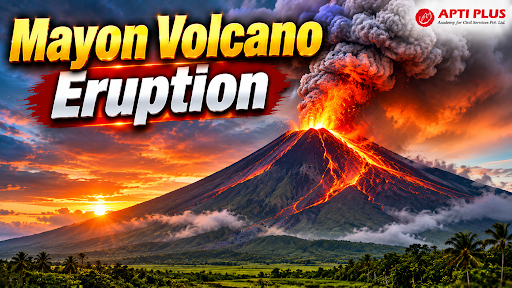
Mayon Volcano in the Philippines had a nearly six-minute “moderately explosive eruption” that sent an ash column 3,000 metres above its crater.
What Is Mayon Volcano?
-
Location: Mayon is an active volcano in Albay province on Luzon Island, Philippines.
-
Height: It rises to 2,462 m above the Albay Gulf and is the Philippines’ most active volcano.
-
Perfect Cone: One of the most symmetrical volcanic cones on Earth, with a base about 130 km in circumference and steep upper slopes.
-
Summit Crater: A circular crater about 250 m across sits at its peak.
-
Ecological And Economic Value
-
Protected Area: Mayon is the centre of Mayon Volcano Natural Park, and UNESCO designated the Albay area a Biosphere Reserve in 2016.
-
Livelihoods: Large abaca (Manila hemp) plantations grow on its fertile lower slopes.
-
Tourism: Its striking cone attracts climbers, campers and tourists.
-
Deadliest Eruption: The 1814 eruption killed more than 1,200 people and destroyed several towns.
Why Is Mayon So Active?
Tectonic Setting
-
Ring Of Fire: Mayon lies on the Pacific Ring of Fire, a horseshoe-shaped belt of volcanoes and earthquakes around the Pacific Ocean.
-
Subduction Zone: It stands on Luzon’s eastern side near the Philippine Trench, where the Philippine Sea Plate sinks beneath the Philippine Mobile Belt.
-
Magma Formation: As the sinking plate descends, water released from it lowers the melting point of the mantle above. This creates magma that rises to feed volcanoes.

Stratovolcano Structure
-
Layered Cone: Mayon is a stratovolcano, built of alternating layers of lava and ash.
-
Viscous Magma: Stratovolcanoes usually have thick, gas-rich andesitic magma, which leads to explosive eruptions and steep slopes.
About StratovolcanoA stratovolcano—also called a composite volcano—is a tall, steep, cone-shaped mountain built up over thousands of years by alternating layers of hardened lava, ash, pumice, and tephra. Key Characteristics & Structure
Why They Are Dangerous? Because sticky, viscous magma traps gas under high pressure, stratovolcanoes tend to produce violent, explosive eruptions rather than quiet, flowing lava.
Famous Examples
|
Source: NDTV
|
PRACTICE QUESTION Q. Consider the following statements: 1. Mayon Volcano lies close to the Philippine Trench, where the Philippine Sea Plate subducts beneath the Philippine Mobile Belt. 2. Stratovolcanoes are generally fed by low-viscosity basaltic magma, which produces gentle, effusive eruptions. 3. Barren Island volcano in India is associated with the subduction of the Indian Plate beneath the Burma Microplate. How many of the statements given above are correct? (a) Only one (b) Only two (c) All three (d) None Answer: (b) Explanation: Statement 1 is correct: Mayon Volcano is an active stratovolcano located on Luzon Island in the Philippines. It is geographically associated with the Philippine Trench, where the Philippine Sea Plate subducts westward beneath the Philippine Mobile Belt. Statement 2 is incorrect: Stratovolcanoes (or composite volcanoes) are typically characterized by high-viscosity andesitic, dacitic, or rhyolitic magma, which traps gases and builds pressure, resulting in highly explosive eruptions. In contrast, low-viscosity basaltic magma is characteristic of shield volcanoes, which exhibit gentle, effusive eruptions. Statement 3 is correct: Barren Island, South Asia's only active volcano located in the Andaman Sea, is formed along a convergent plate boundary where the Indian Plate subducts beneath the Burma Microplate (a part of the Eurasian Plate). |