Why In News?
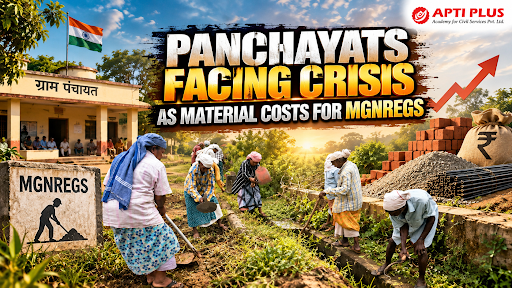
Panchayats are facing financial pressure because material costs for MGNREGS works from the previous financial year have reportedly not been disbursed.
What Is MGNREGS?
It was enacted under the Mahatma Gandhi National Rural Employment Guarantee Act, 2005 (MGNREGA), to provide a statutory guarantee of social security and wage employment across all rural districts in India, excluding areas with a 100% urban population.
Right to Demand Rural Employment: Under Section 3 and Section 7 of MGNREGA, every registered adult rural household volunteer is legally entitled to at least 100 days of unskilled manual work per financial year on demand.
-
If work is not allotted within 15 days, the State Government must legally pay an unemployment allowance equal to one-fourth of the minimum wage for the first 30 days and one-half thereafter.
Role of Gram Panchayats: The Act mandates decentralized planning by empowering Gram Panchayats to execute at least 50% of public works locally based on direct recommendations from the Gram Sabha, strengthening Panchayati Raj Institutions (PRIs).
Creation of Durable Rural Assets: The scheme focuses on Natural Resource Management (NRM), water conservation, drought proofing, afforestation, land development, and rural connectivity to build durable, productive community assets.
MGNREGS Funding
Centre-State Funding Structure: Financing was split between Union and State budgets based on component classifications to maintain a labor-centric social safety net
Unskilled Wage Component: Central Government finances 100% of unskilled manual labor costs, transferring wages directly into beneficiary bank accounts via the Direct Benefit Transfer (DBT) protocol.
Skilled and Semi-Skilled Wage Component: Expenditures on skilled and semi-skilled labor are funded through a shared Centre-State arrangement where the Centre covers 75% and States contribute 25%.
Material Component: Material costs are shared in a 75:25 ratio between the Central Government (75%) and State Governments (25%). Central releases are disbursed periodically in two tranches upon submission of utilization certificates.
60:40 Wage-to-Material Norm: Projects must adhere to a strict statutory ratio where at least 60% of total expenditure is dedicated to unskilled labor wages and a maximum of 40% to material and skilled labor costs.
-
To ensure operational flexibility without compromising asset quality, this 60:40 ratio was shifted from the Gram Panchayat level to the District level, maintaining overall national unskilled wage spending above 65%.
Challenges with MGNREGS
Delay in Fund Release: Prolonged fund processing cycles led to cumulative pending liabilities of ₹18,862 crore as of March 2026, comprising ₹8,688.29 crore in unpaid wages, ₹9,692.28 crore in material dues, and ₹502.42 crore in administrative arrears.
Cash-Flow Problems for Panchayats: Chronic delays in central tranche transfers cause severe liquidity freezes in Gram Panchayats, halting village sanitation, drinking water maintenance, tractor fuel supply, and utility payments.
Impact on Contractors and Suppliers: Material liabilities exceeding ₹9,692 crore disrupt vendor supply chains, causing local suppliers to stop delivering cement, bricks, and construction materials for ongoing public works.
Delay in Completion of Rural Assets: Unpaid material bills and labor shortages cause massive project backlogs; completed works dropped sharply from 94.45 lakh in FY 2022-23 to 64.23 lakh in FY 2025-26.
Weaknesses in Financial Management: Mandatory rollout of the Aadhaar-Based Payment System (ABPS) created technical rejections, as only 43% of active workers were eligible at launch in January 2024, causing an estimated ₹400 crore in uncompensated payment delays.
-
Caste-based wage segregation introduced in 2021 resulted in payment processing delays for general/OBC categories compared to SC/ST categories. Scrapped in late 2021.
Transition Challenges under the New Rural Employment Framework: Shifting from an open-ended, demand-driven legal entitlement under MGNREGA to budget-capped allocations under VB-G RAM G creates severe transitional uncertainty for registered households seeking continuous employment.

What Is VB–G RAM G?
Viksit Bharat – Guarantee for Rozgar and Ajeevika Mission (Gramin): The VB-G RAM G Act, 2025 is the statutory successor designed to modernize rural employment and integrate rural assets into national infrastructure plans.
Replacement of MGNREGS: The Act repeals and replaces MGNREGA, 2005, expanding the statutory employment guarantee from 100 days to 125 days of unskilled manual labor per rural household annually.
-
It requires State Governments to notify up to 60 days in a financial year during which public works under the scheme are paused, to align rural works with peak agricultural sowing and harvesting seasons to prevent labor diversion.
New Centre-State Funding Arrangement: It transforms rural employment into a Centrally Sponsored Scheme (CSS) operating on a 60:40 Centre-State cost-sharing ratio across wage, material, and administrative costs for general States, and 90:10 for North-Eastern and Himalayan States/UTs.
Normative Allocation: The Union Government determines annual State-wise normative budget allocations based on central guidelines, placing a hard fiscal ceiling on central transfers.
State-Level Financial Responsibility: State Governments are legally required to bear 100% of any expenditure incurred beyond their pre-determined normative allocation, alongside financing their 40% statutory co-funding share.
Steps taken by Government to address Financial Challenges in Rural Employment
Digital Fund Management: Wage disbursements are processed electronically through the National Electronic Fund Management System (NEFMS) and Public Finance Management System (PFMS) using automated Fund Transfer Orders (FTOs) credited directly to worker accounts.
Fund Release Mechanism: Central funds are released in two periodic tranches based on the agreed Labour Budget, utilization pace, and verified fund proposals submitted by States.
Social Audit: Independent Social Audit Units train certified auditors and women Self Help Group (SHG) members under DAY-NRLM to conduct mandatory village-level public audits of muster rolls and asset quality.
Panchayat-Level Monitoring: Local tracking is enforced via the NREGASoft e-governance portal, GeoMGNREGA GIS mapping (covering over 3.40 crore assets), and National Mobile Monitoring Software (NMMS) for real-time mobile attendance.
Audit and Accountability Mechanisms: A multi-tiered framework comprising the National Level Steering Committee and State Steering Committees oversees convergence, approves normative allocations, and enforces weekly public disclosures.
Way Forward
Timely Release of Pending Payments & Demand-Driven Liquidity Buffer: Establish an automated, real-time liquidity mechanism under the Public Finance Management System (PFMS) and National Electronic Fund Management System (NEFMS) to eliminate processing bottlenecks and prevent the accumulation of wage and material liabilities
Strengthening Panchayat Finances: Empowering Gram Panchayats with direct grant transfers under Finance Commission awards prevents local operational collapse during central tranche processing transitions.
Transparent Fund-Tracking System: Mandatory 100% geotagging of completed works combined with NMMS real-time mobile attendance prevents muster roll duplication and ensures payment accuracy.
Better Centre-State Coordination: Institutionalizing joint Centre-State steering committees under VB-G RAM G guidelines harmonizes normative budget allocations, reviews material expenditure, and resolves federal cost-sharing friction.
Stronger Social Audit and Accountability: Deploying certified women Self Help Group (SHG) auditors and Barefoot Technicians conducts independent physical verification of rural infrastructure projects.
Faster Grievance Redressal: Enforce statutory penalty mechanisms for wage payment delays and realign wage calculations with real living costs to protect worker livelihoods from inflation.
Smooth Transition to the New Rural Employment Framework: Notifying dedicated transition rules honors all legacy MGNREGA liabilities while onboarding active job card holders smoothly into the VB-G RAM G architecture.
Conclusion
The transition to VB-G RAM G must balance fiscal discipline with statutory employment guarantees to safeguard rural livelihoods. Strengthening cooperative federalism through flexible state co-funding and automated wage releases is essential to fulfill SDG 1 (No Poverty) and SDG 8 (Decent Work)
Source: THEHINDU
|
PRACTICE QUESTION Q. Critically examine the structural implications of replacing MGNREGA with the budget-driven VB-G RAM G framework on fiscal federalism and rural livelihood security in India. 150 words |