Why In News?
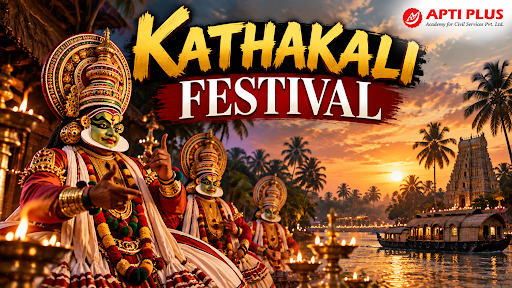
The 17th Kathakali Festival was inaugurated from September 18 to 20, 2026, at the Bharata Kalakshetra Auditorium in Thiruvanmiyur, Chennai, under the theme “Kadha Rasa Sangama – Confluence of Essence of Stories”.
What is Kathakali?
Classical Dance-Drama: Kathakali is one of India's major classical dance-drama traditions native to the southwestern state of Kerala. The term literally translates to "Katha" (story) and "Kali" (play).
Origin in Kerala: The art form crystallized around the 16th and 17th centuries, synthesizing earlier regional theatrical traditions such as Kutiyattam, Krishnanattam, and Ramanattam.
Storytelling Tradition: Performers enact dramatic episodes drawn from regional adaptations of pan-Indian epics—the Ramayana, Mahabharata, and the Puranas—written in Sanskritized Malayalam literature known as attakatha.
Facial Expressions: Facial expression plays a paramount role, using precise movements of the eyes, eyebrows, and facial muscles to evoke emotional resonance.
Mudras: Actors do not speak on stage; dialogue and narrative action are communicated through an intricate sign language consisting of 24 root hand gestures (mudras).
Elaborate Costumes: Characters wear heavy, decorative costumes, including layered skirts made of up to 55 yards of cloth, carved wooden head-dresses (kirita), and breastplates.
Key Features of Kathakali
Integration of Dance and Drama: Performances combine structured choreography, rhythmic dance steps (kalasam), and dramatic acting.
Musical Ensemble: The performance relies on two on-stage vocalists who sing the text alongside a traditional percussion orchestra comprising the Chenda (vertical cylindrical drum), Maddalam (horizontal drum), Chengila (gong), and Elathalam (cymbals).
Abhinaya: The actor-dancer practices Chathurvidhabhinaya (fourfold expression), internalizing emotion (bhava) to project aesthetic sentiment (rasa) to connoisseurs (rasika or sahrdaya).
Traditional Makeup (Vesham): Symbolic facial makeup classifies characters into distinct visual types:
-
Pacha (Green): Represents noble, divine heroes and kings like Krishna, Rama, and Arjuna.
-
Katti (Knife): Features green makeup with red knife-patterned markings and white nose knobs to denote arrogant or villainous characters with a streak of valor (e.g., Ravana).
-
Tadi (Beard): Subdivided into Chuvanna Tadi (Red Beard for vicious villains), Vella Tadi (White Beard for pious divine beings like Hanuman), and Karutta Tadi (Black Beard for primitive forest dwellers).
-
Kari (Black): Represents demonic female figures (demonesses) with jet-black makeup.
-
Minukku (Radiant): A smooth yellow-tinted facial makeup depicting virtuous women, sages, and Brahmins.
-
Chutti: A specialized makeup artist builds white ridges made of rice-flour paste and paper along the jawline to frame the actor's face and accentuate eye movements.
Mythological Themes: Operates within cosmic narratives of divine play (lila), portraying confrontations between gods, demons, and human heroes.
Source: PIB
|
PRACTICE QUESTION Q. With reference to the classical dance-drama Kathakali, consider the following statements:
Which of the statements given above is/are correct? (a) 1 and 2 only (b) 2 and 3 only (c) 1 and 3 only (d) 1, 2 and 3 Answer: (a) Explanation: Statement 1 is correct: Pacha (Green) makeup is categorized under the sattvika (virtuous) disposition. It is traditionally utilized to depict noble, heroic, and divine characters such as Lord Rama, Lord Krishna, and the Pandavas. Statement 2 is correct: The Chutti is the specialized white facial border or ridge applied along the actor's jawline. Traditionally, it was painstakingly constructed layer by layer using a mixture of rice paste and lime to give it a raised contour. Statement 3 is incorrect: Thodayam is indeed a pure dance (ritualistic offering), but it is a prelude performed prior to the main play behind the curtain to invoke blessings for a smooth performance, not after the play concludes. |