Why In News?
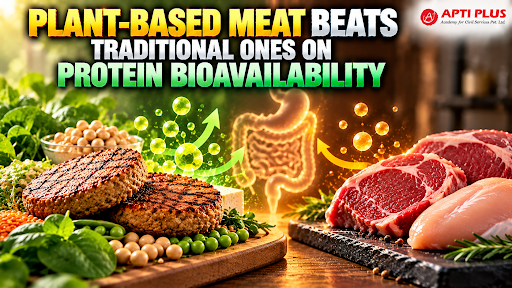
A study by CSIR–Institute of Himalayan Bioresource Technology (CSIR-IHBT), and Good Food Institute India shows commercial plant-based meats in India yield more bioavailable protein after cooking than chicken.
What is Plant-based Meat?
Plant-based meat refers to food products engineered from plant sources to bio-mimic or replicate the taste, texture, appearance, and cooking behavior of animal-derived meat.
-
Early plant-based proteins like Tofu (soy curd) originated around 206 BC in China, while modern "next-generation" alternatives use food technology to simulate the chew, juiciness, and even "bleeding" of real meat.
How It Is Made?
-
Raw Materials: Primary protein and fiber sources include soybeans, pea protein, wheat gluten (seitan), lentils, jackfruit, and mycoprotein (fungal fermentation).
-
Extrusion Technology: Manufacturers use high-moisture or low-moisture extrusion, pushing plant proteins through a die under high heat and mechanical pressure to align the proteins into stringy, sinewy structures that mimic animal muscle fibers.
-
Fat and Color Simulation: Plant oils like coconut oil or sunflower oil mimic melting animal fat, while beetroot juice or plant-derived leghemoglobin is added to replicate the red color and "blood" of cooking beef or mutton.
Advantages (Arguments in Favor)
-
Environmental Sustainability: Generates lower greenhouse gas emissions, demands less land use, and consumes significantly less freshwater compared to cattle and poultry farming.
-
Animal Welfare & Ethics: Offers a cruelty-free alternative, reducing factory farming pressures.
-
Public Health & Zoonotic Risk Mitigation: Lowers the risk of zoonotic disease spillover (such as avian flu or swine flu) associated with dense livestock rearing.
-
Nutritional Additions: Provides dietary fiber (absent in real meat) and is typically cholesterol-free.
Challenges (Arguments Against)
-
High Processing & Additives: Many commercial mock meats are classified as Ultra-Processed Foods (UPFs) and can contain high levels of sodium and saturated fats comparable to conventional meat.
-
Cost and Affordability: R&D and extrusion manufacturing make plant-based meats more expensive than traditional grains or local dairy/poultry, limiting mass adoption in developing markets like India.
-
Textural Limitations: Replicating complex whole-muscle cuts (like a steak or leg piece) remains far harder than ground-meat formats like keema or kebabs.
-
Regulatory and Labelling Gaps: Debate persists on whether plant-based products can legally use terms like "meat," "mutton," or "milk," leading to global pushback from traditional dairy and livestock lobbies.
Indian Market
-
Indian startups (such as Shaka Harry and Imagine Meats) and legacy brands (such as Licious with its UnCrave line) have expanded into mock chicken, momos, and mutton keema.
-
Celebrity investments (including prominent figures like M.S. Dhoni and Virat Kohli) have brought mainstream attention to alternative proteins in India.
-
Regulatory bodies like the FSSAI (Food Safety and Standards Authority of India) are tasked with framing guidelines for vegan and plant-based analogue labeling to prevent consumer deception.
Plant-Based Protein v/s Animal Meat
Comparative Parameters |
Plant-Based Protein (e.g., Pulses, Soy, Millets, Mock Meats) |
Animal Meat (e.g., Poultry, Red Meat, Fish) |
|
Protein Quality |
Generally incomplete protein profiles (often lacking one or more of the 9 essential amino acids, except for soy, quinoa, and amaranth). Requires combining sources (e.g., cereal-pulse combinations). |
Consists of complete proteins containing all 9 essential amino acids in optimal proportions required by the human body. |
|
Bioavailability & Digestibility |
Historically rated lower on the Digestible Indispensable Amino Acid Score (DIAAS). However, recent 2026 CSIR-IHBT research shows processed mock meats can yield higher protein bioavailability than chicken via advanced extrusion technologies. |
High natural digestibility and absorption rate. Traditional meat processing (like prolonged boiling) can occasionally degrade certain absorbable proteins compared to precise biomimicking techniques. |
|
Micronutrients & Anti-Nutrients |
Rich in dietary fibre, antioxidants, and phytochemicals. Prone to containing anti-nutrients (phytates, tannins) that inhibit mineral absorption, and lacks natural Vitamin B12. |
Rich in Vitamin B12, highly absorbable heme-iron, zinc, and omega-3 fatty acids. Lacks dietary fibre completely. |
|
Public Health Implications |
Associated with lower risks of cardiovascular diseases, type-2 diabetes, and obesity. Crucial for mitigating India's dual burden of malnutrition (stunting/wasting vs lifestyle diseases). |
Excess intake of processed/red meat elevates risks of colorectal cancer, cardiovascular diseases, and metabolic syndromes. |
|
Environmental Footprint |
Highly sustainable; requires significantly less land, water, and energy. Produces negligible greenhouse gas (GHG) emissions compared to livestock rearing. |
High environmental cost; livestock accounts for roughly 14.5% of global anthropogenic GHG emissions, contributing to rapid deforestation and water depletion. |
|
Food Security & Scaling |
Offers a highly efficient thermodynamic conversion of calories (direct crop-to-human consumption). Key to achieving SDG 2 (Zero Hunger) under a climate-stressed agricultural paradigm. |
Less efficient energy transfer (trophic level loss through animal feed conversion). Prone to supply-chain disruptions during zoonotic disease outbreaks (e.g., Avian Influenza). |
|
Economic & Industrial Aspect |
The emerging alternative protein sector (supported by bodies like GFI India) offers massive scope under Make in India via high-tech food processing sectors. |
A cornerstone of India's rural economy, supporting lakhs of small and marginal farmers via animal husbandry, allied sectors, and the pink economy. |
Source: DOWNTOEARTH
|
PRACTICE QUESTION With reference to the nutritional aspects of plant-based proteins and animal meat, consider the following statements:
Which of the statements given above are correct? (a) 1 and 2 only (b) 2 and 3 only (c) 1 and 3 only (d) 1, 2 and 3 Answer: Explanation: Statement 1 is incorrect: Not all plant-based protein sources are deficient in essential amino acids. While many individual plant proteins are low in one or more amino acids (e.g., legumes are typically low in methionine, and grains are low in lysine), several plant foods are complete proteins. Foods like soy (tofu, tempeh, edamame), quinoa, buckwheat, and amaranth naturally contain all nine essential amino acids in adequate proportions. Statement 2 is correct: Heme-iron is exclusively found in animal-derived foods (such as red meat, poultry, and fish), where it is bound within hemoglobin and myoglobin structures. Plant-based foods exclusively contain non-heme iron, which has a significantly lower absorption rate in the human body compared to heme-iron. (Note: While some modern food-tech companies bioengineer plant-derived heme via genetically modified yeast, naturally occurring dietary heme-iron is strictly animal-based). Statement 3 is correct: Phytates (found in whole grains, legumes, nuts, and seeds) and tannins (found in tea, coffee, and certain fruits) act as anti-nutrients. They bind to essential minerals like iron, zinc, and calcium in the digestive tract, forming insoluble complexes that inhibit mineral absorption. |