Why In News?
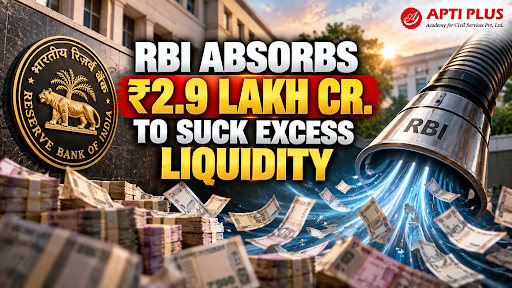
The Reserve Bank of India (RBI) absorbed nearly ₹2.9 lakh crore in surplus banking liquidity through two overnight Variable Rate Reverse Repo (VRRR) auction tranches.
What is Surplus Liquidity?
Surplus Liquidity refers to a situation where banks and financial institutions hold more cash than they need for daily operations, reserve requirements, and lending, creating an excess supply of money in the financial system.
In India, this condition has recently intensified, driven by foreign‑currency inflows through FCNR (B) deposits and RBI’s dollar‑rupee swap facility.
Positive Effects |
Negative Effects |
|
Cheaper Loans: Banks with surplus funds may lower lending rates. Stronger Forex Reserves: Inflows bolster external balances. |
Lower Deposit Rates: Banks reduce interest on fixed deposits. Weaker Monetary Transmission: Excess cash pushes overnight rates below RBI’s target, complicating inflation control. Asset Price Distortion: Surplus funds may inflate equity and bond prices. |
RBI Response: Conducting Variable Rate Reverse Repo (VRRR) auctions and open‑market sales of government securities to absorb excess cash and align short‑term rates with the 5.25 % repo rate.
What is Variable Rate Reverse Repo (VRRR)?
It is a monetary‑policy tool used by the RBI to absorb excess liquidity from the banking system.
It allows banks to park their surplus funds with the RBI for short durations, but unlike the fixed‑rate reverse repo, the interest rate is determined through an auction process rather than being pre‑set.
|
Purpose |
To manage surplus liquidity and keep short‑term interest rates aligned with the repo rate corridor. |
|
Process |
RBI invites banks to bid for depositing their excess funds. The rate is variable, decided by competitive bidding, usually below the repo rate (currently 5.25 %). |
|
Tenure |
Typically 1 to 14 days, though RBI can extend it depending on liquidity conditions. |
|
Instrument Type |
Reverse repo – RBI borrows money from banks and gives government securities as collateral. |
|
Outcome |
Helps RBI drain excess liquidity, stabilize money‑market rates, and control inflationary pressures. |
What Causes Surplus Liquidity?
Government Spending: Large-scale public developmental expenditures and salary disbursements draw down sovereign accounts and inject heavy liquidity into commercial bank deposits.
Capital Inflows: Foreign portfolio investments (FPI) and foreign direct investments (FDI) enter the economy, requiring conversion of foreign currency into domestic rupees.
Foreign Exchange Operations: When the RBI buys US dollars from the market to maintain export competitiveness and build reserves, it automatically injects equivalent rupee liquidity.
Banking-System Conditions: Sustained growth in low-cost savings and current account deposits, paired with cautious corporate credit uptake, builds persistent surplus balances.
Foreign Currency Deposits: Substantial inflows through Foreign Currency Non-Resident (Bank) [FCNR(B)] deposits and Non-Resident External (NRE) accounts enhance lendable funds.
RBI Monetary Operations: The maturity of long-term repo operations, foreign exchange buy-sell swap settlements, and open market bond purchases augment system cash.
What are the Effects of Liquidity Absorption?
Dimension |
Effect |
Explanation |
|
Interest Rates |
Rise in short‑term rates |
When liquidity is absorbed, banks have less surplus cash to lend, pushing up call‑money and short‑term borrowing rates closer to the repo rate. |
|
Inflation Control |
Reduces inflationary pressure |
By curbing excess money supply, RBI prevents demand‑driven inflation and stabilizes price levels. |
|
Credit Availability |
Tightens lending capacity |
Banks face reduced funds for loans, slowing credit growth—especially in sectors dependent on short‑term financing. |
|
Exchange Rate Stability |
Supports rupee stability |
Absorbing liquidity helps offset foreign‑currency inflows and prevents rupee depreciation caused by excess domestic money. |
|
Asset Prices |
Moderates speculative bubbles |
Less liquidity curbs excessive investment in equities, bonds, and real estate, promoting financial discipline. |
|
Monetary Transmission |
Improves policy effectiveness |
Aligns market rates with RBI’s policy corridor, ensuring better transmission of repo‑rate changes to lending and deposit rates. |
|
Fiscal Impact |
Raises government borrowing cost |
Higher yields on government securities can increase the cost of public borrowing in tight liquidity conditions. |
Conclusion
Liquidity absorption is a stabilizing mechanism—it ensures that excess money does not distort interest rates, fuel inflation, or create asset bubbles. However, over‑absorption can slow credit growth and economic momentum, so the RBI must strike a delicate balance between price stability and growth support.
Source: THEHINDU
|
PRACTICE QUESTION Q. With reference to the Liquidity Adjustment Facility (LAF), consider the following statements:
Which of the statements given above are correct? (a) 1 and 2 only (b) 1 and 3 only (c) 2 and 3 only (d) 1, 2 and 3 Answer: (b) 1 and 3 only Explanation: Statement 1 is correct: The Liquidity Adjustment Facility (LAF) was introduced by the Reserve Bank of India based on the recommendations of the Narasimham Committee on Banking Sector Reforms. Statement 2 is incorrect: LAF does not operate exclusively through fixed-rate overnight transactions. The RBI also conducts variable-rate repo and reverse repo auctions (such as term repos) depending on market liquidity conditions. Statement 3 is correct: A primary objective of the LAF is to steer short-term interest rates in the overnight money market by creating an interest rate corridor. |