Why In News?
During a visit to Sikkim, the Union Minister of Fisheries, Animal Husbandry and Dairying announced that the Centre will set up a Centre of Excellence for the conservation and development of the indigenous Siri cattle breed.
What Is Siri Cattle?
-
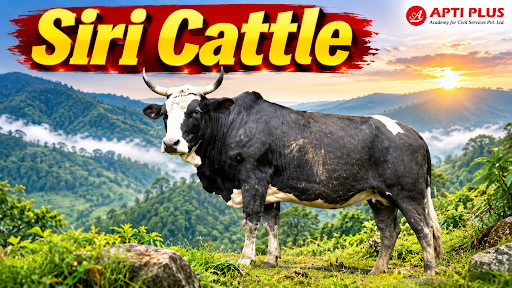
Siri is an indigenous zebu cattle breed of the Eastern Himalaya, found mainly in Sikkim, the Darjeeling hills of West Bengal, and Bhutan.
-
Local Name: It is also known as "Trahbum".
Physical Features
-
Colour And Coat: It is usually black or black and white, with a thick coat of long hair that protects it from cold.
-
Hump: Its hump sits slightly forward compared with other zebu breeds.
-
Strong Build: It has strong legs and feet, suited to steep, hilly terrain.
Utility
-
Dual Purpose: Siri is a dual-purpose breed, used for both milk and work.
-
Draught Power: Males are mainly reared for draught (ploughing and carrying loads) in hilly areas, where they are sometimes the only source of draught power.
-
Low Milk Yield: Average milk yield is about 425.8 kg per lactation, with fat content of 2.8–5.5%.
Adaptability
-
Hill-Hardy: It is adapted to cold climates, steep slopes and low-input farming.
-
Disease Resistance: Like most indigenous breeds, it is generally hardy and resistant to local diseases.
Why Are Indigenous Breeds Important?
Genetic And Ecological Value
-
Climate Resilience: Indigenous breeds tolerate heat, cold and local diseases better than exotic breeds, which makes them valuable as the climate changes.
-
Genetic Diversity: They carry unique genes that may be useful for future breeding.
Livelihood Value
-
Low-Cost Farming: They survive on local fodder with low inputs, suiting small and marginal farmers.
-
A2 Milk: Milk from indigenous Indian cattle is generally of the A2 type, which has attracted market interest.
Breed Registration
-
ICAR-NBAGR: The National Bureau of Animal Genetic Resources in Karnal, Haryana, registers and documents India's livestock breeds.
What Are India's Key Schemes For Indigenous Cattle?
Rashtriya Gokul Mission
-
Launched In 2014: The Rashtriya Gokul Mission aims to conserve and develop indigenous bovine breeds.
-
Key Tools: It supports artificial insemination, sex-sorted semen, IVF and Gokul Grams
Dairy Programmes
-
National Programme for Dairy Development (NPDD): It strengthens dairy infrastructure and cooperatives, including in Sikkim.
-
White Revolution 2.0: Launched in 2024, it aims to expand dairy cooperatives and milk procurement.
What Are The Key Challenges?
Declining Numbers
-
Shrinking Population: Many indigenous breeds are declining as farmers shift to higher-yielding animals.
-
Example: Siri has been listed as vulnerable in a 2022 breed watchlist, reflecting its declining numbers.
Crossbreeding With Exotic Breeds
-
Genetic Dilution: Crossbreeding with exotic breeds such as Jersey and Holstein Friesian raises milk output but dilutes the purity of native breeds.
Low Productivity
-
Weak Economics: With low milk yields, Siri cattle offer lower incomes than crossbred animals, which discourages farmers from rearing them.
-
Example: During his visit to Mangan, the Minister noted that local cattle gave only about three litres of milk a day on average, which highlights the need for breed improvement.
Mechanisation
-
Less Need For Draught Animals: The spread of power tillers and tractors reduces demand for draught bullocks, a key traditional use of Siri cattle.
Way Forward
Scientific Breed Improvement
-
Improve Within The Breed: Use IVF, genomic selection and sex-sorted semen to raise productivity without losing purity.
-
Gene Banks: Store Siri semen and embryos at ICAR-NBAGR and other gene banks as insurance.
Community-Led Conservation
-
Involve Farmers: Support farmers and breeders' societies to conserve pure animals.
-
Example: Kerala's Vechur cattle, among the world's smallest cattle breeds, were brought back from near extinction through a conservation programme by Kerala Agricultural University and local farmers.
Add Value To Products
-
Premium Markets: Promote Siri milk and products such as Churpi as organic, branded products from Sikkim, India's first fully organic State.
Learn From Global Success
-
Indigenous Genetics Abroad: Indian zebu breeds have done well when improved scientifically.
-
Example: Brazil imported Indian breeds such as Gir and Ongole and, through decades of selective breeding, developed high-performing dairy and beef herds, showing the potential of indigenous genetics.
Conclusion
The Centre of Excellence for Siri cattle is a timely step to save a hardy Himalayan breed suited to Sikkim's hills. Scientific breeding, farmer participation and premium organic branding can make Siri both a conservation success and a source of better rural incomes.
Source: PIB
|
PRACTICE QUESTION Q. Consider the following pairs: Indigenous Cattle Breed State Of Origin 1. Siri Sikkim 2. Vechur Kerala 3. Punganur Andhra Pradesh 4. Gir Gujarat How many of the pairs given above are correctly matched? (a) Only one (b) Only two (c) Only three (d) All four Answer: (d) Explanation: Siri (Sikkim): Correct. The Siri is a vital dual-purpose indigenous cattle breed native to the Eastern Himalayan region. It is primarily found in Sikkim, the Darjeeling hills of West Bengal, and Bhutan. Vechur (Kerala): Correct. The Vechur cow is a famous indigenous dwarf cattle breed named after the Vechoor village in the Kottayam district of Kerala. It is officially recognized as the smallest cattle breed in the world by the Guinness Book of Records. Punganur (Andhra Pradesh): Correct. The Punganur is an ancient dwarf cattle breed originating from the Chittoor district in Andhra Pradesh. It is well known for its small size and high-fat milk yield. Gir (Gujarat): Correct. The Gir is one of the principal Zebu milch cattle breeds in India. It originated in the Gir hills and Kathiawar peninsula of Gujarat. |