Why In News?
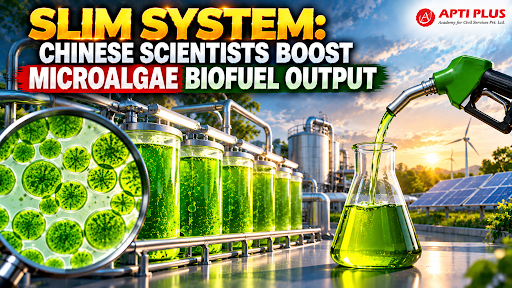
The Chinese Academy of Agricultural Sciences developed the SLIM system, boosting microalgae biofuel output 5.8-fold, according to Nature Communications.
What Is The SLIM System?
The SLIM system is an innovative microalgae cultivation technology developed by researchers at the Chinese Academy of Agricultural Sciences that boosts microalgae biofuel (oil/fat) output by 5.8 times.
How It Works
-
Hydrogel Embedding: Instead of growing algae freely in large volumes of water, the microalgae are trapped inside a soft, porous, jelly-like material called a hydrogel (made from substances derived from the algae itself).
-
Two-Stage Method:
-
Stage 1 (Rapid Growth): The hydrogel is placed in a nutrient-rich environment. Nutrients flow through the porous gel to feed the algae, allowing them to multiply quickly.
-
Stage 2 (Oil Accumulation): The algae are shifted to a saltier, low-nutrient, and low-nitrogen environment. Starved of nitrogen (which they need for protein and growth) and placed under stress, the algae switch to producing and storing fat (lipids).
-
Easier Harvesting: Traditional algae farming requires energy-intensive centrifuges and filtration systems to separate the tiny organisms from water.
-
The SLIM system cuts down on this energy use and can even be manufactured using a 3D bioprinter, allowing structures to be stacked in compact spaces.
What Are Microalgae?
-
Tiny Photosynthetic Organisms: Microalgae are microscopic, mostly single-celled organisms that use sunlight and carbon dioxide to grow, like plants.
-
Oil-Rich: Many species store energy as lipids, which can make up a large share of their dry weight under the right conditions.
-
Fast Growth: Some species can double their biomass within a day.
Why Stress Raises Oil Content
-
Nitrogen Starvation: Without enough nitrogen, algae cannot make proteins needed for cell division. They redirect carbon from photosynthesis into storage lipids instead.
Why Are Algae Considered A Promising Biofuel Source?
Advantages
-
Third-Generation Biofuel: Algae-based fuels are third-generation biofuels, which do not compete with food crops.
-
High Yield Per Area: Microalgae can produce far more oil per hectare than oil crops such as soybean or palm.
-
No Farmland Needed: They can grow on non-arable land, in saline water or even in wastewater.
-
Carbon Capture: They absorb CO₂ as they grow, and can use emissions from power plants and industries.
Fuels From Algae
|
Fuel |
Production Process |
|
Biodiesel |
Transesterification of algal oil |
|
Sustainable Aviation Fuel (SAF) |
Hydroprocessing of algal oil |
|
Bioethanol |
Fermentation of algal sugars |
|
Biogas |
Anaerobic digestion of algal biomass |
Source: THEPRINT
|
PRACTICE QUESTION Q. Why are algae-based biofuels considered promising, and what limits their commercial use? (10 Marks, 150 Words) |