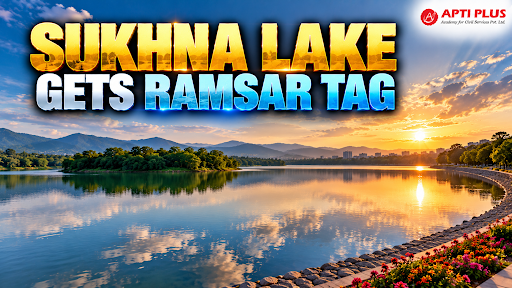
Why In News?
The Union Environment Minister announced the designation of Sukhna Wetland in Chandigarh (alongside Sauj Jheel in Uttar Pradesh) as a Wetland of International Importance under the Ramsar Convention, expanding India's global tally to 103 sites.
About Sukhna Wetland
It is a human-made freshwater reservoir and peri-urban wetland situated at the edge of Chandigarh, near the Shivalik Hills in the foothills of the Outer Himalayas.
-
Creation: It was created in 1958 as Sukhna Lake by damming the seasonal Sukhna Choe stream, forming a central part of Chandigarh's original master plan by Le Corbusier.
-
Area: It covers roughly 565 acres and acts as a peri-urban wetland bridging urban landscapes with natural catchments.
-
Biodiversity: It serves as a vital feeding, roosting, and wintering habitat for waterbirds traveling along the Central Asian Flyway. Notable Species:
-
Common pochard (Aythya ferina) – Classified as Vulnerable.
-
Pallas's fish eagle (Haliaeetus leucoryphus) – Classified as Endangered.
-
Black pond turtle (Geoclemys hamiltonii) – Classified as Endangered, utilizing the shallow shoreline habitats.
-
Habitats: Supports open water surfaces, littoral (shoreline) vegetation, scrublands, and surrounding forests.
-
The Punjab and Haryana High Court declared Sukhna Lake in Chandigarh a living legal entity in March 2020 to protect it from drying up, encroachment, and pollution
-
The court invoked parens patriae jurisdiction to grant the lake legal personhood with rights and duties, declaring Chandigarh citizens as loco parentis to protect it.
-
Construction was banned in catchment areas, the Sukhna Wetland, and the Sukhna Wildlife Sanctuary. Punjab and Haryana were ordered to pay ₹100 crore each for unauthorized constructions.
-
This aligns with prior Indian rulings granting legal status to rivers like the Ganga and Yamuna.
About Sauj Jheel
Sauj Jheel is a shallow perennial floodplain lake located in the Mainpuri district of Uttar Pradesh, within the Ganga River system and Indo-Gangetic Plain.
-
This makes Mainpuri the only district in India with two Ramsar sites, the other being the nearby Saman Bird Sanctuary.
-
Ecological Importance: Recognized as an Important Bird and Biodiversity Area (IBA) by BirdLife International. It regularly shelters over 30,000 waterbirds.
-
Flora & Fauna:
-
Fauna: Provides critical nesting and feeding habitats for the Vulnerable Sarus Crane (Grus antigone) and the Vulnerable Greater Spotted Eagle (Clanga clanga).
-
Flora: Features wetland vegetation including the Sacred Lotus (Nelumbo nucifera) and Wild Sugarcane (Saccharum spontaneum).
About Ramsar Convention
The Ramsar Convention on Wetlands is an intergovernmental treaty adopted on February 2, 1971, in Ramsar, Iran, to conserve and ensure the "wise use" of wetlands.
-
Official Name: Convention on Wetlands of International Importance especially as Waterfowl Habitat.
-
Date in Force: December 21, 1975 (Celebrated annually as World Wetlands Day on February 2).
-
Secretariat: Located in Gland, Switzerland (hosted in partnership with the IUCN).
-
Core Principle ("Wise Use"): Maintaining the ecological character of wetlands while supporting sustainable use by local communities.
-
Three Pillars of the Convention:
-
Work towards the wise use of all wetlands.
-
Designate suitable wetlands for the List of Wetlands of International Importance (Ramsar Sites) and ensure their effective management.
-
Cooperate internationally on transboundary wetlands and shared wetland systems.
-
Montreux Record: Tracks sites facing ecological changes. India includes Keoladeo National Park and Loktak Lake. (Chilika Lake was removed in 2002 after restoration)
India & the Ramsar Convention
-
Date of Ratification: February 1, 1982.
-
First Ramsar Sites in India: Chilika Lake (Odisha) and Keoladeo National Park (Rajasthan) in 1981/1982.
-
Total Sites: India has 103 Ramsar sites as of October 2026, covering over 13.87 lakh hectares across 28 states and union territories. It places India 1st in Asia and 3rd globally.
-
Leading States: Tamil Nadu has the most with 20 sites, followed by Uttar Pradesh with 14.
-
Largest Ramsar Site in India: Sundarbans Wetland, West Bengal.
-
Smallest Ramsar Site in India: Renuka Wetland, Himachal Pradesh.
Source: INDIANEXPRESS
|
PRACTICE QUESTION Q. Consider the following statements regarding Sukhna Wetland: 1. It is a natural tectonic lake formed in the Outer Himalayas during the Holocene epoch. 2. It is fed primarily by the seasonal hill streams Kansal and Saketri within the Ghaggar River Basin. 3. It has been declared a "Legal Entity" by the High Court of Punjab and Haryana. Which of the statements given above are correct? (A) 1 and 2 only (B) 2 and 3 only (C) 1 and 3 only (D) 1, 2 and 3 Answer: (B) 2 and 3 only Explanation: Statement 1 is incorrect: Sukhna Lake is not a natural tectonic lake formed during the Holocene epoch. It is an artificial, human-made reservoir constructed in 1958 by damming the seasonal Sukhna Choe coming down from the Shivalik foothills, designed by Le Corbusier and Chief Engineer P.L. Verma. Statement 2 is correct: Sukhna Wetland receives its inflow from seasonal hill streams—predominantly Kansal and Saketri—which drain the lower Shivalik hills and lie within the sub-catchment of the Ghaggar River Basin. Statement 3 is correct: In March 2020, the High Court of Punjab and Haryana invoked its parens patriae jurisdiction to declare Sukhna Lake a "Legal Entity / Juristic Person" having rights, duties, and liabilities of a living person for its protection, while designating the citizens of Chandigarh as loco parentis. |