Why In News?
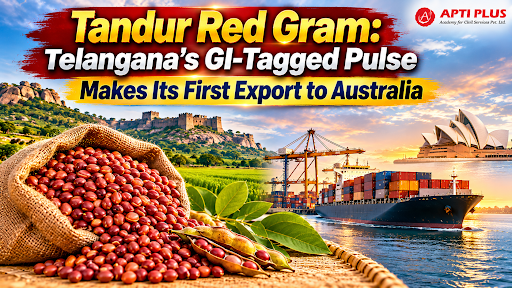
The Agricultural and Processed Food Products Export Development Authority (APEDA) facilitated the first-ever export of GI-tagged Tandur Red Gram from Telangana to Australia.
What Is Tandur Red Gram?
-
Popular Name: Also known as Tandur Toor Dal or Tandur Redgram, it is a region-specific variety of pigeon pea (Cajanus cajan).
-
Location: It is cultivated mainly in the rainfed areas of four mandals in Vikarabad district, Telangana:
-
Tandur
-
Basheerabad
-
Peddemul
-
Yelal
-
GI Recognition: It became the first agricultural product from Telangana to receive a Geographical Indication (GI) tag in December 2022.
-
Characteristics: Its unique quality is associated with:
-
Deep Black Soils: Support crop growth and influence grain characteristics.
-
Attapulgite Clay Deposits: A distinctive clay mineral found in the region.
-
Limestone Deposits: Contribute to the region's geological and soil characteristics.
-
Cultivation Pattern: It is primarily grown under rainfed conditions, making its production dependent on monsoon rainfall and local soil-moisture conditions.
What Makes Tandur Red Gram Nutritionally and Commercially Important?
-
Protein Content: It contains approximately 22–24% protein, making it a valuable plant-based protein source.
-
Nutritional Importance: It supplies dietary protein and contributes to nutritional security, particularly in cereal-based diets.
-
Cooking Quality: It is valued for its distinctive taste and superior cooking characteristics.
-
Storage Quality: Its enhanced keeping quality supports storage, handling and commercial distribution.
-
Agricultural Value: Its regional identity provides an opportunity to differentiate it from generic pigeon pea varieties and improve market recognition.
What Is APEDA?
The Agricultural and Processed Food Products Export Development Authority (APEDA) is a statutory apex body responsible for promoting and developing the export of scheduled agricultural and processed food products.
-
Establishment: Set up in December 1985 through the Agricultural and Processed Food Products Export Development Act, 1985, and came into effect on February 13, 1986 (replacing the Processed Foods Export Promotion Council).
-
Parent Ministry: It operates under the Ministry of Commerce and Industry.
-
Headquarters: New Delhi, with 15 regional offices across India.
Mandate and Functions
-
Scheduled Products: Promotes and regulates the export of specific scheduled items, including fruits, vegetables, meat, poultry, dairy, confectionery, honey, alcoholic/non-alcoholic beverages, and cereal products.
-
RCMC Registration: Issues the Registration-Cum-Membership Certificate (RCMC), which is mandatory for exporters of scheduled products.
-
Organic Certification (NPOP): Serves as the Secretariat to the National Accreditation Board (NAB) for implementing accreditation of certification bodies under the National Programme for Organic Production (NPOP).
-
Sugar Import Monitoring: Monitors the import of sugar.
-
Industry Development: Provides financial assistance, infrastructure development, quality standardization, market intelligence, and global brand promotion.
-
BHARATI Initiative: Launched the BHARATI (Bharat's Hub for Agriitech Resilience Advancement and Incubation for Export Enablement) initiative to empower agri-food startups, boost tech integration (AI, blockchain traceability, cold chains).
What Is a Geographical Indication (GI) Tag?
-
Definition: A Geographical Indication (GI) is a sign used on products originating from a specific geographical area where their quality, reputation or other characteristics are essentially attributable to that geographical origin.
-
Product Categories: GI protection applies to agricultural products, natural goods, foodstuffs, handicrafts and manufactured goods.
-
Legal Framework: India regulates GI registration through the Geographical Indications of Goods (Registration and Protection) Act, 1999.
-
International Framework: GI protection is recognised under Article 22 of the TRIPS Agreement of the World Trade Organization (WTO).
-
Registration Period: GI registration remains valid for 10 years and can be renewed for further periods of 10 years under Section 18 of the 1999 Act.
Source: THEHINDU
|
PRACTICE QUESTION Q. With reference to Geographical Indications (GI) in India, consider the following statements:
Which of the statements given above is/are correct? (a) 1 and 2 only (b) 1, 2 and 4 only (c) 2, 3 and 4 only (d) 1, 2, 3 and 4 Answer: (b) 1, 2 and 4 only Explanation: Statement 1 is correct: In India, GI registration and protection are regulated under the Geographical Indications of Goods (Registration and Protection) Act, 1999, which officially came into force in September 2003. Statement 2 is correct: A GI registration is legally valid for a period of 10 years and can be renewed indefinitely from time to time for subsequent 10-year periods. Statement 3 is incorrect: GI protection is not restricted to agricultural products alone. According to the Act, it applies to agricultural goods, natural goods, manufactured goods, handicrafts, and food items (e.g., Kanjivaram Sarees, Mysore Silk, and Darjeeling Tea). Statement 4 is correct: The TRIPS Agreement (Trade-Related Aspects of Intellectual Property Rights) under the World Trade Organization (WTO) contains specific provisions (Articles 22 to 24) dealing explicitly with the international protection of Geographical Indications. |