Why In News?
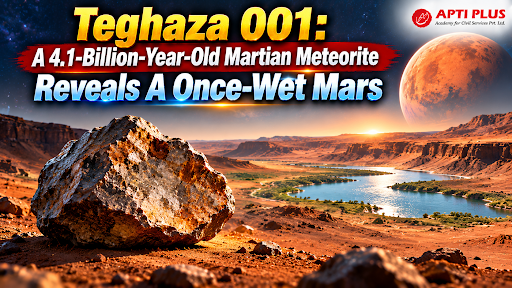
NASA-funded scientists found that Teghaza 001, a rose-coloured meteorite discovered in the Sahara Desert in 2022, is one of the oldest pieces of Mars ever found on Earth.
What Is Teghaza 001?
Discovery And Basic Features
-
Origin Of Name: The meteorite is named after the Teghaza salt plain in Mali, where it was found in 2022.
-
Size And Colour: It is a rose-coloured rock weighing nearly 800 grams.
-
Martian Identity: It is one of roughly 435 Martian meteorites identified on Earth. Scientists at the University of New Mexico first confirmed its Martian origin by analysing its oxygen isotopes.
Rock Type
-
Igneous Rock: Teghaza 001 is a coarse-grained igneous rock, a plagioclase-rich gabbro. Its structure shows that it cooled slowly, probably underground.
-
Unique Composition: Its texture and chemistry do not match any other known group of meteorites.
-
Single Rock Type: Unlike some ancient Martian meteorites that are made of broken fragments, Teghaza 001 is a single, intact piece of ancient crust.
Age
-
Over 4.1 Billion Years: Uranium–lead dating of its zircon crystals gave an age of about 4.11 billion years, with an uncertainty of only about 13 million years.
-
Zircon traps uranium but excludes lead when it forms. As uranium decays into lead at a known rate, scientists can measure the ratio to date the rock precisely.
-
Second Clock: A separate rubidium–strontium analysis gave a consistent but less precise age of about 4.24 billion years.
-
Minimum Age: The researchers note that a heating event around 4.1 billion years ago may have reset these clocks, so the rock may be even older.
Why Is Teghaza 001 Scientifically Significant?
Evidence Of Ancient Water
-
Water-Altered Rock: Chemical markers show that subsurface water altered the rock about 4.1 billion years ago.
-
Active Water Cycle: This points to a more dynamic water cycle on early Mars than scientists previously understood.
-
Window On Habitability: It is a direct witness to a time when Mars was wet and possibly suitable for life to emerge.
Insights Into Mars' Evolution
-
Early Crust Formation: It shows how Mars' crust formed from cooling magma and was later changed by water.
-
Atmospheric Loss: Its age coincides with the period when Mars began losing its early atmosphere to space.
-
Guide For Exploration: Matching its chemistry to orbital data can help choose landing sites for future missions.
What Are Meteoroids, Meteors And Meteorites?
|
|
Meteoroid |
Meteor |
Meteorite |
|
Meaning |
Small solid object orbiting the Sun |
Streak of light seen when a meteoroid burns in the atmosphere |
Meteoroid that survives the atmosphere and hits the ground |
|
Location |
Outer space |
Inside a planet’s atmosphere |
On the surface of a planet |
|
Physical State |
Solid rock or metal fragment |
Glowing, burning body, often called a “shooting star” |
Solid fragment that has survived entry |
|
Size |
From dust grains to about 1 metre |
Visible light trail, usually from small meteoroids |
Varies from small pebbles to large rocks |
|
Visibility |
Not visible from Earth |
Seen as a bright flash or fireball in the night sky |
Can be collected and studied in laboratories |
|
Origin |
Debris from asteroids, comets or planetary collisions |
Created when a meteoroid enters the atmosphere at high speed |
Fragments of asteroids, the Moon or Mars |
|
Example |
Debris from Comet Swift–Tuttle |
Perseid meteor shower |
Teghaza 001 (Martian meteorite) |

Source: livemint
|
PRACTICE QUESTION Q. Consider the following statements about Teghaza 001:
Which of the statements given above is/are correct? (a) 1 and 2 only (b) 2 and 3 only (c) 1 only (d) 1, 2 and 3 Answer: (a) Explanation: Statement 1 is correct: Teghaza 001 is a rare, rose-colored Martian meteorite discovered in 2022 in the Sahara Desert in Mali (named after the salt plain where it was located). Statement 2 is correct: Researchers analyzed tiny zircon crystals (using uranium-lead dating alongside in-situ rubidium-strontium dating) to determine its crystallization age of at least 4.1 billion years, establishing it as one of the oldest known pieces of Mars ever found on Earth. Statement 3 is incorrect: A key finding published in Science is that the meteorite preserves clear geochemical evidence of alteration by subsurface liquid water around 4.1 billion years ago, indicating a dynamic early Martian hydrological cycle. |