Why In News?
The Foreign Contribution (Regulation) Amendment Bill, 2026 proposes changes to how NGOs manage foreign funds and physical assets, sparking nationwide debates on national security versus civil society survival.
What is the Foreign Contribution (Regulation) Act (FCRA)?
The FCRA is a central law that regulates the acceptance and utilisation of foreign contributions (donations) by individuals, associations, and companies in India.
It ensures that foreign money does not enter the country for activities that harm the national interest.
The Ministry of Home Affairs (MHA) directly enforces the FCRA rules and monitors all charities receiving foreign aid.
Only organisations with a definite cultural, economic, educational, religious, or social programme can apply for registration.
Evolution
-
The government first enacted the law in 1976 during the Emergency to stop foreign powers from destabilising India's democracy.
-
The 2010 Act replaces the old law, introducing a strict 5-year renewable registration system for NGOs.
-
The 2020 Amendments reduce the administrative expense cap from 50% to 20%, ban the transfer of funds between NGOs, and force all NGOs to open accounts in the State Bank of India (SBI), New Delhi.

What are the Key Provisions of the FCRA (Amendment) Bill, 2026?
Designated Authority: Central Government will appoint a Designated Authority to take over the foreign funds and physical assets of any NGO whose registration is cancelled, surrendered, or ceases to exist.
-
This authority acts with the powers of a civil court to supervise, maintain, and manage the seized properties.
Management of Foreign-Funded Assets: If an NGO fails to renew its license, its assets vest provisionally with the Designated Authority.
-
If the NGO does not restore its registration within a specific time, the assets vest permanently. The government can then sell these assets (like schools or hospitals) and deposit the money into the Consolidated Fund of India.
Stronger Regulatory Oversight: Introduces "Deemed Cessation", meaning an NGO automatically loses its registration and assets if it forgets to renew its license on time or if the government denies the renewal.
-
Mandates the prior approval of the Central Government before any state or local agency can start investigating an FCRA offence.
Rationalisation of Penalties: Reduces the maximum prison sentence for breaking the rules from five years to one year.
Key Functionaries Liability: Holds directors, trustees, and managers personally liable for the organisation's rule violations unless they prove they exercised due diligence.
Minimum Spending Rules: Associated 2026 rules dictate that NGOs must spend at least Rs 10 lakh of foreign funds over two years to prove they are doing "reasonable activity," or risk losing their license.
Why Do Critics Consider the Bill a Challenge for Civil Society?
Concerns Over Institutional Autonomy: It allows the government to seize mixed-funded assets. If an NGO builds a hospital using 80% local Indian money and 20% foreign money, the government can seize the entire hospital.
-
This traps NGOs in a "No-Exit" system. An NGO can never stop renewing its FCRA license, even if it no longer wants foreign money, because giving up the license means losing its buildings and land.
Impact on Freedom of Association: Strict rules create a chilling effect on free speech. The new rules ban foreign funding for organizations involved in human rights advocacy, policy research, or strategic litigation.
-
International bodies argue this violates Article 22 of the International Covenant on Civil and Political Rights (ICCPR), as seeking and using resources is a core part of the right to freedom of association.
Administrative Burden: NGOs face compliance burden. They must pay separate fees for each state they operate in and for each different type of activity they do.
-
The Rs 10 lakh minimum spending limit heavily penalizes small, grassroots organizations that only need modest amounts of money to help rural communities.
Fear of Regulatory Uncertainty: Foreign donors (like international foundations) will stop funding long-term physical infrastructure (like schools and clinics) because they fear the state will seize the property if the NGO misses a renewal deadline.
-
Instead, donors will only fund short-term software or personnel, leaving India with an infrastructure squeeze in the welfare sector.
Targeting Minorities: Minority religious institutions strongly oppose the associated rules that strictly prohibit "proselytisation", fearing local police will misuse this undefined term to shut down Christian schools and hospitals.
Over 22,400 FCRA registrations have already been cancelled in the last decade, crippling the non-profit sector (Source: FCRA Dashboard)

What are the Government's Arguments in Support of the Bill?
Protecting National Security: Unregulated foreign money acts as a tool for foreign powers to interfere with India's internal democracy and social order.
Enhancing Financial Transparency: Previously, millions in foreign-funded assets remained in limbo when an NGO closed. The Designated Authority provides a clear, legal framework to protect and repurpose these assets for public benefit.
Preventing Diversion of Funds: Prevents "NGO intermediaries" from acting as secret funnels for illegal activities. The rules force NGOs to declare the ultimate original foreign donor to prevent money laundering.
Global Standard: Democracies like the USA, UK, and Australia also maintain strict registries for foreign-funded entities to protect sovereignty.
Provisional Seizure: Asset seizure is initially only provisional. If an NGO proves its compliance and restores its license, it gets all its buildings and money back.
What are the Major Challenges in regulating NGOs?
Balancing National Security with Civil Liberties: Government must prevent terrorism financing, money laundering and foreign interference while safeguarding the constitutional freedoms of association, expression and peaceful dissent under Articles 19 and 21.
Ensuring Transparency Without Excessive Compliance Burden: Small NGOs, particularly in rural and tribal areas, often lack professional accountants, legal expertise and digital compliance systems, increasing the risk of penalties for procedural lapses rather than substantive violations.
Preventing Misuse of Foreign Contributions: Tracking the end-use of foreign funds becomes difficult when international contributions are mixed with domestic donations or routed through multiple projects and implementing agencies.
Maintaining Public Trust in Civil Society: Frequent licence suspensions and cancellations may reduce donor confidence, affecting the credibility of genuine charitable organisations.
FATF Divergence: The Financial Action Task Force (FATF) recommends a risk-based approach, focusing enhanced scrutiny only on NGOs vulnerable to terrorism financing, whereas broader sector-wide restrictions may increase compliance costs for low-risk organisations.
Regulatory Uncertainty: Frequent amendments to FCRA rules create uncertainty in long-term programme planning, donor commitments and institutional sustainability.
Capacity Constraints: Many NGOs lack institutional capacity to comply with digital reporting, audit requirements and financial disclosures within prescribed timelines.
Coordination Challenges: Effective regulation requires coordination among the Ministry of Home Affairs (MHA), Income Tax Department, Enforcement Directorate, Financial Intelligence Unit (FIU-IND) and State authorities.
Technology & Cybersecurity Risks: Increasing digital reporting under FCRA raises concerns about data security, cyberattacks and protection of sensitive donor information.
What Measures Can Balance Regulation and Civil Society Autonomy?
Ensure Clear and Objective Regulatory Standards: Clearly define terms such as "public interest", "national interest" and "proselytisation" to reduce administrative discretion and enhance legal certainty.
Strengthen Independent Review Mechanisms: Provide timely appellate review through independent tribunals or judicial mechanisms before major enforcement actions such as suspension, cancellation or asset management.
Adopt a Risk-Based Regulatory Framework: Align regulation with FATF Recommendation 8 by focusing enhanced scrutiny on organisations identified through evidence-based risk assessments rather than imposing uniform restrictions on the entire sector.
Enhance Digital Transparency: Expand end-to-end digital monitoring through FCRA Online Services, mandatory digital audits, designated SBI banking channels and real-time financial reporting instead of relying primarily on physical inspections.
Institutionalise Stakeholder Consultation: Engage NGOs, civil society organisations, legal experts, donors and State Governments before introducing significant legislative amendments to improve practicality and compliance.
Provide a Structured Exit Mechanism: Allow NGOs voluntarily surrendering FCRA registration to transfer or regularise domestic assets through a transparent legal process while protecting legitimate public-interest institutions.
Capacity Building for NGOs: Conduct regular training on accounting standards, digital compliance, audit requirements and FCRA reporting, particularly for small grassroots organisations.
Strengthen Inter-Agency Coordination: Improve information sharing among MHA, FIU-IND, Income Tax Department, RBI and Enforcement Directorate for targeted and intelligence-based enforcement.
Periodic Regulatory Review: Review FCRA rules at fixed intervals to remove redundant compliance requirements while maintaining robust safeguards against money laundering and terrorism financing.
Promote Transparency Through Public Disclosure: Encourage annual publication of audited financial statements, utilisation certificates and project outcomes to strengthen public trust and accountability.
Conclusion
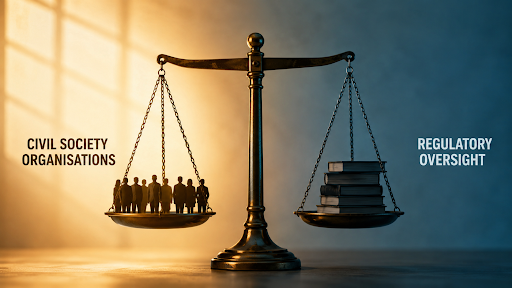
The FCRA (Amendment) Bill, 2026 aims to secure India's sovereignty through strict financial tracking, but its extreme asset-seizure powers risk crippling the physical infrastructure and operational survival of the nation's vital civil society sector.
Source: THEHINDU
|
PRACTICE QUESTION Q. "Effective regulation of foreign contributions must balance national security, financial transparency and the constitutional role of civil society in a democracy." Critically Analyze. 250 words |