Why In News?
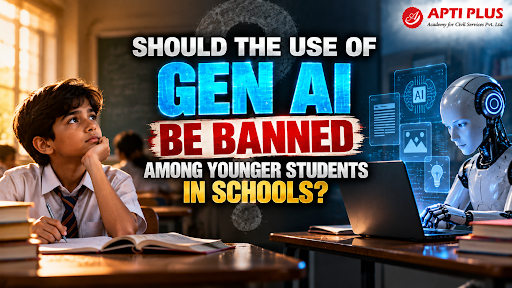
The debate over artificial intelligence in education has gained global urgency following New York City’s implementation of a one-year moratorium on student-facing generative AI tools for public school students through Class 8 (K–8) for the 2026–27 academic year.
What is Generative AI?
Autonomous Content Generation: Generative Artificial Intelligence (Gen AI) refers to advanced deep-learning models capable of creating new, original content—spanning text, imagery, synthetic voice, audio, and computer code—based on user prompts.
Natural Language Text Generation: Powered by Large Language Models (LLMs) trained on a massive corpora of text, enabling automated essay writing, summarization, creative storytelling, and dialogue.
Visual and Image Synthesis: Generates diagrams, illustrations, and realistic images from text descriptions, supporting visual storytelling and conceptual representation.
Computer Code Synthesis: Translates natural language instructions into functional programming scripts (Python, Scratch, HTML), lowering technical barriers for beginners.
Adaptive Personalized Learning: Operates as an interactive, conversational tutor capable of explaining complex academic concepts, generating customized quizzes, and adapting pace to individual learning levels.
What are the Benefits of Gen AI In Education?
Hyper-Personalized Learning Pathways: Customizes lessons according to each student's unique comprehension speed, breaking down difficult topics into accessible analogies.
Instant Formative Feedback: Provides immediate explanations and correction for homework exercises, helping students learn from errors without fear of judgment.
Individualized Remedial Support: Acts as an on-demand, patient tutor for slow learners and first-generation learners who lack academic support at home.
Multilingual and Language Translation Assistance: Bridges linguistic divides by translating learning materials into regional vernaculars and assisting non-native speakers with grammar and vocabulary.
Universal Accessibility Support: Empowers neurodivergent children and students with visual, auditory, or motor disabilities through text-to-speech, real-time captioning, and simplified reading interfaces.
Creative Brainstorming and Conceptual Ideation: Inspires students to outline stories, design interactive science projects, and visualize abstract historical or scientific phenomena.
Teacher Support and Lesson Plan Automation: Frees educators from administrative burdens by generating differentiated worksheets, rubric designs, and bilingual teaching aids.
What are the Major Risks?
Overdependence and Cognitive Atrophy: Routine reliance on generative shortcuts can cause mental passivity, reducing the brain's capacity for memory recall and prolonged concentration.
-
Case Study: Cognitive neuroimaging studies show that students who use automated writing tools exhibit lower neural connectivity in language formulation zones compared to those who draft manually.
Decline in Independent Thinking and Problem-Solving: Students bypass the cognitive struggle of structuring arguments, leading to superficial analytical capability.
Erosion of Academic Integrity: Widespread unauthorized use of AI-generated text for school assignments undermines authentic student evaluation and fair grading metrics.
Proliferation of AI Hallucinations and Misinformation: Generative models frequently fabricate historical dates, scientific facts, and citations with plausible-sounding authority, misleading young learners.
-
For example, a study of seven widely used AI detectors found that they wrongly flagged more than 61% of essays by non-native English speakers as AI-generated, while judging those written by native English speakers as almost entirely human-written. (Source: UNESCO)
Severe Privacy Violations and Data Harvesting: Commercial AI platforms collect, profile, and train their algorithms on children’s conversational inputs, questions, and behavioral patterns.
-
Case Study: Multiple international data protection watchdogs issued compliance notices to AI ed-tech providers for harvesting minors' voice recordings and browsing history without verifiable parental consent.
Exacerbation of the Digital Divide: Affluent students with paid subscriptions to advanced AI models gain an unfair academic edge over peers in under-resourced schools with limited digital access.

Why Should Gen AI Not Simply Be Banned?
AI Literacy is a Fundamental 21st-Century Competency: Outright bans risk producing digitally illiterate students unprepared to understand or critically evaluate the algorithms shaping society.
Future Workplace and Economic Preparedness: As AI becomes ubiquitous across professions, students must learn prompt formulation, algorithmic critique, and collaborative human-AI problem-solving.
Unenforceability of Blanket Bans: Students can easily bypass school network firewalls using personal mobile data, home devices, or third-party web proxies, turning bans into mere formalities.
Missed Opportunities for Differentiated Pedagogy: Complete prohibition deprives struggling and neurodivergent students of powerful assistive learning and accessibility tools.
Encouraging Clandestine and Unethical Use: Blanket bans stigmatize the technology, discouraging students from discussing algorithmic bias, errors, or ethical dilemmas openly with teachers.
Controlled Classroom Experimentation Builds Safeguards: Safe, supervised classroom sandboxes allow educators to teach prompt ethics, source verification, and digital hygiene firsthand.
What Should Schools Consider Before Allowing Gen AI?
Chronological and Developmental Age of Students: Implement age-tiered access (e.g., prohibition in primary school, supervised introduction in middle school, and critical use in secondary grades).
Clear Pedagogical Purpose: Mandate that AI tools be introduced only for specific learning outcomes (e.g., grammar comparison or brainstorming) rather than as a substitute for primary work.
Vetting of Safe, Closed-Garden AI Platforms: Restrict access to child-safe, ad-free educational AI models that do not retain student data or train on user inputs.
Direct and Active Teacher Supervision: Ensure that all AI engagement occurs within monitored classroom hours under explicit educator guidance.
Robust Student Data Privacy and Consent Protocols: Secure verifiable parental consent and ensure compliance with statutory child privacy mandates.
Redesigning Evaluation and Assessment Methods: Shift grading weight away from take-home text essays toward handwritten exams, oral vivas, classroom debates, and practical projects.
Baseline Student Digital Literacy: Train students on identifying hallucinations, bias, and source verification before granting tool access.
What are the Major Policy Challenges?
Lack of Clear, Statutory Age-Based Guidelines: Most national educational systems, including India’s, lack uniform statutory guidelines defining permissible ages and boundaries for AI tools in schools.
Rapid Pace of Technological Advancement: Fast-evolving multimodal models (voice, video, text) outpace the capacity of government curriculum bodies to draft relevant regulations.
Wide Digital Divide and Teacher Training Deficits: Millions of government school teachers lack training in artificial intelligence, leaving them unprepared to guide students or detect automated plagiarism.
Vulnerabilities in Children’s Data Protection: Regulatory gaps in enforcing child privacy frameworks leave minors exposed to corporate behavioral profiling.
Ingrained Algorithmic and Cultural Bias: Most commercial LLMs are trained on Western datasets, reflecting cultural biases and linguistic idioms misaligned with diverse developing societies.
Absence of Platform Accountability: Big Tech firms provide consumer-facing conversational bots without implementing age gates, parental consent verifications, or child-safety filters.
Way Forward
Formulating National Age-Calibrated Educational AI Policies: Formulate a national regulatory policy adopting UNESCO’s guidance to restrict unsupervised generative AI use for children below 13 years, while permitting structured, supervised engagement for secondary grades.
-
Example: UNESCO’s Global Guidance for Generative AI in Education and Research, recommending an age threshold of 13 years for independent AI interactions in schools.
Adopting the Mandatory "Teacher-in-the-Loop" Pedagogical Model: Ensure that AI is never deployed as an autonomous teacher replacement; every AI interaction must be mediated, verified, and directed by a certified educator.
Institutionalizing Comprehensive AI and Media Literacy Curricula: Introduce mandatory modules from Class 6 onward focusing on algorithmic ethics, digital footprint hygiene, data bias identification, and critical fact-checking.
-
Example: Australia’s National AI in Schools Framework, establishing pedagogical principles for ethical AI integration across all educational tiers.
Enforcing Strict Child Data Privacy Mandates: Strictly enforce the DPDP Act 2023, prohibiting behavioral tracking, targeted advertisements, and processing of children's personal data by AI ed-tech platforms without parental consent.
-
Example: European Union Artificial Intelligence Act (EU AI Act), classifying AI systems deployed in educational grading and minor profiling as high-risk technologies subject to strict audits.
Redesigning School Evaluation and Assessment Paradigms : Modernize examination frameworks by reducing reliance on take-home essays, prioritizing handwritten comprehension, in-class vivas, group discussions, and project-based assessments.
-
Example: International Baccalaureate (IB) AI Guidance Framework, permitting ethical AI co-use provided students explicitly cite prompts while assessing them through oral defense.
Bridging Digital and Teacher Capacity Gaps: Roll out nationwide continuous professional development modules to train government school teachers in AI tools, prompt engineering, and ethical classroom integration.
-
Example: NISHTHA (National Initiative for School Heads' and Teachers' Holistic Advancement) AI Module, training public school educators on digital pedagogy.
Balancing Algorithmic Capabilities with Human Values: Reinforce foundational human attributes that AI cannot replicate—empathy, ethical integrity, physical sports, public speaking, and community social service.
-
Example: Happiness Curriculum and Deshbhakti Curriculum Models (Delhi Government), prioritizing social-emotional learning and human values alongside modern digital literacy.
Conclusion
Generative AI in education is neither a panacea nor a tool for blanket prohibition. While New York City's moratorium addresses early cognitive and screen-dependence risks, the sustainable answer is an age-calibrated framework.
Source: THEHINDU
|
PRACTICE QUESTION Q. The integration of Generative AI into school education represents a double-edged sword, offering unprecedented personalization while risking the erosion of foundational cognitive and critical thinking skills among young learners. Analyze (15 Marks, 250 Words) |