Why In News?
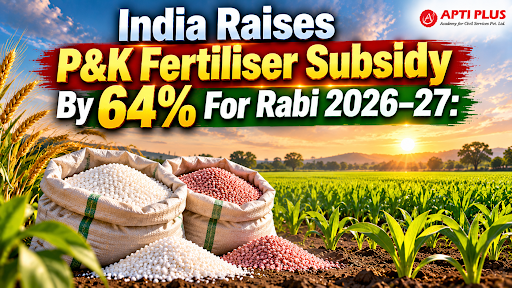
The Union Cabinet approved a ₹62,370.02 crore Nutrient Based Subsidy for P&K fertilisers for Rabi 2026–27—a 64.3% hike (₹24,417.73 crore) over last year—to offset surging global input costs and rising fertiliser expenses.
What Has The Cabinet Approved?
Key Features
|
Feature |
Details |
|
Outlay |
₹62,370.02 crore |
|
Coverage |
DAP (di-ammonium phosphate) and various NPKS grades |
|
Period |
1 October 2026 to 31 March 2027 |
|
DAP retail price |
Held at ₹1,350 per 50-kg bag through special support over and above NBS |
|
Announced by |
Union Minister Ashwini Vaishnaw after the Cabinet meeting |
Support For Raw Materials
-
Cost-Linked Support: Manufacturers will get support equal to 20% of the actual procurement cost of key inputs.
-
Floor Prices: This support is subject to floor prices of $800 per tonne for sulphur and $266.67 per tonne for sulphuric acid.
Government's Rationale
-
Global Price Link: NBS rates are revised in line with international prices of fertilisers and their inputs, such as DAP, MOP, phosphoric acid, ammonia and sulphur.
-
Shielding Farmers: The official statement said the increase seeks to keep farm input costs affordable amid volatile global prices.
Rabi Crop
-
Winter Crops: The rabi season covers wheat, mustard, gram, barley and lentils, which together are central to India's food and edible oil supply.
What Do Fertilisers Do For Crops?
Major Nutrients And Their Roles
|
Nutrient |
Main Role In Plants |
|
Nitrogen (N) |
Leaf and stem growth, green colour, protein formation |
|
Phosphorus (P) |
Root development, flowering, seed and grain formation |
|
Potassium (K) |
Water regulation, disease resistance, grain quality |
|
Sulphur (S) |
Oil content in oilseeds, protein synthesis |
- Micronutrients: Crops also need small amounts of zinc, boron, iron and manganese, deficiencies of which are widespread in Indian soils.
Common Fertilisers
|
Fertiliser |
Nutrient Content |
|
Urea |
About 46% nitrogen |
|
DAP |
18% nitrogen and 46% phosphorus (as P₂O₅) |
|
MOP (Muriate of Potash) |
About 60% potash (as K₂O) |
|
NPK complexes |
Varying combinations such as 10:26:26 and 20:20:0:13 |
How Has Fertiliser Policy Evolved?
|
Year |
Details |
|
1960s |
The Green Revolution made chemical fertilisers central to Indian farming |
|
1977 |
Retention Price Scheme (RPS), based on the Marathe Committee, guaranteed producers a fixed return on costs |
|
1992 |
P&K fertilisers decontrolled, while urea remained under price control |
|
2010 |
Nutrient Based Subsidy introduced for P&K from 1 April 2010 |
|
2015 |
New Urea Policy and gas pooling to bring uniform gas prices for urea plants |
|
2018 |
Direct Benefit Transfer (DBT) rolled out; urea bag size cut from 50 kg to 45 kg |
|
2021 |
Special DAP package after a global price spike |
2021 DAP Package: In May 2021, the Centre raised the DAP subsidy from ₹500 to ₹1,200 per bag, a 140% increase, to keep the retail price unchanged despite a sharp rise in global prices. It marked the start of the practice of special DAP support beyond normal NBS rates.
How Does The Subsidy System Work?
Two Separate Regimes
|
Aspect |
Urea |
P&K Fertilisers |
|
Price |
Statutorily fixed MRP of ₹242 per 45-kg bag |
Decontrolled; companies set MRPs under government guidance |
|
Subsidy design |
Covers the gap between cost and fixed MRP |
Fixed amount per kg of nutrient, revised every season |
|
Budget risk |
Rises with gas and import prices |
Rises with global P&K and raw material prices |
How NBS Rates Are Fixed?
-
Inter-Ministerial Process: An inter-ministerial committee, chaired by the Secretary, Department of Fertilizers, recommends NBS rates based on international prices, exchange rates and inventory levels.
-
Seasonal Revision: Rates are approved separately for kharif (April–September) and rabi (October–March).
Legal Framework
-
Fertiliser (Control) Order, 1985: Issued under the Essential Commodities Act, 1955, it regulates quality, sale and distribution of fertilisers.
-
Fertiliser (Movement Control) Order, 1973: Empowers the Centre to regulate movement of fertilisers across States.
Constitutional Context
-
State Subject, Central Subsidy: Agriculture is a State subject under Entry 14 of the State List, but fertiliser pricing, imports and subsidy are managed by the Centre.
-
Directive Principles: Article 48 asks the State to organise agriculture on modern and scientific lines.
Distribution And Tracking
-
Monthly Supply Plans: The Department of Fertilizers, with the Ministry of Agriculture, allocates supplies to States through monthly plans.
-
Digital Tracking: The Integrated Fertilizer Management System (iFMS) tracks fertilizer movement from factory or port to retailer.
-
Point-Of-Sale Payment: Under DBT, companies receive subsidy only after sales are recorded on Point of Sale (PoS) machines with Aadhaar-based authentication of buyers.
Why Is India So Exposed To Global Markets?
Import Dependence
-
Potash: India imports almost all its MOP, having no commercially producing reserves.
-
Phosphates: India relies heavily on imported rock phosphate, phosphoric acid and finished DAP.
-
Urea Feedstock: Domestic urea plants run largely on imported liquefied natural gas (LNG).
Concentrated Global Supply
-
Few Exporters: Global potash and phosphate exports are dominated by a small group of countries, including Canada, Russia, Belarus, Morocco, China and Saudi Arabia.
Recent Global Shocks
-
Russia–Ukraine War (2022): Sanctions on Russia and Belarus, both major potash exporters, sent prices soaring.
-
Chinese Export Curbs: China has restricted phosphate fertiliser exports since 2021 to protect domestic supply.
-
West Asia Tensions (2026): Conflict and shipping disruptions around the Strait of Hormuz have raised costs of gas, ammonia and sulphur, much of which comes from the Gulf.
India's Scale
-
Among The Largest Consumers: India is one of the world's biggest consumers and importers of fertilisers, so its buying decisions themselves influence global prices.
How Does The Subsidy Affect Public Finances And The Economy?
Budget Overshoot
-
Budget Estimate: The Union Budget 2026–27 set aside about ₹1.7 lakh crore for fertiliser subsidy.
-
Likely Outcome: CareEdge Ratings expects the total to reach ₹2.5–2.7 lakh crore.
Pressure On The Fiscal Deficit
-
Slippage Risk: Higher fertiliser and fuel subsidies are among the main reasons analysts expect the fiscal deficit to exceed the 4.3% of GDP target this year.
External Account
-
Import Bill: Costlier imports widen the trade deficit.
-
Currency Loop: A weaker rupee makes imports dearer, which in turn raises the subsidy, creating a cycle.
Opportunity Cost
-
Competing Needs: Money spent on input subsidies is not available for irrigation, storage, research or rural roads, which may yield higher long-term returns.
Benefit To Inflation Control
-
Stable Food Prices: By keeping input costs steady, the subsidy helps prevent a jump in production costs that could feed into food inflation.
How Increasing Fertiliser Use Affects Soil, Water And Climate?
Nutrient Imbalance
-
Skewed Ratio: The recommended N:P:K ratio for Indian soils is broadly 4:2:1, but actual use is heavily tilted towards nitrogen.
-
Regional Hotspots: The imbalance is sharpest in intensively farmed Punjab and Haryana.
Low Nutrient-Use Efficiency
-
Wasted Fertiliser: Only about 30–50% of applied nitrogen is typically absorbed by crops; the rest is lost to air and water.
Soil Degradation
-
Falling Fertility: Long-term imbalanced use lowers soil organic carbon and depletes micronutrients.
-
Degraded Land: ISRO's Desertification and Land Degradation Atlas (2021) found nearly 30% of India's land area under degradation.
Water Pollution And Health
-
Nitrates In Groundwater: The Central Ground Water Board's latest groundwater quality report found nitrate above safe limits in about 440 districts.
-
Health Risk: High nitrate levels in drinking water can cause methaemoglobinaemia ("blue baby syndrome") in infants.
-
Algal Blooms: Fertiliser runoff into lakes and rivers causes eutrophication, choking aquatic life.
Climate Impact
-
Nitrous Oxide: Excess nitrogen releases nitrous oxide, a greenhouse gas nearly 300 times more potent than carbon dioxide over a century.
How Does The Subsidy Affect Farmers And States?
Small And Marginal Farmers
-
Majority Of Holdings: About 86% of India's operational holdings are small and marginal, according to the Agriculture Census 2015–16, so affordable inputs are crucial for them.
-
Tenant Farmers: Tenants and sharecroppers often lack formal records, limiting their access to subsidised inputs and advice.
Regional Inequality
-
Uneven Benefits: Fertiliser use per hectare is far higher in irrigated north-western States than in rain-fed and north-eastern regions, so the subsidy benefits some regions much more than others.
Centre–State Friction
-
Allocation Disputes: During shortages, States often complain about inadequate supplies, especially at sowing time.
Women Farmers
-
Limited Access: Women farmers, who are often not recorded as landowners, face barriers in accessing inputs, credit and extension advice.
Fairness To Future Generations
-
Hidden Costs Passed On: Subsidies that encourage degradation of soil and water shift the burden onto future generations of farmers.
Initiatives Taken By Government
-
Soil Health Card Scheme (2015): Gives farmers soil test-based cards recommending the right nutrient doses for their fields.
-
Neem-Coated Urea (2015): All urea is neem-coated to curb its diversion to industry and slow nitrogen release in soil.
-
One Nation One Fertiliser And PM Kisan Samriddhi Kendras (2022): Introduced a single "Bharat" brand for subsidised fertilisers and converted retail outlets into one-stop centres for inputs, soil testing and advice.
-
PM-PRANAM (2023): Rewards States that reduce chemical fertiliser use by giving them 50% of the subsidy saved.
-
Nano Fertilisers: Nano urea (2021) and nano DAP (2023) were launched to reduce bulk fertiliser use and imports.
-
National Mission On Natural Farming (2024): Approved with an outlay of about ₹2,481 crore to promote chemical-free farming among 1 crore farmers.
Important Committees And Reports
|
What Are The Key Challenges?
Open-Ended Fiscal Liability
-
Government Absorbs Shocks: Because retail prices are held steady while global costs swing, nearly the entire price shock falls on the Budget.
-
Frequent Top-Ups: Fertiliser subsidy often needs extra funds through supplementary demands for grants in Parliament.
Distorted Price Signals
-
Frozen Urea Price: Urea's farm-gate price has barely changed for over a decade while P&K prices have risen, deepening the nitrogen bias.
-
Weak Potash Incentive: The very low potash rate this season may further discourage balanced use of potassium.
Supply Disruptions At Sowing Time
-
Shortages When Needed Most: Global disruptions can delay imports during peak demand.
-
Example: During the 2024 rabi season, several States reported DAP shortages and long queues at sale points as imports fell short.
Leakages, Diversion And Smuggling
-
Industrial Diversion: Subsidised urea has been diverted to make plywood, resins and adhesives, and even to adulterate milk.
-
Cross-Border Smuggling: Cheap Indian urea has been smuggled to Nepal and Bangladesh, where prices are higher.
Environmental Costs Not Priced In
-
Uncounted Damage: Harm to soil, groundwater and climate is not reflected in fertiliser prices, so overuse continues unchecked.
Uncertainty Over Alternatives
-
Debate On Effectiveness: Field results of some newer products, such as nano fertilisers, remain debated, while organic inputs are bulky and slow-acting.
-
Low Farmer Confidence: Many farmers hesitate to cut chemical use for fear of lower yields.
Risk Of Abrupt Policy Shifts
-
Danger Of Sudden Bans: Rapid cuts in chemical inputs can damage food security.
-
Example: Sri Lanka's abrupt 2021 ban on chemical fertilisers led to sharp falls in rice and tea output, contributing to an economic and food crisis.
What Is The Way Forward?
Reform Pricing Step By Step
-
Bring Urea Into A Nutrient-Based System: Gradually move urea into a per-nutrient subsidy framework so all nutrients are priced consistently.
-
Use Price Bands: Link subsidies to transparent global price bands, making costs more predictable for farmers and the Budget.
Shift Towards Direct Support
-
Per-Hectare Transfers: Pilot direct cash support to farmers per hectare, allowing free choice of inputs and reducing diversion.
Secure Supply At Home And Abroad
-
Domestic Minerals: Speed up exploration and auction of potash deposits in Rajasthan and of rock phosphate reserves.
-
Overseas Partnerships: Expand long-term supply contracts and joint ventures in countries such as Morocco, Saudi Arabia, Jordan and Senegal.
-
Green Ammonia: Link fertiliser production with the National Green Hydrogen Mission, using green ammonia to cut dependence on imported gas.
-
Strategic Buffer Stocks: Build reserve stocks of DAP and MOP to cushion supply shocks during sowing seasons.
Adopt Precision Farming
-
Targeted Application: Use drones, sensors and fertigation (supplying fertilisers through drip irrigation) to apply nutrients only where needed.
-
Example: Israel uses fertigation widely, achieving high yields with far less water and fertilizer than conventional methods.
Diversify Cropping
-
Beyond Paddy–Wheat: Encourage pulses, oilseeds and millets, which need less fertilizer and water, particularly in the north-west.
Set National Reduction Goals
-
Learn From Others: Clear targets backed by farmer support can cut chemical use without hurting yields.
-
Example: China's 2015 plan for zero growth in fertiliser use by 2020 met its goal through better advisory services, while the EU's Farm to Fork Strategy aims to cut fertiliser use by 20% by 2030.
Strengthen Enforcement And Research
-
Data-Driven Vigilance: Use analytics on DBT sales to spot unusual purchases and act against diversion and smuggling.
-
Customised Fertilisers: Fund ICAR research on region-specific, micronutrient-fortified fertilisers matched to local soil deficiencies.
-
Extension Services: Strengthen Krishi Vigyan Kendras to train farmers in balanced nutrient management.
Conclusion
The 64% rise in the rabi P&K subsidy reflects the government's commitment to keeping fertilisers affordable during a period of global turbulence. Yet it also exposes long-standing weaknesses: dependence on imports, an unpredictable fiscal burden, distorted prices, leakages and steady harm to soil, water and climate.
Protecting farmers today must be matched with reforms for tomorrow, through gradual pricing reform, direct support, secure supplies, precision farming, crop diversification and a careful, science-led move towards balanced and sustainable nutrient use.
Source: HINDUSTANTIMES
|
PRACTICE QUESTION Q. "India's fertiliser subsidy regime has kept food production high but at a growing cost to soil, water and public finances." Critically examine this statement and suggest a reform roadmap. (15 Marks, 250 Words) |