Why In News?
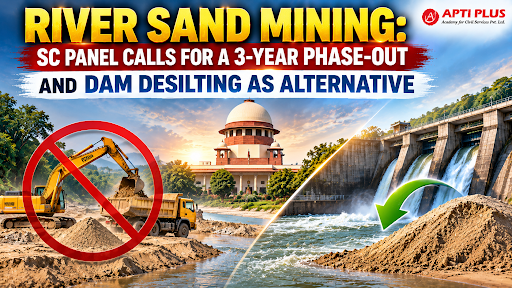
The Supreme Court-appointed Central Empowered Committee (CEC) has recommended phasing out "unsustainable" sand extraction from active river channels.
What Are The CEC Recommendations?
Phasing Out River Sand Mining
-
Three-Year Roadmap: A time-bound roadmap to progressively phase out unsustainable extraction from active river channels over three years.
-
Alternatives First: The phase-out must go alongside developing adequate alternative sources, so that legitimate construction needs are still met.
-
Three Alternatives: Reservoir sediment, M-sand (Manufactured Sand), and recycled construction and demolition (C&D) waste.
A National Dam Desilting Programme
-
Desilting Contracts: Award contracts for eligible desilting works within three years, followed by a structured 10-year desiltation cycle for suitable reservoirs.
-
Assessment Of Old Dams: Assess all storage dams over 15 years old that have never been systematically desilted. About one-tenth of suitable reservoirs would be desilted each year.
-
Not Every Dam: The cycle "should not be construed as a mandate for desiltation of every dam".
-
Transparent Sale: Recovered sand would be sold through transparent mechanisms.
-
Lead Ministry: The Ministry of Jal Shakti should prepare a national framework, covering reservoir-wise sediment availability, recoverable quantities, processing, timelines, financing and environmental safeguards, in consultation with the Central Water Commission (CWC), National Dam Safety Authority (NDSA), MoEFCC and States.
Digital Monitoring And Traceability
-
Electronic Transit Permits: Secure e-transit permits with unique QR codes, barcodes or RFID (Radio Frequency Identification) identification to track sand movement.
-
State Monitoring Systems: State mining departments must set up digital systems tracking permissions, quantities permitted, actual extraction, transit permits and end-use.
Honest About Data Gaps
-
Unknown Reservoir Potential: The CEC admitted that the potential of reservoir sediment as construction sand "has not been adequately assessed at the national level".
-
Not All Sediment Is Usable: Total accumulated sediment "cannot be equated with the quantity that is technically recoverable, environmentally permissible or commercially usable".
-
No Illegal Mining Estimate: There is "no consolidated, reliable national database" on the volume or value of illegally mined river sand.
What Is Sand Mining?
Meaning
-
Sand Mining: The extraction of sand from riverbeds, floodplains, coasts and dunes, mainly for construction.
-
Why River Sand: River sand is prized because water naturally sorts and rounds its grains, making it ideal for concrete and mortar. Desert sand is usually too smooth and fine for this use.
A Global Resource Under Pressure
-
Second Most Used Resource: After water, sand and gravel are the most extracted materials on Earth.
-
Massive Extraction: The UN Environment Programme estimates that 40–50 billion tonnes of sand and gravel are extracted globally every year.
-
Faster Than Nature: Extraction far exceeds the rate at which rivers naturally replenish sand.
India's Demand
-
Construction Boom: Rapid urbanisation and infrastructure projects, such as highways, metros and housing under PMAY, drive huge sand demand.
-
Scale: The Ministry of Mines' Sand Mining Framework (2018) estimated India's sand demand at about 700 million tonnes a year, growing at around 6–7% annually.
What Is The Legal Framework For Sand Mining?
Constitutional Position
-
State Subject: Entry 23 of the State List covers mines and minerals, subject to Union regulation under Entry 54 of the Union List.
-
Water Too: Water is also a State subject under Entry 17.
Laws And Rules
-
Minor Mineral: Sand is a "minor mineral" under Section 3(e) of the Mines and Minerals (Development and Regulation) Act, 1957.
-
State Rules: Under Section 15 of the MMDR Act, States frame rules for granting leases and regulating minor minerals.
-
Environmental Clearance: Sand mining requires environmental clearance under the EIA Notification, 2006, amended in 2016 to create District Environment Impact Assessment Authorities (DEIAAs) and require District Survey Reports.
National Guidelines
|
Guideline |
Year |
Key Feature |
|
Sustainable Sand Mining Management Guidelines |
2016 |
Scientific planning, replenishment studies, mining limits |
|
Sand Mining Framework |
2018 |
Demand–supply assessment, alternatives such as M-sand |
|
Enforcement and Monitoring Guidelines for Sand Mining |
2020 |
Drone surveys, night-mining bans, online tracking |
Key Judicial Interventions
-
Deepak Kumar vs State of Haryana (2012): The Supreme Court required environmental clearance even for minor mineral leases below 5 hectares, closing a loophole used to fragment leases.
-
NGT Order (2013): The National Green Tribunal barred sand mining across India without environmental clearance.
-
Public Trust Doctrine: In M.C. Mehta vs Kamal Nath (1997), the Supreme Court held that the State holds natural resources such as rivers in trust for the public.
What Are The Impacts Of Sand Mining?
Damage To Rivers
-
Riverbed Lowering: Excessive mining deepens riverbeds, changing water flow and causing bank erosion.
-
Falling Groundwater: Sand acts as a natural aquifer. Removing it reduces groundwater recharge and lowers water tables in nearby wells.
-
Changed River Courses: Rivers may shift course, damaging farmland and settlements.
Threats To Biodiversity
-
Habitat Loss: Sandbanks are nesting and basking sites for many species.
-
Example: The National Chambal Sanctuary, spread across Madhya Pradesh, Rajasthan and Uttar Pradesh, is a key habitat for the critically endangered gharial, which nests on sandbanks. Illegal sand mining directly threatens these nesting sites, which is why the Supreme Court took up the case.
-
Other Species: Sand mining also harms freshwater turtles, the Gangetic dolphin and fish breeding grounds.
Coastal And Delta Effects
-
Coastal Erosion: Reduced sediment flow to the sea causes coastal erosion and shrinking deltas.
-
Example: In the Mekong Delta in Vietnam, large-scale sand extraction has been linked to riverbank collapse, saltwater intrusion and land loss, affecting millions of people.
Infrastructure Damage
-
Undermined Bridges: Lower riverbeds can expose and weaken bridge foundations, embankments and water intake structures.
The "Sand Mafia"
-
Organised Crime: Illegal sand mining is often run by powerful networks with political links.
-
Violence: Officials and journalists who confront illegal mining have faced attacks.
-
Example: In 2012, IPS officer Narendra Kumar was killed in Morena, Madhya Pradesh, near the Chambal region, while trying to stop a tractor carrying illegally mined stone, highlighting the danger faced by enforcement officials.
Revenue Loss
-
Lost Royalties: Illegal mining deprives States of royalty and tax revenue, though no reliable national estimate exists, as the CEC noted.
Livelihood Impacts
-
Farmers And Fishers: Falling water tables and eroded banks hurt farmers, while habitat loss affects fishing communities.
Why Is Reservoir Sedimentation A Problem?
Scale Of Sedimentation
-
Lost Storage: Of 439 reservoirs assessed, gross storage lost to sedimentation averaged 19.24%, according to the Ministry of Jal Shakti in December 2025.
-
Severe Cases: 23 reservoirs had lost more than half their capacity.
-
Example: Gobind Sagar, the reservoir behind the Bhakra dam, has shrunk from 9,868 million cubic metres (MCM) to about 7,300 MCM, a loss of about 26%.
-
Many Dams: India's 2025 national register lists 6,628 specified dams.
Challenges
-
Less Water And Power: Sedimentation reduces water for irrigation, drinking and hydropower.
-
Flood Risk: Reduced storage limits a dam's ability to absorb floods.
-
Dam Safety: Sediment build-up can affect dam operations and safety.
Desilting As A "Dual Purpose" Solution
-
Two Benefits: The CEC argues desilting would restore reservoir storage and supply part of the construction sand demand.
-
Indian Precedent: Using river and reservoir silt for infrastructure has already been tried.
-
Example: Under the "Buldhana pattern" in Maharashtra, silt excavated from water bodies was used for highway construction, deepening water bodies while supplying material. In November 2026, a similar Nadi Sanjivani agreement in Bihar planned to use over 1,000 lakh cubic metres of river silt for national highway projects.
What Are The Alternatives To River Sand?
Manufactured Sand (M-Sand)
-
What It Is: M-sand is produced by crushing and processing suitable rock.
-
Standards: When it meets BIS (Bureau of Indian Standards) specifications, such as IS 383:2016, it can replace river sand in concrete.
-
State Policies: Tamil Nadu has adopted an M-sand policy to promote its use and reduce pressure on rivers.
Recycled Construction And Demolition Waste
-
Recycling Rubble: Crushed C&D waste can be processed into aggregates and sand substitutes.
-
Rules: The C&D Waste Management Rules, 2016, now updated through newer environment rules on construction and demolition waste, encourage recycling and use of recycled materials.
Reservoir And River Sediment
-
Desilted Material: Sediment from reservoirs and silted rivers can be processed into usable sand, though suitability varies.
Other Options
-
Fly Ash And Slag: Industrial by-products like fly ash and steel slag can partly replace sand in some uses.
-
Imported Sand: Some States have explored importing sand, though costs and logistics are high.
What Are The Key Challenges?
Lack Of Reliable Data
-
Unknown Reserves: The CEC admitted that India does not know how much usable sand its reservoirs hold.
-
No Illegal Mining Estimate: There is no reliable national database on the scale of illegal mining, making it hard to design and measure policy.
-
Weak Replenishment Studies: Many District Survey Reports are of poor quality and do not accurately assess how much sand rivers replenish each year.
Demand–Supply Gap
-
Growing Demand: India's sand demand, estimated at about 700 million tonnes a year in 2018 and growing 6–7% annually, keeps rising with infrastructure growth.
-
Risk Of Shortages: A phase-out without enough alternatives could cause shortages and price spikes, fuelling illegal mining, as happened in Rajasthan, where legal supply fell from 57 million to 5 million tonnes.
Technical And Economic Hurdles In Desilting
-
Unsuitable Sediment: Much reservoir sediment is fine silt and clay, not construction-grade sand, and needs costly processing.
-
High Costs: Dredging, transport and processing can be expensive, especially for remote dams.
-
Environmental Risks: Desilting can disturb downstream ecosystems and water quality if done carelessly.
-
Example: Internationally, Japan uses sediment bypass tunnels at dams such as Miwa to route sediment past reservoirs, showing that sediment management needs careful engineering rather than simple dredging.
Weak Enforcement And The Sand Mafia
-
Poor Monitoring: Mining often continues at night, beyond lease limits or in banned areas.
-
Collusion: Links between illegal miners, officials and politicians weaken enforcement.
-
Danger To Officials: Enforcement staff face violence, as the 2012 killing of IPS officer Narendra Kumar in Morena showed.
Federal Complexity
-
State Subject: Sand and water are State subjects, so a national framework requires close Centre–State cooperation.
-
Uneven State Capacity: States differ widely in their monitoring capacity and political will.
Quality And Acceptance Of Alternatives
-
M-Sand Quality: Poorly made M-sand with excess fine dust can weaken concrete.
-
Builder Reluctance: Many builders and engineers still prefer river sand out of habit or distrust.
-
Low C&D Recycling: Only a small share of India's construction and demolition waste is currently recycled.
Ecological Costs Of Alternatives
-
Quarrying Impacts: M-sand requires rock quarrying, which has its own environmental costs, such as dust, noise and hill destruction.
-
Energy Use: Crushing and processing consume energy and add to emissions.
What Is The Way Forward?
Build A Reliable National Sand Database
-
Scientific Assessment: Map river sand replenishment, reservoir sediment and alternative sources at district and national levels.
-
Improve District Survey Reports: Strengthen DSRs with satellite data and field studies, as required under the 2016 and 2020 guidelines.
-
Track Illegal Mining: Create a national database on illegal extraction, using enforcement records and remote sensing.
Phase Out River Mining Gradually
-
Alternatives First: Scale up alternatives before reducing river mining, to avoid shortages, as the CEC emphasised.
-
Protect Sensitive Areas: Prioritise bans in ecologically sensitive stretches, such as the National Chambal Sanctuary and other wildlife habitats.
Implement A Scientific Desilting Programme
-
National Framework: Have the Ministry of Jal Shakti prepare the reservoir-wise framework recommended by the CEC, with the Central Water Commission (CWC) and the National Dam Safety Authority (NDSA).
-
Pilot Projects: Start with pilot desilting projects to test costs, sediment quality and environmental impacts.
-
Link With Dam Safety Programmes: Integrate desilting with the Dam Safety Act, 2021 and the Dam Rehabilitation and Improvement Project (DRIP).
-
Learn From Indian Models: Scale up approaches like the Buldhana pattern and Bihar's Nadi Sanjivani plan, which use silt for highway construction.
Promote M-Sand And Recycled Materials
-
Standards And Certification: Strictly enforce BIS standards for M-sand quality.
-
Government Procurement: Mandate minimum use of M-sand and recycled C&D materials in public works.
-
Recycling Infrastructure: Set up C&D waste recycling plants in all major cities.
Use Technology For Monitoring
-
Digital Tracking: Implement the CEC's recommended e-transit permits with QR codes or RFID.
-
Remote Surveillance: Use drones, satellite imagery and GPS tracking of vehicles, building on the Mining Surveillance System used for major minerals.
-
Learn From State Models: Telangana's online Sand Sale Management and Monitoring System sells sand through a transparent digital platform, reducing middlemen and illegal sales.
Strengthen Enforcement And Accountability
-
Special Task Forces: Set up district-level task forces with police, mining and revenue officials.
-
Protect Officials And Whistle-Blowers: Provide security to enforcement staff and protect informants.
-
Stricter Penalties: Impose heavy fines and confiscate vehicles used in illegal mining.
Learn From Global Practices
-
Strategic Resource Approach: Treat sand as a strategic resource, as recommended by UNEP's 2022 report on sand and sustainability.
-
Circular Construction: Promote building designs that use less sand, such as precast and lightweight materials.
-
Avoid Delta Damage: The Mekong Delta experience shows the cost of unchecked river mining, reinforcing the need for limits based on natural replenishment.
Conclusion
The CEC's call to phase out unsustainable river sand mining and desilt dams requires reliable data, alternatives like M-sand, and strong digital monitoring to balance construction needs with river protection.
Source: INDIANEXPRESS
|
PRACTICE QUESTION Q. Banning sand mining without alternatives only fuels illegal mining. Examine. (10 Marks, 150 Words) |