Why In News?
As of 2026, PM-JUGA is being implemented across 63,843 villages in 549 districts and 2,911 blocks, covering 30 States/UTs and 5+ crore tribal people.
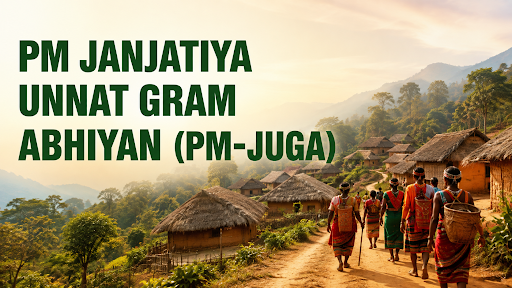
What Is Pradhan Mantri Janjatiya Unnat Gram Abhiyan (PM-JUGA)?
It is also known as Dharti Aaba Janjatiya Gram Utkarsh Abhiyan, is a Centrally Sponsored Scheme designed to achieve saturation coverage of essential services, social infrastructure, and livelihood opportunities across tribal-majority villages and aspirational districts in India.
The Prime Minister launched the Abhiyan on 2 October 2024 at Hazaribag, Jharkhand, with implementation planned up to 31 March 2029.
Nodal Ministry: The Ministry of Tribal Affairs coordinates the mission, while 17 line ministries implement their respective interventions.
Core Approach: It uses convergence + saturation + gap-based planning, rather than creating an entirely new scheme for every tribal development need.
Major Objectives
-
Infrastructure: Close gaps in housing, roads, electricity, drinking water and telecommunications through convergence with existing schemes.
-
Health: Improve access through mobile medical units, health facilities, nutrition and Anganwadi services, especially in remote tribal settlements.
-
Education: Expand hostels and educational infrastructure, reducing distance and access barriers for tribal students.
-
Livelihoods: Promote skills, entrepreneurship, agriculture, animal husbandry, fisheries, Van Dhan and tribal marketing to strengthen household incomes.
-
Digital Inclusion: Improve telecommunication and digital connectivity so tribal villages can access education, banking, markets and government services.
Which Villages Are Covered?
-
Village Criteria: Tribal-majority villages generally include those with 500+ population and at least 50% ST population, while specified Aspirational Blocks include villages with at least 50 tribal persons.
-
Data-Based Selection: Village gaps are identified using Mission Antyodaya 2022–23 data alongside Census 2011, enabling targeted infrastructure planning.
Key Interventions
-
Housing: PM-JUGA targets 20 lakh pucca houses through PMAY-Gramin, directly addressing the housing gap in tribal-majority villages.
-
Roads: The programme targets 25,000 km of rural roads, improving market, school, healthcare and administrative connectivity.
-
Water: Jal Jeevan Mission interventions aim at Functional Household Tap Connections, alongside community water points for smaller hamlets.
-
Electricity: The mission targets unelectrified households and public institutions through RDSS, including approximately 2.35 lakh connections.
-
Education: Tribal hostels provide residential support where distance and remoteness restrict school access.
-
Livelihood: Van Dhan Vikas Kendras, Tribal Multipurpose Marketing Centres and skills support aim to convert forest and local resources into sustainable income opportunities.
-
Tourism: Tribal homestays can connect local culture and natural landscapes with tourism markets while creating community-level income opportunities.
Strategic Significance
-
Shift to Saturation: Moves tribal welfare from piecemeal allocations to 100% "saturation coverage" of basic amenities in 63,000 target villages.
-
Whole-of-Government Approach: Converges 17 line ministries under one umbrella, breaking administrative silos.
-
Scaling the PM-JANMAN Model: PM-JUGA builds upon the operational learnings and targeted successes of the PM-JANMAN (Pradhan Mantri Janjati Adivasi Nyaya Maha Abhiyan) scheme, which explicitly catered to Particularly Vulnerable Tribal Groups (PVTGs).
-
Security & LWE Mitigation: Targets 549 districts, many overlapping with Left-Wing Extremism affected zones, reducing geographic alienation through roads, telecom, and healthcare.
-
Economic Formalisation: Transitions forest dwellers from subsistence to commercial value-chains by supporting FRA patta holders and creating Tribal Homestays.
-
Human Capital Boost: Tackles low Gross Enrolment Ratios (GER) and high dropouts via dedicated tribal hostels, alongside deploying 1,000 Mobile Medical Units.
-
Cooperative Federalism: Enforces a strict cost-sharing formula (₹56,333 cr Centre / ₹22,823 cr State) that mandates tight federal-state coordination.
Source: PIB
|
PRACTICE QUESTION Q. Consider the following statements with reference to the Pradhan Mantri Janjatiya Unnat Gram Abhiyan (PM-JUGA):
Which of the statements given above is/are correct? A) 1 only B) 1 and 3 only C) 2 and 3 only D) 1, 2 and 3 Answer: B) 1 and 3 only Explanation: Statement 1 is correct: The Pradhan Mantri Janjatiya Unnat Gram Abhiyan (PM-JUGA) is a Centrally Sponsored Scheme explicitly designed to adopt a saturation approach. It aims to cover basic social infrastructure, health, education, and livelihood gaps for tribal families residing in tribal-majority villages and Aspirational Districts. Statement 2 is incorrect: The scheme has a total financial outlay of ₹79,156 crore, where the Central Share is ₹56,333 crore and the State Share is ₹22,823 crore. It is not funded exclusively by a single pool or administered solely by the Ministry of Tribal Affairs; instead, it relies on a cost-sharing architecture between the Centre and the States. Statement 3 is correct: PM-JUGA functions through a multi-sectoral, whole-of-government convergence mechanism. It features 25 targeted interventions executed collaboratively by 17 line ministries/departments. Each ministry utilizes funds systematically earmarked under the Development Action Plan for Scheduled Tribes (DAPST) over a 5-year timeline. |