Why In News?
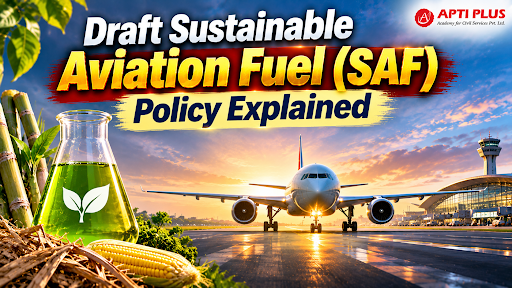
The Ministry of Civil Aviation has circulated a draft National Policy on Sustainable Aviation Fuel (SAF), with plans to open it for public consultation within one to two weeks.
What Is The Draft Sustainable Aviation Fuel Policy?
Meaning Of SAF: Sustainable Aviation Fuel is a drop-in fuel made from sources such as used cooking oil, agricultural residue and sugarcane products. It cuts lifecycle emissions compared with fossil jet fuel.
Phase One: The draft National Policy on Sustainable Aviation Fuels proposes a phased blending mandate with fiscal incentives, financing support and a regulatory framework to encourage domestic production. The first phase of 2027–2030 would raise the requirement from 1% to 5%.
Phase Two: The second phase of 2031–2040 would progressively raise the mandate to 40%.
Domestic Production Only: Only indigenously manufactured SAF would qualify for blending with Aviation Turbine Fuel (ATF).
Volume Estimate: At projected 2030 consumption, a 5% blend would mean about 710,000 tonnes of SAF a year, if the mandate is calculated by fuel mass.
Investment And Incentives: The draft proposes tax incentives and an investment need estimated at $70 to 85 billion.
Initial Scope: The mandate applies first to international flights.
Joint Policy Making: The Ministry of Petroleum and Natural Gas and the Ministry of Civil Aviation steer the policy jointly.
|
Sustainable Aviation Fuel (SAF)
|
Why Does SAF Matter For India?
CORSIA Deadline: The mandatory phase of the Carbon Offsetting and Reduction Scheme for International Aviation (CORSIA) begins on 1 January 2027. Airlines flying abroad must offset emissions above baseline or use eligible fuels.
Net Zero Goal: The policy aligns with international emission standards and India's net-zero target of 2070.
Export Opportunity: The policy aims to position India as a future supplier of SAF to international markets.
Farm Link: Sugarcane syrup, molasses and bagasse are possible feedstocks for SAF. This links aviation with farm incomes and India's ethanol programme.
Feasibility Study: The Ministry released a SAF feasibility study with the International Civil Aviation Organization and support from the European Union.
What Are The Key Challenges?
High Cost Of SAF
-
Price Premium: SAF costs more than fossil jet fuel, and the domestic-only rule could add to airline costs unless local production becomes competitive.
-
Thin Airline Margins: Indian carriers operate on narrow margins, and fuel is a large share of cost. A mandate may raise fares on international routes.
Feedstock And Production Limits
-
Supply Gap: Challenges include cost, classification and feedstock availability. India lacks commercial-scale SAF plants.
-
Feedstock Competition: Sugarcane, used cooking oil and agricultural residue are also needed for ethanol, food and other uses.
Large Investment Need
-
Financing Requirement: The draft estimates an investment need of $70 to 85 billion. Refiners and start-ups need long-term credit.
-
Uncertain Returns: Without assured offtake and price support, investors may hesitate.
Regulatory Transition Risks
-
Compliance Burden: The Niyam's 220 rules apply from 1 January 2027, and smaller operators and flying schools need time to adjust.
-
Pending Directions: The Directorate General of Civil Aviation will issue detailed Civil Aviation Requirements. Draft requirements and comment windows must be monitored.
Passenger Protection And Fare Concerns
-
Fares Remain Free: Airlines still set their own domestic fares, and the Supreme Court petition on fares and ancillary charges shows persistent concern.
-
Limited Remedies: Government intervention must be proportionate and time-bound. This limits quick action in sudden fare spikes.
Certification And Global Alignment
-
Standards Gap: Lifecycle accounting and certification are still being built. International buyers will accept only fuel that meets verified sustainability criteria.
-
Competing Regimes: The European Union and other regions have their own SAF mandates. Indian exporters must meet several standards.
What Is The Way Forward?
Make SAF Cost-Competitive
-
Incentives: Offer capital subsidies, tax relief and viability support for early plants. Share the cost among airlines, oil companies and the government.
-
Pooled Procurement: Let oil marketing companies buy SAF in bulk and blend it centrally. This lowers handling costs.
Secure Feedstock
-
Used Cooking Oil Collection: Build collection networks for used cooking oil and agricultural residue. Link with the existing biofuel programme.
-
Diverse Pathways: Support ethanol-to-jet, power-to-liquid and waste-based routes along with oil-based pathways.
Mobilise Long-Term Finance
-
Blended Finance: Use development banks, green bonds and viability gap funding. Provide assured offtake contracts to lenders.
-
Pilot Plants: Back demonstration plants at refineries before scaling up.
Ease The Rule Transition
-
Handholding: Issue clear guidance and model procedures before 1 January 2027. Offer extended timelines to small operators.
-
Stakeholder Consultation: Use comment windows for draft requirements and publish responses.
Strengthen Passenger Safeguards
-
Pricing Transparency: Enforce price disclosure and clear ancillary charge rules. Set a fast grievance system for passengers.
-
Predictable Interventions: Define clearly when time-bound intervention can occur in extreme fare surges.
Build Certification And Export Readiness
-
Lifecycle Accounting: Complete national rules for carbon intensity and sustainability certification. Align them with CORSIA requirements.
-
Trade Partnerships: Sign supply agreements with foreign airlines and fuel buyers. Position India as a supplier to Europe and Asia.
Conclusion
The draft SAF policy can cut aviation emissions and meet CORSIA, but its success depends on cost, feedstock and finance.
Source: PIB
|
PRACTICE QUESTION Q. Consider the following statements regarding Sustainable Aviation Fuel (SAF):
Which of the statements given above is/are correct? (a) 1 and 2 only (b) 1 and 3 only (c) 2 and 3 only (d) 1, 2 and 3 Answer: (b) Explanation Statement 1 is correct: SAF works as a "drop-in" fuel in existing aircraft engines and fueling infrastructure without requiring major modifications. Statement 2 is incorrect: While SAF shares similar properties with conventional jet fuel, standard certification limits generally cap blending with traditional Aviation Turbine Fuel (ATF) up to 50% (depending on the production pathway), rather than 100%. Statement 3 is correct: SAF can substantially cut lifecycle greenhouse gas emissions compared to fossil jet fuel—often by up to around 80%—depending on the feedstock and production pathway used. |