Why In News?
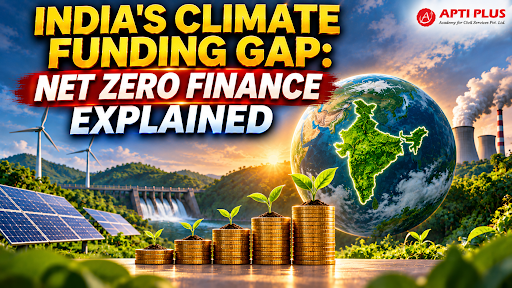
A report by Australian economist Nicki Hutley, titled India's Net Zero Transition is the World's Net Zero Transition, estimates that India faces a $6.5 trillion funding gap to reach net zero by 2070.
What Are The Key Findings?
The Financing Arithmetic
|
Indicator |
Estimate |
|
Total investment needed by 2070 |
$22.7 trillion (cumulative) |
|
Share for the energy sector |
About half |
|
Finance available with reforms |
About $16.2 trillion |
|
Funding gap |
About $6.5 trillion |
|
Share domestic sources can meet |
Just over 70% of total need |
|
Minimum share of gap needing international capital |
40% |
- Based On NITI Aayog: The figures draw on NITI Aayog's report Scenarios Towards Viksit Bharat and Net Zero.
The Nearer-Term Gap
-
By 2050: India's total financing needs are estimated at $8.05 trillion, against $5.56 trillion in available finance.
Capacity Versus Generation
-
Installed Capacity: Non-fossil sources made up 54.2% of India's installed electricity capacity by June 2026.
-
Actual Generation: Renewable energy's share of actual electricity generation was only about one-quarter, showing the need to invest in grids and storage, not just new capacity.
Adaptation Burden
-
Self-Funded Resilience: India funds about 98% of its adaptation needs from domestic sources, showing how little international finance reaches climate resilience.
What Is Climate Finance?
-
Definition: Climate finance refers to money spent on reducing emissions (mitigation) and coping with climate impacts (adaptation).
-
Sources: Public budgets, private investment, development banks and international transfers.
Global Commitments
-
UNFCCC Principle: The UNFCCC (1992) states that developed countries should provide financial support to developing countries for climate action.
-
The $100 Billion Promise: Developed countries pledged $100 billion a year by 2020, but met it only in 2022, by which time it was seen as far below actual needs.
-
New Collective Quantified Goal: At COP29 (Baku, 2024), countries agreed on at least $300 billion a year by 2035, with a broader aim of $1.3 trillion a year from all sources.
What Are India's Climate Commitments?
India’s climate commitments are structured around its Nationally Determined Contributions (NDCs) under the Paris Agreement, guided by the principles of Common but Differentiated Responsibilities and Respective Capabilities (CBDR-RC) and climate justice.
Panchamrit Targets (Announced at COP26, 2021)
At the Glasgow COP26 summit, India laid out five ambitious near-term goals for 2030, known as Panchamrit:
-
500 GW Non-Fossil Energy Capacity: Reach 500 GW of non-fossil fuel electricity capacity by 2030.
-
50% Renewable Energy Share: Meet 50% of the cumulative electric power installed capacity from non-fossil/renewable sources by 2030.
-
Carbon Emission Reduction: Reduce total projected carbon emissions by 1 billion tonnes between now and 2030.
-
Emissions Intensity: Lower the carbon intensity of the economy (emissions intensity of GDP) by 45% by 2030, compared to 2005 levels (upgraded from the original 33–35% target).
-
Net-Zero Goal: Achieve Net-Zero emissions by 2070.
Updated First NDC (2022 Cabinet / UNFCCC Submission)
India formally updated its first NDC to the UNFCCC, incorporating the Panchamrit promises and adding a focus on sustainable living:
-
LiFE (Lifestyle for Environment) Movement: Promoting a mass movement for mindful and deliberate utilization of resources rather than destructive consumption.
-
Forest Carbon Sink: Creating an additional carbon sink of 2.5 to 3 billion tonnes of CO₂-equivalent through additional forest and tree cover by 2030.
-
Sectoral Adaptation: Enhancing resilience in vulnerable sectors such as agriculture, water, health, Himalayan and coastal ecosystems, and disaster management.
Second NDC / 2035 Climate Goals (Submitted in 2026)
India submitted its updated 2035 Nationally Determined Contribution extending its framework into the next decade:
-
Non-Fossil Capacity Target: Raised to 60% of total installed electric power capacity by 2035.
-
Emissions Intensity Reduction: Increased to 47% relative to 2005 GDP levels by 2035.
-
Carbon Sink Expansion: Scaled up the target to 3.5 to 4 billion tonnes of CO₂ equivalent.
Key Institutional and Policy Pillars
-
National Action Plan on Climate Change (NAPCC): Features core missions covering solar energy, enhanced energy efficiency, sustainable habitat, water, and Himalayan ecosystems.
-
Global Alliances Co-founded by India:
-
International Solar Alliance (ISA)
-
Coalition for Disaster Resilient Infrastructure (CDRI)
-
Leadership Group for Industry Transition (LeadIT) (co-led with Sweden)
What Are The Key Challenges?
Inadequate International Climate Finance
-
Broken Promises: Despite decades of talks, the report notes that commitments from both public and private sources remain well below required levels.
-
Too Little For Adaptation: The UNEP Adaptation Gap Report estimates developing countries need hundreds of billions of dollars a year for adaptation, far above actual flows.
High Cost Of Capital
-
Expensive Borrowing: Clean energy projects in India face much higher financing costs than in developed countries because of perceived country and currency risks, making projects costlier.
-
Currency Risk: Foreign investors worry about rupee depreciation, which reduces returns.
Shallow Green Finance Markets
-
Limited Instruments: India's market for green bonds and long-term infrastructure finance is still small.
-
Example: India issued its first Sovereign Green Bonds in 2023, but the premium investors were willing to pay (the "greenium") remained small, limiting cost savings.
Grid And Storage Bottlenecks
-
Capacity Not Translating Into Power: With renewables supplying only about a quarter of generation despite majority capacity, India needs heavy investment in transmission and storage.
Lack Of Clear Green Definitions
-
Greenwashing Risk: Without a clear climate finance taxonomy, investors cannot easily tell which projects are truly green.
Hard-To-Abate Sectors
-
Costly Decarbonisation: Sectors like steel, cement and fertilisers need expensive new technologies such as green hydrogen.
Fiscal Constraints
-
Limited Public Money: The government must balance climate spending with development, welfare and debt reduction goals.
What Is The Way Forward?
Mobilise International Capital
-
Deliver On NCQG: Push developed countries at COP31 to deliver on the $300 billion goal and the $1.3 trillion roadmap.
-
Country Platforms: Use structured partnerships that pool donor and private money.
-
Example: South Africa's Just Energy Transition Partnership (2021), backed by about $8.5 billion from developed countries, and Indonesia's $20 billion partnership in 2022, show how international finance can support coal transitions.
Reform Multilateral Development Banks
-
Bigger, Cheaper Lending: Implement the G20 Independent Expert Group recommendation, co-chaired by N.K. Singh and Lawrence Summers under India's 2023 G20 Presidency, to triple multilateral development bank lending.
Lower The Cost Of Capital
-
Risk-Sharing Tools: Use blended finance, credit guarantees and currency hedging facilities to reduce investor risk.
-
Deepen Bond Markets: Strengthen corporate bond markets for long-term green infrastructure funding.
Build A Clear Green Taxonomy
-
Finalise Definitions: Finalise India's Climate Finance Taxonomy, released in draft form by the Ministry of Finance in 2025, to guide investors and prevent greenwashing.
-
Better Disclosures: Strengthen climate risk disclosures under SEBI's BRSR framework and RBI's climate risk guidelines.
Invest In Grids And Storage
-
Round-The-Clock Clean Power: Prioritise transmission lines, battery storage and pumped hydro so that renewable capacity translates into clean electricity.
Use Carbon Markets
-
Domestic Market: Fully operationalise the Carbon Credit Trading Scheme to raise funds and reward emission cuts.
-
International Markets: Use Article 6 of the Paris Agreement to attract investment through high-quality carbon credits.
Prioritise Adaptation Finance
-
Fund Resilience: Seek greater international support for adaptation, as India currently funds nearly all of it domestically.
Conclusion
India's net-zero journey needs about $22.7 trillion by 2070, and even with ambitious domestic reforms, a $6.5 trillion gap remains. Closing it will require developed countries to honour their climate finance promises, reforms to development banks, lower capital costs, a clear green taxonomy and investment in grids and storage.
Source: BUSINESS-STANDARD
|
PRACTICE QUESTION Q. Consider the following statements: Statement-I: Non-fossil sources made up more than half of India's installed electricity capacity by June 2026. Statement-II: Renewable energy supplied more than half of India's actual electricity generation by June 2026. Which one of the following is correct in respect of the above statements? (a) Both Statement-I and Statement-II are correct and Statement-II explains Statement-I (b) Both Statement-I and Statement-II are correct, but Statement-II does not explain Statement-I (c) Statement-I is correct, but Statement-II is incorrect (d) Statement-I is incorrect, but Statement-II is correct Answer: (c) Explanation: Statement-I is Correct: Non-fossil sources made up 54.2% of installed capacity by June 2026. Statement-II is Incorrect: Renewables supplied only about one-quarter of actual generation, because solar and wind produce power for fewer hours than coal plants. |