Why In News?
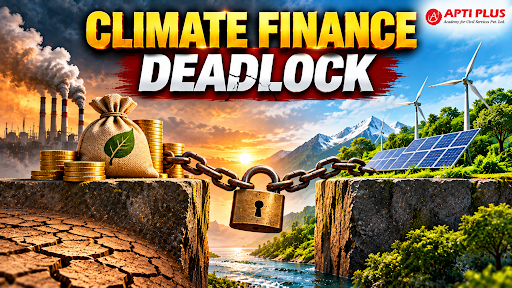
At COP31 in Antalya, Türkiye (9–20 November 2026), developing countries led by the G77/China, backed by India, again pressed developed nations to deliver on finance obligations under Article 9.1 of the Paris Agreement, reviving a dispute seen at almost every recent climate summit.
What Is The Dispute At COP31?
Competing Positions
|
Group |
Position |
|
G77/China, BASIC, India |
The Climate Finance Work Programme must focus on Article 9.1: developed countries' obligation to provide finance |
|
African Group, AILAC |
Seek operationalisation of Article 9.1 and standard methods to count finance |
|
AOSIS / LDCs |
Want predictable, grant-based finance, easier access and tripled adaptation finance |
|
EU |
Says the scope is Article 9 as a whole, including a broader contributor base, enabling environments and private finance |
Leaders And Roles
-
COP31 President: Türkiye's environment minister urged delivery on the $300 billion goal.
-
Shared Arrangement: Australia leads the negotiations under a hosting deal with Türkiye.
-
UNFCCC Chief: Simon Stiell said full delivery of existing pledges is key and that the Baku to Belém Roadmap is essential to reach $1.3 trillion a year by 2035.
How Did Climate Finance Commitments Evolve?
|
Year |
Milestone |
|
1992 |
UNFCCC listed rich countries in Annex II with a duty to provide finance |
|
2009 |
Copenhagen (COP15): pledge of $100 billion a year by 2020 |
|
2010 |
Cancún (COP16): Green Climate Fund set up |
|
2015 |
Paris Agreement: Article 9.1 obligation on developed countries |
|
2022 |
$100 billion goal met for the first time, two years late, at $115.9 billion |
|
2022–23 |
Loss and Damage Fund agreed at COP27 and operationalised at COP28 |
|
2024 |
Baku (COP29): New Collective Quantified Goal (NCQG) of $300 billion a year by 2035, with a wider $1.3 trillion aim |
|
2025 |
Belém (COP30): pledge to triple adaptation finance, and the Baku to Belém Roadmap report |
Key Paris Agreement Provisions
|
Article |
Content |
|
9.1 |
Developed countries shall provide financial resources to developing countries |
|
9.2 |
Other parties are encouraged to contribute voluntarily |
|
9.3 |
Developed countries should lead in mobilising finance from various sources |
|
2.1(c) |
Making all finance flows consistent with low-emission, climate-resilient development |
Why Does The Same Dispute Keep Returning?
No Agreed Definition Of Climate Finance
-
Counting Disputes: Developed countries count loans, private finance and even non-concessional lending, while developing countries say only grants and concessional money should count.
-
Inflated Figures: Oxfam's 2023 Climate Finance Shadow Report estimated that the true value of the $83.3 billion reported for 2020 was only about $21–24.5 billion after accounting for loan repayments and interest.
"Provided" Versus "Mobilised" Finance
-
Blurred Lines: The NCQG combines public provision, private mobilisation and alignment of financial flows, so obligations under Article 9.1 get diluted.
-
Article 2.1(c) Tension: Developing countries fear rich nations use Article 2.1(c) to shift attention from their own finance duties.
Contributor Base Fight
-
Who Should Pay: The EU wants richer developing countries, such as China and Gulf States, to contribute, while developing countries insist on common but differentiated responsibilities.
Voluntary Roadmaps
-
No New Money Mechanism: The Baku to Belém Roadmap creates no new financing mechanism and labels 2026–28 contributions non-binding and non-exhaustive.
-
Soft Deadlines: Developed countries are only urged to publish delivery plans by end-2026, with no consequences for failure.
Initiatives Taken By India For Mobilising Climate Finance And Shaping Global Climate Finance Negotiations
Sovereign Green Bonds
-
Launch: India issued its first Sovereign Green Bonds in January 2023, raising ₹16,000 crore in two tranches in 2022–23.
-
Use: Proceeds fund renewable energy, clean transport and climate adaptation projects.
Climate Finance Taxonomy
-
Draft Framework: The Ministry of Finance released a draft Climate Finance Taxonomy in May 2025 to define what counts as climate-aligned investment.
-
Purpose: Prevents greenwashing and helps attract credible global capital.
Carbon Credit Trading Scheme
-
Launch: Notified in 2023 under the Energy Conservation Act, 2001 (amended 2022).
-
Mechanism: Sets emission-intensity targets for energy-intensive industries, with tradable credits for overachievers.
International Solar Alliance
-
Founded: Launched by India and France at COP21 in 2015, headquartered in Gurugram.
-
Finance Role: Mobilises investment in solar projects in member countries, especially in Africa and small island states.
Coalition For Disaster Resilient Infrastructure
-
Founded: Launched by India in 2019 at the UN Climate Action Summit.
-
Adaptation Focus: Helps countries build resilient infrastructure, including through its Infrastructure for Resilient Island States initiative.
National Adaptation Fund For Climate Change
-
Launch: Set up in 2015 to fund State-level adaptation projects in vulnerable sectors such as agriculture and water.
Negotiating Leadership
-
Strong Positions: At COP29, India rejected the $300 billion goal as too small, calling it an "optical illusion", and has consistently backed the G77/China on Article 9.1.
What Are The Key Challenges In Resolving The Climate Finance Deadlock?
Scale Gap Between Needs And Pledges
-
Huge Needs: The Independent High-Level Expert Group on Climate Finance estimated that developing countries other than China need about $2.4 trillion a year by 2030, including about $1 trillion from external sources.
-
Small Pledge: The $300 billion NCQG covers only a fraction of this need.
-
Adaptation Shortfall: LDCs and island states say adaptation finance remains far below needs, despite the COP30 pledge to triple it.
Loans Instead Of Grants
-
Debt Trap Risk: OECD data show that around two-thirds of public climate finance from developed countries comes as loans, adding to the debt of poor countries.
-
Adaptation Unattractive To Private Investors: Adaptation projects, such as flood defences, rarely generate profits, so they need grants.
Geopolitical Retreat From Aid
-
US Withdrawal: The United States announced its withdrawal from the Paris Agreement in January 2025, removing the world's largest historical emitter from finance commitments.
-
Aid Cuts In Europe: Several European donors, such as the UK, have announced cuts to overseas aid budgets, squeezing climate finance.
Procedural Deadlock
-
Agenda Fights: Much negotiating time is spent on whether finance should even be on the agenda, as seen when the Article 9 item failed at COP31.
-
Consensus Rule: UNFCCC decisions need consensus, so a few parties can block outcomes.
Access Barriers
-
Complex Procedures: Small and poor countries struggle with lengthy application processes at funds such as the Green Climate Fund.
Trust Deficit
-
Broken Promises: The $100 billion goal was met only in 2022, two years late, eroding trust in new pledges.
Weak Accountability
-
No Enforcement: There are no penalties if developed countries fail to deliver, and no common method to verify contributions.
What Is The Way Forward For Breaking The Climate Finance Deadlock?
Agree On What Counts
-
Common Definition: Adopt a UNFCCC-wide definition of climate finance that separates grants, concessional loans and market-rate loans, and counts grant-equivalent value.
-
Use The Transparency Framework: Use Biennial Transparency Reports under the Enhanced Transparency Framework, first due in 2024, to track delivery consistently.
Make Article 9.1 Delivery Concrete
-
Binding Delivery Plans: Require developed countries to publish year-wise plans showing how they will reach $300 billion by 2035, as urged under the Roadmap.
-
Dedicated Agenda Space: Give Article 9.1 a regular agenda item at future COPs to end procedural fights.
Grants For Adaptation And Loss And Damage
-
Grant Priority: Fund adaptation and loss and damage mainly through grants, especially for LDCs and small islands.
Innovative Sources Of Finance
-
Global Levies: Explore levies on shipping, aviation and fossil fuel windfall profits, as proposed by the Global Solidarity Levies Task Force.
-
Debt-For-Climate Swaps: Expand swaps that cut debt in exchange for climate spending.
-
Example: In 2023, Ecuador completed a debt-for-nature swap worth about $1.6 billion to fund conservation of the Galápagos marine reserve.
Reform Multilateral Development Banks
-
More Concessional Lending: Stretch MDB balance sheets to provide cheaper, longer-term finance for climate projects in developing countries.
Build Trust Through South–South Cooperation
-
Developing-Country Platforms: Use platforms like the International Solar Alliance and CDRI to show that developing countries also contribute, easing the contributor-base debate.
Simplify Access
-
Direct Access: Expand direct access to climate funds for national institutions, reducing reliance on intermediaries.
Conclusion
The recurring COP climate finance deadlock stems from unresolved core issues: payer responsibilities, funding amounts, mechanisms, and accounting standards. Resolving this requires a unified finance definition, binding delivery commitments, grant-based adaptation support, new funding sources, and restored North-South trust.
Source: THEHINDU
|
PRACTICE QUESTION Q. Without credible climate finance, the Paris Agreement's goals will remain unattainable for developing countries. Examine this statement and suggest reforms to the global climate finance architecture. (15 Marks, 250 Words) |