Why In News?
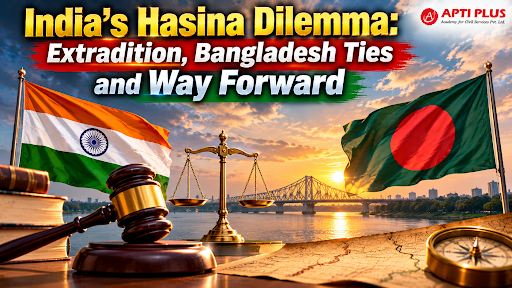
Experts argue that India must improve ties with Bangladesh's elected government while protecting Sheikh Hasina, who has lived in India since fleeing Dhaka in August 2024.
Background
|
Date |
Event |
|
July–August 2024 |
Student-led uprising; Hasina resigns and flies to India on 5 August 2024 |
|
February 2025 |
UN human rights office estimates up to 1,400 people killed during the protests |
|
December 2024 / November 2025 |
Interim government under Muhammad Yunus sends extradition requests to India |
|
17 November 2025 |
International Crimes Tribunal (ICT) sentences Hasina to death in absentia for crimes against humanity |
|
17 February 2026 |
Tarique Rahman of the BNP becomes Prime Minister after the February 2026 election |
|
9–10 November 2026 |
Passport request; Dhaka calls it "utterly ridiculous" and demands extradition |
Dhaka's Stand
-
Extradition Only: Home Minister said the government would act under the extradition treaty if Hasina wants to return.
-
No Ordinary Return: State Minister rejected her return as an ordinary traveller with a new passport.
-
Political Interference Concern: Critics in Bangladesh object to Hasina issuing political statements from Indian soil.
New Delhi's Stand
-
Measured Response: India has said it is "examining" the request and remains committed to peace, democracy, inclusion and stability in Bangladesh.
What Does The India–Bangladesh Extradition Treaty Say?
|
Provision |
Content |
|
Signed |
28 January 2013, during Hasina's own tenure |
|
Article 6(1) |
Extradition may be refused for offences of a political character |
|
Article 6(2) |
Murder, incitement to murder and related offences are not treated as political offences |
|
Article 8 |
Refusal possible if the request is not in good faith or would be unjust or oppressive |
|
2016 Amendment |
Amended Article 10(3) so an arrest warrant from a competent court suffices, without full evidence |
- Indian Procedure: Under the Extradition Act, 1962, a magistrate holds an inquiry, and the Centre retains discretion to refuse surrender.
-
Possible Indian Defence: India could argue that the trial lacked credibility and the verdict was politically motivated, especially given the death penalty and trial in absentia.
Asylum Context
-
No Refugee Law: India is not a party to the 1951 Refugee Convention and has no national asylum law; protection is granted case by case.
-
Precedents: India has long hosted political exiles, such as the Dalai Lama since 1959 and Bangladeshi writer Taslima Nasrin, despite diplomatic costs.
Why Is Bangladesh Important For India?
|
Area |
Significance |
|
Border |
India's longest land border, about 4,096 km, touching West Bengal, Assam, Meghalaya, Tripura and Mizoram |
|
Northeast Access |
Bangladesh surrounds the narrow Siliguri Corridor, critical to links with the Northeast |
|
Trade |
India's largest trading partner in South Asia, with trade of about $12 billion |
|
Water |
54 shared rivers, including the Ganga and Teesta |
|
Security |
Past cooperation helped dismantle northeastern insurgent bases in Bangladesh |

Initiatives Taken For Strengthening India–Bangladesh Relations
-
Land Boundary Agreement, 2015: Implemented through the 100th Constitutional Amendment, settling the boundary and exchanging 162 enclaves.
-
Ganga Water Treaty, 1996: A 30-year treaty on sharing Ganga waters at Farakka, set to expire in December 2026.
-
Lines Of Credit: India extended about $8 billion in concessional credit for roads, railways, ports and power.
-
Akhaura–Agartala Rail Link (2023): Connects Tripura with Bangladesh's rail network, cutting travel time to Kolkata.
-
India–Bangladesh Friendship Pipeline (2023): Carries diesel from Siliguri to Parbatipur, India's first cross-border energy pipeline with Bangladesh.
-
Maitree Super Thermal Power Project: A 1,320 MW joint venture plant at Rampal, Bangladesh.
What Are The Challenges In Balancing The Hasina Question With India–Bangladesh Ties?
Legal–Political Trap Over Extradition
-
Treaty Pressure: Since murder-related offences are excluded from the political exception under Article 6(2), Dhaka argues India has little legal basis to refuse.
-
Death Penalty Concern: Handing over a person facing execution after a trial in absentia raises human rights questions under Indian and international norms.
-
Precedent Risk: Refusing could undermine India's own extradition requests to neighbours for fugitives and terror suspects.
Anti-India Sentiment In Bangladesh
-
Perception Of Bias: Many Bangladeshis see India as having backed Hasina's government through three disputed elections (2014, 2018 and 2024).
-
Hasina's Statements: Her political remarks from India feed Dhaka's view that India is enabling interference.
Trade And Transit Frictions
-
Tit-For-Tat Measures: India withdrew the transshipment facility for Bangladeshi exports via Indian ports in April 2025, and in May 2025 restricted entry of Bangladeshi readymade garments to only two sea ports.
-
Northeast Remarks: Then Chief Adviser Yunus described India's Northeast as "landlocked" during a visit to China in March 2025, alarming New Delhi.
Water Disputes
-
Ganga Treaty Renewal: With the treaty expiring in December 2026, a deal must be negotiated amid strained ties.
-
Teesta Stalemate: A Teesta water-sharing agreement, ready since 2011, remains unsigned due to West Bengal's objections, while China has offered to fund a Teesta river project.
Growing China And Pakistan Influence
-
Strategic Competition: Dhaka has expanded engagement with China in infrastructure and defence, and restored warmer ties with Pakistan, including direct trade links.
Minority Security And Border Issues
-
Attacks On Minorities: Bangladesh's Hindu Buddhist Christian Unity Council reported over 2,000 incidents of attacks on minorities in the weeks after August 2024.
-
Border Tensions: Disputes over border fencing, cross-border killings and push-backs of alleged undocumented migrants strain relations.
Pending Energy Disputes
-
Power Dues: Delays in Bangladesh's payments to Indian power suppliers, such as Adani Power's Godda plant in Jharkhand, have caused friction over supply.
Way Forward For Repairing India–Bangladesh Ties
Separate The Hasina Issue From The Relationship
-
Ring-Fence The Case: Treat the extradition request as a legal process under the Extradition Act, 1962, and keep it apart from trade, water and security cooperation.
-
Restrain Political Activity: Ensure Hasina does not use Indian territory for political campaigns against the elected government, a key demand from Dhaka.
Engage The Elected Government Fully
-
High-Level Visits: Invite Prime Minister Tarique Rahman and resume regular Joint Consultative Commission meetings.
-
Engage All Parties: Broaden contacts beyond any single party to correct the perception of bias.
Renew Water Agreements
-
Ganga Treaty 2.0: Negotiate a renewed Ganga treaty before the December 2026 expiry, with better data-sharing on lean-season flows.
-
Teesta Deal: Build consensus with West Bengal for a Teesta agreement, possibly with Indian funding for river management.
Restore Trade And Connectivity
-
Reverse Restrictions: Restore transshipment and land-port access in exchange for Bangladesh easing non-tariff barriers.
-
Revive CEPA Talks: Resume talks on a Comprehensive Economic Partnership Agreement and operationalise the BBIN Motor Vehicles Agreement (2015).
Manage The Border Humanely
-
Non-Lethal Policy: Strictly follow agreed non-lethal border management to cut cross-border deaths.
-
Joint Patrols: Expand coordinated patrols by the BSF and Border Guard Bangladesh.
Rebuild People-To-People Trust
-
Ease Visas: Restore full visa services for medical, education and tourism travel, as Bangladeshis are among the largest groups of medical tourists to India.
-
Scholarships And Culture: Expand scholarships and cultural exchanges through ICCR.
Cooperate On Shared Threats
-
Security Dialogue: Continue counter-terrorism and anti-smuggling cooperation, which helped curb insurgent groups in the past.
-
Rohingya Crisis: Work jointly on the crisis of over 10 lakh Rohingya refugees in Cox's Bazar.
Conclusion
India faces a difficult choice between loyalty to a long-standing ally and the need to rebuild ties with Bangladesh's elected government. Handing Hasina to face a death sentence raises legal and human rights concerns, while sheltering her without restraint risks alienating a crucial neighbour.
The way forward is to handle the extradition request through due legal process, prevent political activity from Indian soil, and focus on water, trade, connectivity and people-to-people ties, so that one person's fate does not define India's relationship with 17 crore Bangladeshis.
Source: THEHINDU
|
PRACTICE QUESTION Q. India's Bangladesh policy must move from being person-centric to people-centric. Discuss with reference to recent developments, and suggest measures to rebuild bilateral ties. (15 Marks, 250 Words) |