Why In News?
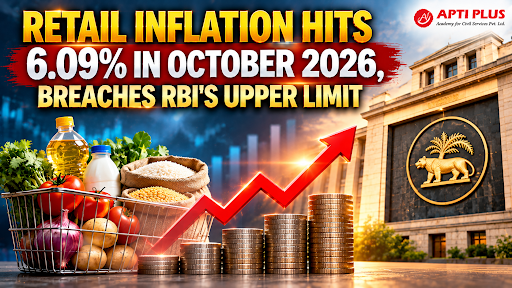
India's retail inflation rose to 6.09% in October 2026, crossing the Reserve Bank of India's (RBI) upper tolerance limit of 6% for the first time under the new Consumer Price Index (CPI) series.
How Inflation Moved Through 2026?
Monthly Trend (CPI Base 2024 = 100)
|
Month (2026) |
Headline CPI |
Food (CFPI) |
Rural CPI |
Urban CPI |
|
June |
4.38% |
5.32% |
4.74% |
3.93% |
|
July |
4.45% |
5.52% |
4.84% |
3.96% |
|
August |
4.83% |
5.97% |
5.24% |
4.31% |
|
September |
5.54% |
7.74% |
6.08% |
4.88% |
|
October |
6.09% |
— |
— |
— |
-
Rural Burden: Rural food inflation (8.06%) ran ahead of urban food inflation (7.18%) in September, showing that villages are bearing more of the price rise.
-
Wholesale Pipeline: Wholesale Price Index (WPI) inflation was about 9.9% in August 2026, signalling cost pressures that can pass on to retail prices.
What Is Driving The Price Rise?
Food Prices Turning Broad-Based
-
Entrenched Items: Bank of Baroda noted that inflation in edible oils, tomatoes and pulses has become entrenched since July 2026.
-
Onion Spike: September saw sharp increases in onion and other vegetable prices.
Unfavourable Base Effect
-
Record-Low Comparison: CPI inflation fell to just 0.25% in October 2025, with food prices in deflation at –5.02%, helped by GST rate cuts and low vegetable prices. The year-on-year jump now looks larger against that base.
External Shocks
-
Energy Costs: West Asian tensions and disruptions around the Strait of Hormuz raised fuel and freight costs.
-
Weak Rupee: With the rupee near ₹96 per dollar, imports such as edible oils and fuel have become costlier.
Core Inflation Still Moderate
-
Contained Demand Pressure: Core inflation (excluding food and fuel) was expected at 4.6–4.8%, held down by companies absorbing input costs and softer gold prices.
What Is India's Inflation Targeting Framework?
|
Feature |
Details |
|
Legal basis |
Section 45ZA, RBI Act, 1934, inserted in 2016 |
|
Target |
4% CPI, band of 2–6%, set for five-year periods |
|
Origin |
Urjit Patel Committee (2014) chose CPI as the nominal anchor |
|
Decision body |
Six-member Monetary Policy Committee (MPC) |
|
Accountability |
If average inflation stays outside the band for three consecutive quarters, the RBI must explain reasons and remedies to the government under Section 45ZN |
|
First breach |
Triggered in November 2022 |
RBI's Recent Actions
-
Rate Hike: The MPC raised the repo rate by 25 bps to 5.50% in October 2026, the first hike since February 2023, and moved to "calibrated tightening".
-
Projection: It expects inflation of about 6% in October–December 2026 and 5.2% for 2026–27.
-
Next Review: The MPC meets on 2–4 December 2026.
Initiatives Taken By Government For Controlling Food Inflation
Price Stabilisation Fund (PSF)
-
Launch: Set up in 2014–15 under the Department of Agriculture and moved to the Department of Consumer Affairs in April 2016.
-
Mechanism: Funds procurement of onions, potatoes and pulses when prices are low, for release during shortages.
Bharat Brand Retail Sales
-
Launch: Bharat Dal (chana) at ₹60/kg (2023), Bharat Atta at ₹27.50/kg (November 2023) and Bharat Rice at ₹29/kg (February 2024).
-
Delivery: Sold through NAFED, NCCF and Kendriya Bhandar outlets and mobile vans.
-
Purpose: Puts low-priced staples directly before consumers, signalling markets to cool prices.
Open Market Sale Scheme
-
Mechanism: The Food Corporation of India auctions surplus wheat and rice from central stocks to bulk buyers such as flour mills.
-
Impact: Adds supply in lean months, cooling cereal and flour prices.
National Mission On Edible Oils–Oilseeds
-
Launch: Approved in October 2024 with an outlay of ₹10,103 crore for 2024–25 to 2030–31.
-
Target: Raise primary oilseed output from about 39 million tonnes to 69.7 million tonnes by 2030–31.
-
Relevance: Reduces exposure to global edible oil prices, a key inflation driver.
Mission For Aatmanirbharta In Pulses
-
Launch: Announced in the Union Budget 2025–26 as a six-year mission.
-
Assured Procurement: NAFED (National Agricultural Cooperative Marketing Federation of India Ltd.) and NCCF (National Cooperative Consumers' Federation of India Limited) to procure tur, urad and masoor from registered farmers for four years.
-
Goal: Cut pulse imports and stabilise dal prices.
Operation Greens
-
Launch: Announced in the Union Budget 2018–19 with ₹500 crore for tomato, onion and potato (TOP).
-
Expansion: Extended in 2021 to 22 perishable crops, with transport and storage subsidies.
Trade And Stock Measures
-
Duty Cuts: Basic customs duty on crude edible oils was cut from 20% to 10% in May 2025, with a further cut in late September 2026.
-
Stock Limits: Limits on traders' stocks of wheat and pulses under the Essential Commodities Act, 1955 curb hoarding.
PM Garib Kalyan Anna Yojana
-
Coverage: Free foodgrains to about 81 crore people, extended for five years from January 2024.
-
Relevance: Shields poor households from cereal price spikes.
What Are The Key Challenges In Keeping India's Inflation Within The RBI Target?
Weather Shocks To Food Supply
-
Heat And Rain Damage: 2024 was India's warmest year since 1901, and repeated heatwaves and erratic rain damage vegetables and pulses.
-
Past Pattern: In October 2024, vegetable inflation hit 42.18% after a late monsoon withdrawal damaged crops, pushing CPI to 6.21%.
Post-Harvest Losses And Weak Storage
-
Huge Wastage: A 2022 NABCONS study estimated post-harvest losses of about ₹1.53 lakh crore a year.
-
Perishables Most Exposed: Tomatoes and onions have short shelf lives, so small supply shocks cause large price swings.
Import Dependence For Essentials
-
Edible Oils: India imports over half of its edible oil needs, tying domestic prices to global markets.
-
Currency Pass-Through: The RBI estimates that a 5% rupee depreciation can raise inflation by about 35 bps.
Limits Of Monetary Policy
-
Supply-Side Problem: Interest rate hikes cannot raise vegetable output, and mainly slow demand.
-
Growth Trade-Off: The October hike came even as GDP grew 7.8% in Q1 FY27, showing the cost of fighting supply-driven inflation with monetary tools.
Policy Trade-Offs Hurting Farmers
-
Export Bans: Measures to protect consumers often hurt farmers, as seen when India banned onion exports in December 2023, depressing farm-gate prices.
-
Import Duty Cuts: Lower duties on edible oils ease consumer prices but reduce returns for domestic oilseed growers.
Fiscal Room Shrinking
-
Relief Costs: Earlier excise duty cuts on petrol and diesel cut collections from ₹1.38 lakh crore to ₹1.07 lakh crore in the first half of 2026–27, limiting further fiscal relief.
-
Rising Subsidies: Food and fertiliser subsidies are rising with prices, adding to fiscal strain.
Risk Of Second-Round Effects
-
Expectations Spiral: Persistent food inflation can lift household inflation expectations, feeding into wages and service prices.
-
Rural Squeeze: Higher rural inflation reduces real incomes in villages, weakening consumption demand.
What Is The Way Forward For Bringing India's Inflation Back Within The RBI Target?
Calibrated Monetary Policy
-
Look Through Base Effects: The MPC should separate temporary base and food effects from broader demand pressure before further hikes in December 2026.
-
Clear Guidance: Forward guidance can anchor expectations without excessive tightening.
-
Watch Core Inflation: Focus on core inflation, expected at 4.6–4.8%, as the main gauge of demand-driven pressure.
Smarter Buffer Stock Management
-
Early Release: Release pulse and onion buffers before prices peak, using price triggers.
-
Dynamic Buffer Sizes: Set buffer targets each season based on crop forecasts and import trends.
Cut Post-Harvest Losses
-
Cold Chain Expansion: Expand cold storage and processing under PM Kisan SAMPADA Yojana.
-
Innovation: Scale up ideas from the Tomato Grand Challenge (2023), launched by the Department of Consumer Affairs to find low-cost storage and processing solutions.
Strengthen Farmer-To-Market Links
-
Electronic Trading: Expand e-NAM, which links over 1,400 mandis, to improve price discovery.
-
Farmer Collectives: Use the 10,000 FPO scheme (2020) to help farmers store and sell directly, reducing middlemen margins.
Climate-Resilient Agriculture
-
Better Forecasts: Use Mission Mausam (2024), with an outlay of about ₹2,000 crore, to improve weather forecasts for sowing and harvest planning.
-
Resilient Seeds: Promote heat- and flood-tolerant varieties developed by ICAR.
-
Insurance: Widen Pradhan Mantri Fasal Bima Yojana (PMFBY) coverage so farmers can replant quickly after shocks.
Predictable Trade Policy
-
Rules-Based Approach: Replace sudden export bans with transparent, price-linked export duties that protect both consumers and farmers.
-
Diversify Import Sources: Sign long-term contracts for edible oils and pulses with multiple suppliers.
Reduce Energy-Linked Inflation
-
Ethanol And Renewables: Build on 20% ethanol blending, achieved in 2025, and expand electric mobility to reduce oil import exposure.
Conclusion
October's inflation reflects a mix of rising food prices, a very low base from 2025, higher energy costs and a weaker rupee. While the RBI's tightening can contain demand and expectations, most of the pressure is on the supply side. Lasting price stability requires better buffer management, lower post-harvest losses, climate-resilient farming, predictable trade policy and reduced import dependence, with monetary and fiscal policy working together.
Source: BUSINESS-STANDARD
|
PRACTICE QUESTION Q. "Food inflation in India is a supply-side problem that monetary policy alone cannot solve." Critically examine this statement and suggest measures for durable price stability. (15 Marks, 250 Words) |