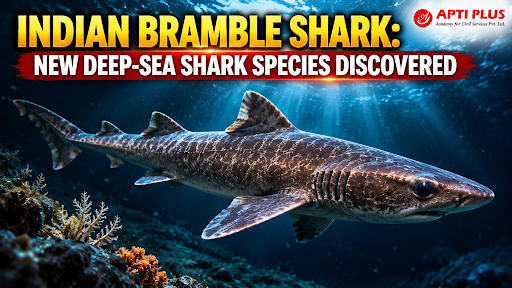
Why In News?
Scientists from the Zoological Survey of India (ZSI) and the ICAR-Central Marine Fisheries Research Institute (ICAR-CMFRI) identified a new species of deep-sea shark in the Indian Ocean named Echinorhinus roinee, commonly known as the Indian Bramble Shark.
About The Indian Bramble Shark
|
Feature |
Details |
|
Scientific name |
Echinorhinus roinee |
|
Common name |
Indian Bramble Shark |
|
Identified by |
ZSI and ICAR-CMFRI |
|
Published in |
Records of the Zoological Survey of India |
|
Specimen source |
Sakthikulangara Fishing Harbour, Kollam, Kerala, landed as bycatch by deep-sea shrimp trawlers |
|
Habitat |
Continental slope, at depths of about 350–450 m |
|
Size |
Up to about 3 m |
|
Possible range |
Genetic records suggest it may extend to waters off Oman, Sri Lanka and Thailand |
|
Research support |
Deep Ocean Mission |
Naming: The species name roinee is dedicated to Roinee, the daughter of ZSI Director and study co-author Dhriti Banerjee.
How It Differs From Related Species
|
Feature |
E. roinee Compared With Relatives |
|
Eyes |
Larger |
|
Pelvic fins |
Larger |
|
Snout-to-gill region |
Longer |
|
DNA |
Distinct from the Atlantic bramble shark (E. brucus) and the Pacific prickly shark (E. cookei) |
-
Genus Expanded: The genus Echinorhinus earlier had only two recognised species, E. brucus and E. cookei; E. roinee is the third.
-
Name Origin Of "Bramble": Bramble sharks are named for the large, thorn-like denticles scattered on their skin.
Source: PIB
|
PRACTICE QUESTION Q. Consider the following statements regarding the recently discovered ‘Indian Bramble Shark’ (Echinorhinus roinee):
Which of the statements given above are correct? A) 1 and 2 only B) 1 and 3 only C) 2 and 3 only D) 1, 2, and 3 Answer: B) 1 and 3 only Explanation: Statement 1 is correct: Echinorhinus roinee was identified by researchers from the Zoological Survey of India (ZSI) and ICAR-CMFRI from specimens landed as bycatch at Kollam, Kerala. Statement 2 is incorrect: It was historically misclassified as the Atlantic bramble shark (Echinorhinus brucus) rather than the Pacific prickly shark. Statement 3 is correct: The species features a dark body with thorn-like dermal denticles that fuse into multi-pointed plates with age. |