Why In News?
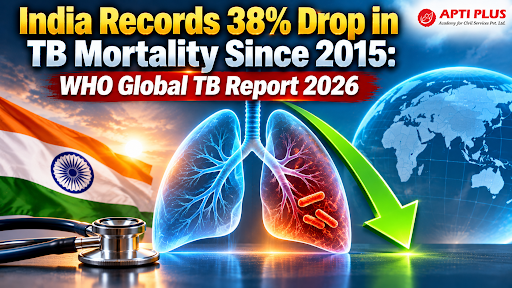
The WHO Global Tuberculosis Report 2026 shows India's estimated TB mortality fell by 38% between 2015 and 2025, faster than the 35% global decline.
What Are The Key Findings For India?
Mortality And Treatment
|
Indicator |
Figure |
|
TB mortality rate, 2015 |
28 per lakh population |
|
TB mortality rate, 2025 |
18 per lakh population |
|
Decline since 2015 |
38% (global: 35%) |
|
Treatment success (drug-susceptible TB) |
94% |
|
Share of global TB cases |
About 25% |
Better Mortality Estimation
-
New Data Sources: WHO combined the Registrar General's Sample Registration System (SRS), community verbal autopsy studies and Ni-kshay programme data to estimate deaths more accurately.
Incidence Under Review
-
No New Estimate: The 2026 report did not update India's incidence estimate. WHO will revise it in early 2027 after analysing district-level sentinel surveillance data with the Central TB Division and ICMR.
-
Previous Estimate: The 2025 report found India's incidence fell 21%, from 237 to 187 per lakh between 2015 and 2024, nearly twice the global decline of 12%.
Drug-Resistant TB
-
High Burden: India is among four countries that together accounted for more than half of global multidrug-resistant (MDR) TB cases in 2025, though MDR-TB incidence is gradually declining.
Asymptomatic Cases
-
Hidden Patients Found: Nearly 15 lakh asymptomatic TB cases were detected through active screening, people who would otherwise have gone undiagnosed.
What Are The Global TB Targets?
|
Framework |
Target |
|
SDG 3.3 |
End the TB epidemic by 2030 |
|
WHO End TB Strategy (2015) |
Cut TB deaths by 90% and incidence by 80% by 2030, compared with 2015 |
|
India's goal |
Eliminate TB ahead of the global deadline under the National Strategic Plan. |
- Gap To Target: A 38% fall in deaths over ten years is well short of the 90% cut WHO seeks by 2030.
|
About Tuberculosis (TB)
|
Initiatives Taken By Government For Eliminating Tuberculosis In India
National TB Elimination Programme (NTEP)
-
Renamed: The Revised National TB Control Programme was renamed NTEP in 2020, reflecting the shift from control to elimination.
-
Mandatory Notification: Private providers have been required to notify TB cases since 2012, bringing private-sector patients into the system.
Ni-kshay Poshan Yojana
-
Launch: Started in 2018 as direct benefit transfer of nutrition support to TB patients during treatment.
-
Enhanced Support: Raised from ₹500 to ₹1,000 per month in November 2024.
Pradhan Mantri TB Mukt Bharat Abhiyaan
-
Launch: September 2022, mobilising Ni-kshay Mitras (individuals, firms and NGOs) to adopt patients and provide food baskets.
-
Community Role: Adds social support to clinical care, helping patients complete treatment.
100-Day TB Mukt Bharat Abhiyan
-
Launch: December 2024, an intensive campaign for vulnerable groups.
-
Results: Screened over 19 crore people and detected 24.5 lakh TB patients, including 8.61 lakh asymptomatic cases.
New Drug Regimens
-
BPaLM: India approved the six-month BPaLM regimen (bedaquiline, pretomanid, linezolid, moxifloxacin) for MDR-TB in 2024, replacing treatment that could last up to two years.
Indigenous Rapid Diagnostics
-
TrueNat: India-made portable molecular test that detects TB and rifampicin resistance quickly, usable even at primary health centres.
-
Ni-kshay Portal: Tracks each patient digitally from diagnosis to treatment completion and benefit transfer.
What Are The Key Challenges In Achieving TB Elimination In India?
Still The World's Largest TB Burden
-
Quarter Of Cases: India accounts for about 25% of global TB, so even fast progress leaves a huge absolute burden.
-
Far From 2030 Goal: A 90% cut in deaths by 2030 would require mortality to fall to about 3 per lakh, from 18 today.
-
Leading Infectious Killer: TB remains the world's top infectious cause of death, with about 12 lakh deaths globally in 2024.
Drug-Resistant TB
-
Concentrated Burden: India is among four countries with over half of global MDR-TB, making resistant strains a long-term threat.
-
Costly Treatment: MDR-TB drugs are more expensive and toxic, and need close monitoring.
-
Treatment Gaps: Interrupted or incomplete treatment fuels further resistance.
Undernutrition As A Driver
-
Leading Risk Factor: WHO identifies undernutrition as the largest attributable risk factor for TB in India.
-
Evidence: The RATIONS trial (Jharkhand), published in The Lancet in 2023, found that food support to patients' households cut new TB cases among family members by about 39%.
Missing And Asymptomatic Cases
-
Silent Spread: The detection of 15 lakh asymptomatic cases shows that many infected people spread TB without knowing it.
-
Private Sector Gaps: Despite mandatory notification, under-reporting from private clinics and chemists continues.
Uncertain Incidence Data
-
Estimate Pending: With incidence estimates on hold until early 2027, it is harder to judge whether new infections are falling fast enough.
Rising Co-Morbidities
-
Diabetes Link: India's high burden of diabetes, along with smoking, alcohol use and HIV, raises the risk of active TB.
Financial Burden On Families
-
Hidden Costs: Even with free drugs, patients face costs for travel, tests and lost wages, pushing many families into debt.
What Is The Way Forward For Achieving TB Elimination In India?
Make Nutrition Central To TB Care
-
Household Food Support: Extend food support to household contacts, as shown effective in the RATIONS trial.
-
Timely Payments: Ensure Ni-kshay Poshan money reaches patients at the start of treatment.
Find Every Case Early
-
Active Screening: Make campaigns like the 100-day Abhiyan a routine, year-round effort in high-risk groups such as slums, prisons, miners and people with diabetes.
-
AI-Enabled Chest X-Rays: Use portable X-ray machines with AI reading in villages to catch asymptomatic TB.
Scale Up Rapid Diagnostics
-
Molecular Tests At Primary Health Centre (PHC): Place TrueNat machines at more primary health centres so patients are diagnosed and tested for resistance in one visit.
Tackle Drug Resistance
-
Universal BPaLM Access: Ensure all eligible MDR-TB patients get the shorter BPaLM regimen.
-
Universal Resistance Testing: Test every new patient for drug resistance at diagnosis.
Engage The Private Sector
-
Public–Private Support Agencies: Expand partnerships that help private doctors notify cases and access free drugs, reducing under-reporting.
Invest In Vaccines And Research
-
New Vaccines: Support trials of new TB vaccines for adults, as the BCG vaccine mainly protects children.
-
Global Collaboration: Join global vaccine efforts, such as WHO's TB Vaccine Accelerator Council, launched in 2023.
Address Social Determinants
-
Housing And Air: Improve ventilation, housing and clean cooking to reduce TB transmission in crowded homes.
-
Reduce Stigma: Run community campaigns so patients seek care early and complete treatment.
Conclusion
The WHO Global TB Report 2026 shows real progress: India has cut TB deaths by 38% since 2015 and achieved 94% treatment success, outpacing the world. But with a quarter of global cases, a large MDR-TB burden and undernutrition still driving infection, the road to elimination remains long.
Source: THEHINDU
|
PRACTICE QUESTION Q. Consider the following statements about the WHO Global TB Report 2026: 1. India's TB mortality rate fell from 28 to 18 per lakh population between 2015 and 2025. 2. Global TB mortality declined by 35% over the same period. 3. The report updated India's TB incidence estimate for 2025. How many of the statements given above are correct? (a) Only one (b) Only two (c) All three (d) None Answer: (b) Explanation: Statement 1 is correct. According to the WHO Global Tuberculosis Report 2026, India's estimated TB mortality rate declined by 38% between 2015 and 2025, falling from 28 to 18 deaths per lakh population. Statement 2 is correct. Over the same 2015–2025 period, global TB deaths declined by 35% (from 1.74 million in 2015 to 1.13 million in 2025), reaching the WHO End TB Strategy's first mortality milestone five years behind schedule. Statement 3 is incorrect. The 2026 report did not publish updated TB incidence estimates for India. India's incidence figures were omitted and placed under review while WHO statisticians evaluate data from a nationally representative sentinel prevalence survey conducted across 50 districts in 2025. |