Why In News?
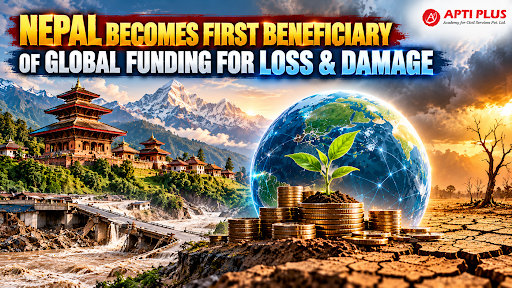
The United Nations (UN) Fund for Responding to Loss and Damage (FRLD) provisionally approved a $20 million emergency grant (plus $1.6 million oversight fee) for Nepal's flood recovery following August 2026 glacial floods.
What Is The UN Loss And Damage Fund?
The concept of Loss and Damage (L&D) under the United Nations Framework Convention on Climate Change (UNFCCC) addresses unavoidable economic and non-economic losses caused by anthropogenic climate change.
The fund was officially established at COP27 in Sharm el-Sheikh (2022) and operationalized at COP28 in Dubai (2023) to provide financial compensation and rapid emergency response to vulnerable developing nations suffering from acute climate disasters.
Governance Structure: Hosted provisionally by the World Bank, the fund is governed by an independent FRLD Board representing developed countries, Least Developed Countries (LDCs), Small Island Developing States (SIDS), and regional blocs.
Current Capitalization Status: Total pledges stand at $822.06 million across 27 donor countries, with actual paid-in grant contributions standing at $629.70 million. (Source: FRLD)
-
Major donor commitments include the United Arab Emirates (UAE), Germany, France, United Kingdom (UK), Spain, and Australia.
Severe Demand-Supply Mismatch: The FRLD faces 176 funding applications from 118 developing nations totaling $2.8 billion in requested assistance. (Source: FRLD)
-
Requests exceed total pledged capital by over 300%, while individual project grants are strictly capped at $20 million under current operational guidelines.

Why Did Nepal Request Emergency Climate Compensation From The FRLD?
Himalayan Disaster: In August 2026, climate-driven rock-and-ice avalanche high in the Himalayas triggered severe flash floods and debris flows along the Bhotekoshi, Trishuli, and Narayani river systems in Nepal's Rasuwa and Nuwakot districts.
Humanitarian Toll: Disaster killed over 1,400 people, left over 5,000 people missing, and directly affected over 60,000 individuals across 15,000 households.
Economic Loss: Preliminary physical damages to infrastructure and economic losses reached $2.7 billion, while total long-term recovery and reconstruction costs were assessed at $4.7 billion to $4.8 billion—equivalent to nearly 10% of Nepal's GDP. (Source: NDRRMA)
Asymmetry of Climate Vulnerability: Nepal contributes barely 0.1% of global greenhouse gas emissions, yet its fragile cryosphere faces accelerated glacial melt, permafrost thaw, and glacial lake outburst floods due to global warming driven by major historical emitters. (Source: NDRRMA)
Inadequate Coverage Ratio: Nepal's approved $20 million emergency grant covers just 0.7% of direct physical damages ($2.7 billion) and less than 0.3% of overall reconstruction needs ($4.8 billion).
What Are The Legal Dimensions Of Nepal's Claim?
Barbados Implementation Modalities (BIM): The FRLD Board allowed Nepal to submit a proposal under the Barbados Implementation Modalities (BIM) outside the standard application window, piloting an extraordinary rapid-response pathway for sudden-onset disasters.
ICJ Advisory Opinion (2025) Precedent: The International Court of Justice (ICJ) Advisory Opinion on Obligations of States in respect of Climate Change (2025) established a 'sufficiently direct and certain' legal causation standard, validating scientific attribution studies to link specific extreme weather events to global warming and hold major historical emitters legally accountable.
Principle of CBDR-RC: Under Article 2(2) of the Paris Agreement, climate finance operates under Common But Differentiated Responsibilities and Respective Capabilities (CBDR-RC), placing a moral and financial obligation on developed nations to compensate climate-vulnerable LDCs.
Role of Climate Attribution Science: Nepal's claim leverages rapid attribution assessments from World Weather Attribution (WWA), demonstrating that cryosphere degradation and extreme precipitation cascades in the Himalayas are directly linked to global temperature rise.

What Are the Major Challenges Facing the Fund?
Capital Deficit: Total pledges to the Fund for Responding to Loss and Damage (FRLD) stand at approximately $822 million, with only $630 million actually paid in.
-
In contrast, developing nations have already submitted 176 to 180 funding applications totaling $2.8 billion.
-
Total pledges represent less than 0.2% of the estimated $100 billion to $580 billion in annual climate-induced losses faced by developing countries by 2030.
Voluntary Nature: Contributions under the UNFCCC framework remain entirely voluntary, lacking mandatory contribution schedules or legally binding scales of assessment for developed historical emitters. This unpredictability threatens complete capital exhaustion of the fund by 2027.
Procedural Delays: The FRLD enforces a complex 11-step project review pipeline designed for multi-year development projects rather than urgent disaster response. Consequently, $0 was disbursed to disaster victims during the fund's first three years of operation.
Governance Friction: Hosting the secretariat interim trustee under the World Bank as a Financial Intermediary Fund (FIF) faces strong criticism from developing nations.
-
Concerns center on high administrative overheads, donor-heavy voting structures, and World Bank fiduciary rules that hinder direct financial access for national entities.
Arbitrary Allocation Caps: Individual project funding is strictly capped at $20 million under the Barbados Implementation Modalities (BIM).
-
For major events like Nepal's August 2026 flash floods, this grant covers just 0.7% of direct physical damages ($2.7 billion) and 0.3% of overall reconstruction costs ($4.8 billion).
Inadequate Recognition of Non-Economic Losses: Global climate finance mechanisms lack standardized tools to evaluate, record, and compensate for non-economic loss and damage (NELD), such as loss of human lives, forced displacement, cultural degradation, and ecosystem collapse.
Way Forward
Transition to Mandatory Assessed Contributions: Shift from discretionary pledges to legally binding assessed contributions for high-emitting developed nations based on historical emissions, fiscal capacity, and the Polluter Pays Principle.
Automated Parametric Triggers and Emergency Windows: Institutionalize dedicated rapid-response windows featuring automated parametric triggers (linked to weather indices, hazard thresholds, or disaster declarations) to release pre-approved liquidity within days of a catastrophe.
Mobilizing Innovative Global Revenue Streams: Establish non-voluntary financing mechanisms, including a Climate Damages Tax on fossil fuel extraction, international maritime shipping levies, and solidarity taxes on aviation and financial transactions.
Direct Access Modalities: Simplify accreditation processes to enable direct access for national social protection ministries, sub-national bodies, and local community organizations without intermediate multilateral development bank (MDB) friction.
Integration with Shock-Responsive Social Protection: Channel loss and damage grants directly into nationally owned shock-responsive social protection systems (e.g., cash transfer registries and public works programs) to prevent disaster victims from falling into chronic poverty traps.
Transitioning to Fully Independent Governance: Shift control from the interim World Bank setup to a permanent, independent UNFCCC entity governed by a majority representation from the Global South.
Frameworks for Non-Economic Losses: Establish participatory, human-rights-based community windows to document and compensate for non-economic loss and damage (NELD) without reducing non-monetary cultural or ecological harms to pure financial metrics.
Conclusion
The Fund for Responding to Loss and Damage (FRLD) must urgently evolve from a voluntary, procedurally clogged mechanism into a mandatory, grant-based architecture of climate justice that delivers rapid liquidity to frontline communities.
Source: INDIANEXPRESS
|
PRACTICE QUESTION Q. The global Loss and Damage Fund represents an important step towards climate justice, but its effectiveness depends on adequate financing and timely disbursement. Discuss. 250 words |