Why In News?
Indian Oil Corporation (IOC) has secured government approvals to supply sustainable aviation fuel (SAF) commercially from its Panipat refinery in Haryana.
What Is Sustainable Aviation Fuel (SAF)?
It is a non-petroleum, cleaner alternative to conventional fossil jet fuel that reduces the carbon footprint of air travel.
Chemically similar to standard kerosene, it can be safely blended with regular jet fuel and used in existing aircraft and airport infrastructure without requiring engine or ground system modifications.
How It Works and Its Benefits
-
Carbon Reduction: SAF can cut lifecycle greenhouse gas emissions by up to 80% compared to traditional fossil kerosene, depending on the feedstock and production method.
-
Drop-In Compatibility: It is certified as a "drop-in" fuel, meaning it is typically blended with conventional jet fuel at ratios between 10% and 50% (though industry work is underway for 100% pure SAF flights).
-
Closed Carbon Cycle: The plants and waste materials used to make SAF absorb CO₂ from the atmosphere during their growth lifecycle, balancing out the emissions released when the fuel is burned.
Common Feedstocks and Production Pathways
SAF is manufactured from renewable and waste resources rather than crude oil:
-
HEFA (Hydroprocessed Esters and Fatty Acids): Made from used cooking oils, animal fats, and industrial grease.
-
Alcohol-to-Jet (ATJ): Converted from plant-based ethanol or iso-butanol (derived from agricultural residues or starches).
-
Fischer-Tropsch (FT) Synthetics: Produced from solid municipal waste, forestry residue, or biomass.
-
e-Fuels (Power-to-Liquids): Created by combining captured carbon dioxide with renewable-hydrogen produced via electrolysis.
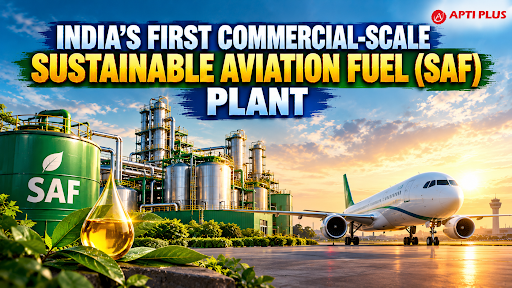
What Is India's First Commercial-Scale SAF Plant?
-
Location And Host: The Panipat refinery has a crude processing capacity of about 301,000 barrels per day. It is IOC's flagship refinery in north India.
-
Certification: It received India's first ISCC CORSIA certification for SAF production in 2025.
-
Capacity: The unit will produce about 35,000 tonnes of SAF a year from used cooking oil. This matches the national 1% requirement for 2027.
-
Technology: The plant co-processes UCO using the HEFA (hydroprocessed esters and fatty acids) pathway. IOC upgrades a 300,000 barrels-per-day diesel desulphuriser for this purpose.
-
Feedstock Chain: Collection agencies will source used cooking oil from hotels, restaurants and large food makers.
|
ISCC CORSIA is a globally recognized certification system developed by the International Sustainability and Carbon Certification (ISCC) to prove that Sustainable Aviation Fuel (SAF) and lower-carbon aviation fuels comply with the International Civil Aviation Organization's (ICAO) Carbon Offsetting and Reduction Scheme for International Aviation (CORSIA). |
Why Is Commercial SAF Important For India?
-
Mandated Demand: A 1% blending mandate for international airlines comes into force in 2027 and rises to 2% in 2028.
-
Waste To Fuel: There is ample Used Cooking Oil (UCO) collection in India, and most of it is currently exported. Domestic use links waste management with aviation decarbonisation.
-
Export Opportunity: Europe already has SAF blending mandates, so European airlines could be early buyers when they fly into India.
-
Climate Goal: SAF supports India's Net Zero 2070 commitment. It addresses emissions from a sector hard to electrify.
-
Energy Security: Domestic production lowers dependence on imported crude-based jet fuel over time
Initiatives Taken By Government And Industry To Promote SAF
-
ISCC CORSIA Certification For Panipat: IOC became the first Indian company certified under this scheme for SAF from used cooking oil. The certification is a global prerequisite for commercial SAF production and is valid for one year.
-
Indicative Blending Targets: In 2023, the National Biofuels Coordination Committee, chaired by the Union Petroleum Minister, set the initial indicative SAF blending percentages. The targets are 1% in 2027 and 2% in 2028.
-
Air India Supply Agreement: IOC and Air India signed an agreement in August 2025 for SAF supply. It gives the refinery an anchor customer from the national carrier.
-
Second Plant With LanzaJet Technology: IOC announced an alcohol-to-jet plant with US firm LanzaJet at a capacity of 86,800 tonnes a year. It is expected to be operational by March 2028.
-
National Policy On Biofuels, 2018: The policy covers biojet fuel along with ethanol and biodiesel. It created the framework for the oil ministry's committee to recommend SAF blending.
-
Repurpose Used Cooking Oil (RUCO) Initiative: The Food Safety and Standards Authority of India launched RUCO to collect used cooking oil and convert it into biodiesel. It builds the collection network that SAF producers can use.
What Are The Key Challenges In Scaling SAF In India?
Feedstock Supply And Sustainability
-
Sustainability Concern: IOC has flagged feedstock sustainability as a core challenge for India's SAF journey. Certified, traceable feedstock is needed.
-
Collection Gaps: Most UCO is collected by agencies and exported today. A domestic collection network must be built from hotels, restaurants and households.
High Cost And Viability
-
Price Premium: SAF costs more than conventional jet fuel. Airlines will need tax breaks or carbon credits to make it viable.
-
Tight Margins: Airline operations run on thin margins. This slows long-term purchase agreements.
Limited Scale Of Production
-
Small Capacity: The 35,000 tonnes-a-year unit meets only the 1% requirement for international flights. The 2% target in 2028 needs more capacity.
-
Demand-Led Investment: IOC will first seek airline agreements before committing to new projects. This can delay capacity additions.
Technology And Project Risks
-
Project Delays: LanzaJet's plant in Georgia, the first large-scale alcohol-to-jet facility, began production in November 2025 after several years of delays. India's alcohol-to-jet plant could face similar risks.
-
Uncertain Timelines: The start date for commercial supply has not been disclosed. This creates planning uncertainty for airlines.
Certification And Compliance Burden
-
Annual Validity: The certification is valid for one year, so the IOC must renew it. Lifecycle emission and traceability audits repeat every year.
-
Multiple Pathways: Each technology and unit needs certification before commercial operation. This slows the entry of new producers.
Dependence On Few Producers
-
Concentrated Supply: IOC is currently the only Indian company certified for SAF from UCO. Supply risk is concentrated in one refinery.
-
Slow Entry Of Others: Other refiners such as Mangalore Refinery and Petrochemicals Limited are still planning units. Their output will take years to arrive.
What Is The Way Forward For India's SAF Sector?
Secure And Certify Feedstock
-
Aggregator Network: Build a formal UCO collection chain with certified aggregators in large cities. Link it to RUCO.
-
Diversify Feedstock: Add agricultural residues, ethanol and non-edible oils to reduce reliance on one source.
Make SAF Commercially Viable
-
Fiscal Support: Offer tax relief or green premium support for airlines buying SAF. Link purchases to carbon credit benefits.
-
Long-Term Contracts: Encourage offtake agreements between producers and airlines. This gives certainty to investors.
Scale Capacity Faster
-
Replicate At Other Refineries: Upgrade existing units at other public sector refiners, as at Panipat. This avoids building new plants.
-
Fast-Track Second Plant: Complete the alcohol-to-jet project on time and widen ethanol-based supply.
Tap Export Demand
-
European Airlines: Offer certified SAF to airlines flying into India, where mandates already exist. This gives early revenue.
-
Trade Alignment: Align domestic certification with international schemes so Indian SAF is accepted abroad.
Strengthen Regulation And Standards
-
Clear Mandate Path: Notify a predictable blending trajectory beyond 2028. Predictable rules reduce investment risk.
-
Faster Approvals: Create a single window for certification and clearances for new SAF units.
Link SAF With Green Energy
-
Green Hydrogen Link: Use the 10,000 tonnes-a-year green hydrogen unit at Panipat to power SAF processing. This lowers the fuel's carbon footprint.
-
Circular Economy: Treat waste oil as a resource. Build recycling incentives for food businesses.
Conclusion
The Panipat approval makes IOC the first commercial SAF supplier in India and gives the 2027 blending mandate a domestic source. Scaling beyond the 1% target needs secure feedstock, airline demand and clear policy.
Source: REUTERS
|
PRACTICE QUESTION Q. Explain the significance of sustainable aviation fuel for India's climate and energy goals. (10 Marks, 150 Words) |