Why In News?
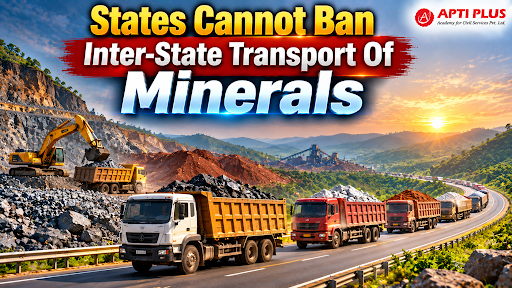
The Madras High Court has struck down a Tamil Nadu rule that allowed the State to ban the transport of excavated minerals to other States.
What Was The Tamil Nadu Rule And Ban?
-
Rule 3-A: A notification inserted Rule 3-A into the 2011 Rules. It let the Director of Geology and Mining regulate transport of rough stone, boulders, M-sand, metal jelly and other construction materials to other States.
-
The Ban: In July 2026, the Director used the rule to impose a three-month ban, exempting only Puducherry and Karaikal.
-
Materials Covered: The ban covered rough stones, crushed stones, M-sand, metal jelly, ballast and road construction stones.
-
State's Stand: The State said the rule balanced domestic demand, public safety and construction material availability. It said excessive inter-State movement had diverted minerals largely to Middle Eastern countries.
What Did The Madras High Court Hold?
-
Core Ruling: The court said any State measure to ban transport of minerals to other States, or restrict sales, except as provided under Part XIII of the Constitution, is unconstitutional and beyond legislative competence.
-
Section 23C Limited: Relying on State of Gujarat vs Jayeshbhai Kanjibhai Kalathiya, the bench held that Section 23C of the Mines and Minerals (Development and Regulation) Act, 1957 (MMDR Act) targets illegal mining, transport and storage only. It cannot be stretched to restrict legally mined minerals.
-
Ownership Of Minerals: Minerals excavated under a valid lease, with statutory requirements met, vest in the lessee.
-
No Rational Link: Once mining is permitted, a temporary ban on transport to other States has no rational connection to the statute's objective.
-
Delegated Legislation: Delegated legislation must stay within the powers of the parent Act.
-
Infructuous Plea Rejected: The State argued the ban had run its course. The court still decided the constitutional question.
|
Constitutional And Legal Provisions
|
Initiatives Taken By Government To Regulate Mineral Transport And Prevent Illegal Mining
MMDR Act Amendments Of 2015 And 2021: The Union amended the Act in 2015 and 2021 to improve auctions, transparency and enforcement. Tamil Nadu's Industries Minister admitted that parts of the State's minor mineral rules were not in line with these central changes.
-
Section 23C Rules On Illegal Mining: Section 23C lets States make rules to prevent illegal mining, transport and storage. Tamil Nadu framed its 2011 Rules under this power.
Mineral Conservation And Development Rules, 2017: Rule 45 of these Rules requires returns and records on mineral movement. They apply alongside State rules to track production and dispatch.
State Action Against Illegal Transport: Tamil Nadu told the court it had set up committees to stop illegal transport of gravel and M-sand from Coimbatore to Kerala.
Sustainable Sand Mining Guidelines: The Ministry of Environment, Forest and Climate Change issued guidelines in 2016 and enforcement and monitoring guidelines in 2020. They stress replenishment studies, bans in monsoon and satellite monitoring.
What Are The Key Challenges Raised By The Issue?
Centre-State Federal Tension
-
Overlapping Powers: Mining regulation sits under a central Act while States control minor minerals. The line between the two is often contested.
-
Delegated Rules Overreach: Rule 3-A went beyond what Section 23C allows. The court held that delegated rules must stay within the parent Act.
Illegal Mining And Diversion
-
Diversion Claims: The State said excessive inter-State movement had diverted minerals largely to Middle Eastern countries. Proving illegality needs strong records.
-
Weak Tracking: Masquerading of illegal mining as lawful trade is hard to detect. State monitoring must rely on e-permits and checks.
Supply And Price Pressure
-
Local Prices: Reports say exports to other States for higher profit affect local construction material prices. This drives State intervention.
-
Domestic Demand: The State wanted to secure sufficient supply of stone and M-sand within Tamil Nadu. A blanket ban was not a lawful tool.
Impact On Neighbouring States And Projects
-
Supply Standstill: After the July ban, supply of rocks, bricks and M-sand to Kerala reportedly came to a standstill.
-
Infrastructure Delays: Kerala warned that the curbs could delay national highway and port-linked projects.
Livelihood And Business Losses
-
Losses To Operators: Quarry, crusher and lorry owners said the three-month ban caused huge losses. They moved the High Court.
-
Transport Sector Hit: Truck owners faced idle fleets and lost income during the ban.
Environmental Costs Of Mining
-
Ecological Pressure: Environmentalists, farmers and activists called for a permanent ban, citing damage from quarrying. Lawful mining still has environmental costs.
-
Regulation Gap: Bans on transport do not address over-extraction at the source. The right tool is limits at the leasing stage.
What Is The Way Forward?
Respect Constitutional Limits
-
Use Part XIII Route: Any restriction on inter-State trade should follow Article 304 of the Constitution, including the President's previous sanction for the State Bill.
-
Stay Within The Parent Act: Frame State rules strictly within powers conferred by the MMDR Act.
Control Mining At The Source
-
Lease Conditions: Cap extraction through lease conditions and environmental clearances rather than transport bans.
-
Replenishment Studies: Base sand and stone mining limits on scientific studies under national guidelines.
Strengthen Anti-Illegal-Mining Enforcement
-
E-Permits And Tracking: Use digital transit passes, GPS tracking of trucks and checkpost data to detect diversion.
-
Satellite Surveillance: Use satellite monitoring to detect unauthorised quarries.
Ensure Supply Security Through Lawful Tools
-
Promote Alternatives: Encourage M-sand and recycled aggregate from construction waste to ease pressure on natural sources.
-
Price Monitoring: Set up State-level price monitoring for construction materials instead of export curbs.
Improve Inter-State Coordination
-
Dialogue Mechanism: Use forums such as the Inter-State Council to resolve supply disputes between neighbouring States.
-
Priority For Public Projects: Ensure free movement of materials for national highways and ports.
Support Affected Livelihoods
-
Predictable Rules: Give notice and consult stakeholders before any restriction. This avoids sudden losses to operators.
-
Transport Sector Support: Ensure prompt compensation or relief where unlawful orders cause losses.
Conclusion
The ruling confirms that States cannot ban inter-State transport of lawfully mined minerals outside Part XIII. Mining must be controlled at the leasing stage and through enforcement against illegality.
Source: CNBCTV18
|
PRACTICE QUESTION Q. Examine the tension between States' regulatory powers over minerals and the freedom of inter-State trade, and suggest lawful ways to manage mining and supply. (10 Marks, 150 Words) |