Why In News?
The Union Minister for Agriculture and Farmers' Welfare launched the "Khet Bachao Abhiyan" to correct imbalanced chemical fertilizer application, reverse severe Soil Organic Carbon (SOC) depletion, and halt deteriorating soil biological health across Indian farmlands.
What Is Khet Bachao Abhiyan?
It is a nationwide agricultural awareness and capacity-building campaign launched by the Ministry of Agriculture and Farmers Welfare and the Indian Council of Agricultural Research (ICAR).
The campaign's core message is “Save the Soil, Save Farming, Save Farmers.”
Key Objectives
-
Soil Health Protection: Combats soil degradation, nutrient depletion, and chemical pollution caused by the overuse of synthetic fertilizers (especially urea) and pesticides.
-
Soil-Test-Based Management: Encourages farmers to use Soil Health Cards and conduct regular soil tests so they apply fertilizers in a balanced, scientific manner.
-
Promotion of Natural & Sustainable Farming: Supports zero-budget natural farming (ZBNF), green manuring (such as using Dhaincha), crop diversification, and integrated nutrient management.
-
Crop Residue Management: Focuses on reducing stubble burning and teaching farmers modern residue-handling techniques (like using balers and Super Seeders).
-
Counterfeit Protection: Protects farmers from fake seeds, low-quality pesticides, and fraudulent fertilizers.
-
Scheme Linkage: Connects grassroots farmers with schemes like PM-Kisan Samman Nidhi, Kisan Credit Cards (KCC), and crop insurance programs.
Implementation Framework
-
Institutions Involved: Carried out via Krishi Vigyan Kendras (KVKs), the Agricultural Technology Management Agency (ATMA), ICAR research institutes, and state agriculture departments.
-
Ground Activities: Conducts Kisan Chaupals (farmer meetings), village seminars, field demonstrations, and distribution of bio-fertilizers.
What Is The Current Status Of Soil Health In India?
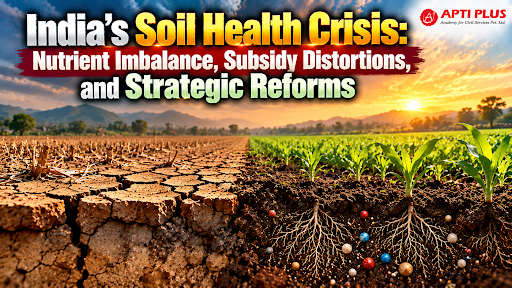
Soil Organic Carbon (SOC) Depletion: As per the 2025-26 testing cycle of 96 lakh samples under the Soil Health Card (SHC) Scheme, 52% of tested soils are deficient in SOC, with intensive agricultural tracts in Punjab and Haryana witnessing SOC levels plunging to 0.2%–0.4% against the normative benchmark of 1.5%–2.0% .
Macro and Micronutrient Imbalances: Pan-India testing under the Soil Health Card (SHC) Scheme reveals that 72% of soils suffer from Nitrogen (N) deficiency, 40%–52% from Phosphorus (P) deficiency, and 32%–72% from Potassium (K) deficiency, while 42% lack Boron and 37% lack Zinc.
Skewed NPK Application Ratio: Driven by disproportionate subsidies under the Nutrient-Based Subsidy (NBS) framework, India's NPK consumption ratio stands at 10.5:4.1:1 in 2024-25 (and 7.7:3.1:1 in 2021-22), diverging sharply from the normative ratio of 4:2:1 or derived optimal 2.8:1.5:1.
Declining Crop Response Ratio: Over-reliance on synthetic inputs without organic matter incorporation has caused the nationwide fertilizer-to-grain response ratio to collapse from 1:10 in the 1970s to 1:2.7 in 2015.
Land Degradation: Approximately 147 million hectares (comprising 29.77% of India's total geographical area under the SAC 2021 Atlas) face land degradation, dominated by water erosion across 94 million hectares and wind erosion across 9 million hectares.
Why Is Soil Health Essential For Long-Term Agricultural Sustainability And Food Security?
Optimization of Input Efficiency and Farm Profitability: Soil-test-based nutrient applications under the Soil Health Card (SHC) Scheme reduce excessive urea usage by 8%–10%, boosting net farm incomes per acre by 54.8% for Paddy and 139.8% for Maize in state-level field demonstrations.
Enhancement of Water Retention and Moisture Resilience: Every 1% increase in Soil Organic Carbon (SOC) expands soil water-holding capacity by 25,000 gallons per acre, bolstering climate resilience for rainfed agriculture across 50% of India's net sown area.
Combatting Hidden Hunger and Malnutrition: Micronutrient-depleted soils yield nutrient-deficient food crops, compounding public health crises where 18.7% of children under 5 suffer from wasting and 50% of women aged 15-49 suffer from anemia.
Fulfilling Land Degradation Neutrality (LDN) Commitments: Restoring soil physical structure and microbial ecosystems is mandatory to fulfill India's statutory pledge under the United Nations Convention to Combat Desertification (UNCCD) to achieve Land Degradation Neutrality (LDN) by 2030.
What Are Drivers Of Soil Degradation Across Indian Farmlands?
Fiscal Distortion and Skewed Fertilizer Pricing: Under the Nutrient-Based Subsidy (NBS) regime and Essential Commodities Act, 1955, retail urea prices have remained capped at ₹242 per 45 kg bag since 2012 despite production costs exceeding ₹2,600 per bag, creating a distorted price signal that incentivizes urea overuse while Potassium application suffers a 72% deficit nationwide. (Source: ICRIER)
Cropping System Fatigue and Monoculture: Intensive rice-wheat rotation supported by Minimum Support Price (MSP) procurement in the Indo-Gangetic Plains causes deep nutrient mining, resulting in an annual gap of 8 to 10 million tonnes of NPK between nutrient extraction and replenishment.
Flood Irrigation and Secondary Salinization: Unscientific irrigation management—with agricultural extraction reaching 87% of India's 239.16 bcm groundwater abstraction—has induced waterlogging and salinization across 6.7 million to 8.5 million hectares, generating annual crop losses of ₹150.17 billion.
Crop Residue Burning and Carbon Loss: Annual burning of approximately 100 million tonnes of agricultural stubble destroys surface organic layers, eliminates rhizosphere microbes, and releases greenhouse gas emissions.
Steps Taken by Government to Improve Soil Health
Soil Health Card (SHC) Scheme: Launched in 2015 at Suratgarh, Rajasthan, and merged as the ‘Soil Health & Fertility’ component under Rashtriya Krishi Vikas Yojana (RKVY) since 2022–23.
-
12 Parameter Testing: Evaluates macro-nutrients (N, P, K, S), micro-nutrients (Zn, Fe, Cu, Mn, B), and physical-chemical indicators (pH, Electrical Conductivity, Soil Organic Carbon).
-
Coverage & Validity: Cards are issued every 3 years, with over 25 crore cards distributed to farmers nationwide.
-
Lab Infrastructure: Established 8,272 Soil Testing Laboratories (STLs), including 1,068 static labs, 163 mobile units, 6,376 mini labs, and 665 Village-Level Soil Testing Labs (VLSTLs) run by rural youth, SHGs, and FPOs.
-
Digital Integration & School Programme: Upgraded with a GIS-interactive portal, geo-tagged sample collection via SHC Mobile App, and unique QR codes for transparent reporting. Includes the School Soil Health Programme operating across 1,021 schools with 1,000 school labs.
Khet Bachao Abhiyan (Save the Farm Campaign): Initiated in October 2026 in Karnal, Haryana, by the Union Ministry of Agriculture.
-
Focuses on correcting imbalanced chemical input usage by aligning farm applications with State Agricultural University (SAU) recommendations.
-
Enforces the 4Rs Nutrient Stewardship Framework—Right Source, Right Rate, Right Time, and Right Place—based on plot-level advisories.
Nutrient-Based Subsidy (NBS) Policy: Introduced in 2010 to promote balanced fertilization by providing fixed annual subsidies for Phosphorous (P), Potassium (K), and secondary/micro-nutrients.
PM-PRANAM (Programme for Restoration, Awareness, Nourishment and Amelioration of Mother Earth): Designed to incentivize States and Union Territories that successfully reduce overall chemical fertilizer consumption and switch to balanced nutrient blends.
Promotion of Next-Gen & Coated Fertilizers: Mandatory Neem-Coated Urea (NCU) to slow nitrogen release and prevent leaching, alongside government backing for Nano Urea, Nano DAP, Triple Super Phosphate (TSP), bio-fertilizers, and customized fertilizer formulations.
Paramparagat Krishi Vikas Yojana (PKVY): Sub-scheme under the National Mission for Sustainable Agriculture (NMSA) promoting organic farming through cluster-based adoption, Participatory Guarantee System (PGS) certification, and organic input support.
-
National Mission for Sustainable Agriculture (NMSA): Integrates climate-resilient practices, conservation agriculture, and resource management across rainfed agricultural belts.
Bharatiya Prakritik Krishi Paddhati (BPKP) / National Mission on Natural Farming (NMNF): Promotes chemical-free, low-input natural farming, scaling successful regional models like Andhra Pradesh Community-Managed Natural Farming (APCNF) and Zero Budget Natural Farming (ZBNF).
National Agroforestry Policy (NAP): Promotes multi-tiered tree-crop integration (alley-cropping) to deepen root stabilization, pull deep-soil nutrients to the surface, and build permanent carbon sinks.
National Land Degradation Neutrality (LDN) Targets: Aligned with UNCCD commitments to restore 147 million hectares of degraded land and combat desertification by 2030.
Per Drop More Crop (PDMC): Expands micro-irrigation (drip and sprinkler systems) to replace traditional flood irrigation, preventing secondary soil salinization, waterlogging, and topsoil nutrient leaching.
What Are The Challenges In Managing Soil Health?
Fiscal Entrenchment of Chemical Subsidies: The Union Government's fertilizer subsidy outlay stands at ₹1.71 lakh crore in FY 2026-27, with geopolitical supply disruptions in the Strait of Hormuz threatening to escalate expenditures to ₹2.5 to ₹3.0 lakh crore, creating severe fiscal drag that starves public investment in soil biological rejuvenation.
-
Example: Union Budget 2026-27 & ICRIER Report, 2026, allocation of one-ninth of the total agricultural budget to chemical subsidies while nitrogen subsidy benefits remain heavily skewed (Punjab receives ₹25,700 per hectare, 10 times that of Kerala), locking in soil-degrading monocultures.
Testing Infrastructure Gaps and Delay in Actionable Advisories: Despite establishing 8,272 Soil Testing Laboratories (SLTs) under the Soil Health Card (SHC) Scheme, institutional capacity suffers from delayed sample processing, lack of bio-indicator testing (e.g., microbial biomass and enzyme activity), and weak integration with local extension networks.
-
Example: Soil Health Card Scheme Performance Audit, static and mobile labs focus exclusively on chemical N-P-K parameters without assessing biological health indicators, leaving farmers without actionable guidance for biological soil restoration.
Widespread Industrial Contamination and Heavy Metal Bioaccumulation: Peri-urban agricultural lands suffer from unregulated industrial effluent discharge and untreated sewage sludge irrigation, contaminating topsoil with hazardous heavy metals.
-
Example: According to Union Government Groundwater & Soil Pollution Data, over 9.6 million people in West Bengal, 1.6 million in Assam, and 1.2 million in Bihar face immediate health risks from heavy metal and arsenic accumulation entering the agricultural food chain.
Way Forward To Restore India's Soil Ecosystems
Transition to Integrated Nutrient Management (INM) & Subsidizing Bio-Inputs: Repurposing the Nutrient-Based Subsidy (NBS) to incentivize organic compost, bio-fertilizers, nano-urea, and biological inoculants under the National Mission for Sustainable Agriculture (NMSA) and Rashtriya Krishi Vikas Yojana (RKVY) - Soil Health & Fertility component.
-
Example: Pusa Bio-Decomposer & Andhra Pradesh Community-Managed Natural Farming (APCNF) Model, scaling in-situ microbial decomposition of crop residue across 1 million hectares, increasing Soil Organic Carbon (SOC) by 0.2% annually and reducing chemical input expenditure by 40%.
Scaling Up Conservation Agriculture and Zero-Tillage: Expanding zero-till seed drills, Happy Seeder technology, and Direct Seeded Rice (DSR) to eliminate crop residue burning and prevent topsoil erosion.
-
Example: Happy Seeder & Conservation Agriculture Initiative in Punjab & Haryana, adopting zero-tillage on stubble-covered fields reduced topsoil erosion by 60%, preserved moisture equivalent to 25,000 gallons per acre per 1% SOC increase, and curbed carbon oxidation.
Institutionalizing Agroforestry and Watershed Management: Merging soil restoration with state forestry and employment initiatives under the National Agroforestry Policy (NAP) and PMKSY - Watershed Development Component (WDC).
-
Example: Zaï Pits & Alley-Cropping Models in Rajasthan & Odisha, constructing traditional Zaï water-harvesting pits and leguminous alley cropping restored 50,000 hectares of degraded semi-arid lands, boosting soil nitrogen and surface microbial biomass.
Conclusion
Addressing India's soil crisis requires shifting to regenerative farming, restoring Soil Organic Carbon (SOC), and rebalancing nutrient policies to secure food supply and rural stability.
Source: INDIANEXPRESS
|
PRACTICE QUESTION Q. Fixing India's deteriorating soil health requires shifting from price-distorted chemical subsidies to outcome-based regenerative agriculture. Discuss. 150 words |