Why In News?
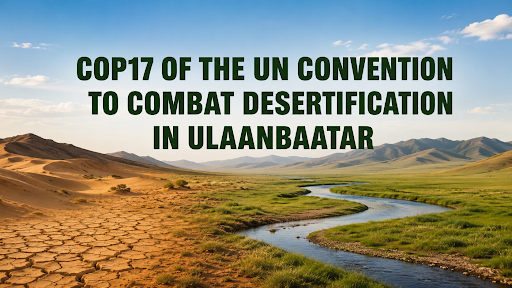
The 17th session of the Conference of the Parties (COP17) to the United Nations Convention to Combat Desertification (UNCCD) started in Ulaanbaatar (Mongolia) under the theme "Restoring Land. Restoring Hope."
What is the UNCCD?
The United Nations Convention to Combat Desertification (UNCCD) is a legally binding international environmental agreement addressing desertification, land degradation and drought, alongside sustainable land management.
It is one of the three Rio Conventions, alongside theCBD (Convention on Biological Diversity) and the UNFCCC (United Nations Framework Convention on Climate Change), all originating from the 1992 Rio Earth Summit.
Host country Mongolia: nearly 77% of Mongolia's land is already degraded.
What is Land Degradation, Desertification and Drought?
-
Land degradation: A decline in land productivity through soil degradation, vegetation loss, biodiversity decline, and reduced ecosystem services.
-
Desertification: Land degradation specifically occurring in drylands (arid, semi-arid and dry sub-humid regions), driven by both climatic factors and human activity.
-
Drought has four recognised dimensions: meteorological, agricultural, hydrological, and socio-economic drought, each affecting different stages of the water-food-livelihood chain.
Why is Land Degradation a Global Concern?
-
Global Scale: About 70% of ice-free land has already been altered, affecting over 3.2 billion people; at current rates, 90% of land could bear human influence by 2050. (Source: UNCCD).
-
Food Security: Soil degradation reduces productivity and threatens food systems, while agricultural soils can erode up to 100 times faster than natural replenishment under unsustainable practices. (Source: UNCCD)
-
Water Security: Degraded land loses ecosystem functions such as water retention and freshwater storage, increasing vulnerability to drought and hydrological stress.
-
Migration & Conflict: Land degradation and drought can trigger crop failure, livelihood loss, migration and conflict, turning an ecological problem into a human-security issue.
-
Biodiversity: Land degradation reduces habitat quality, ecological integrity and ecosystem services, making it a major driver of biodiversity decline.
What are the Major Causes of Land Degradation?
-
Unsustainable Agriculture: Intensive cultivation, excessive tillage, monocropping and poor nutrient management accelerate soil erosion, fertility decline and organic-carbon loss.
-
Overgrazing: Excessive livestock pressure removes vegetation faster than regeneration, exposing fragile soils to wind and water erosion.
-
Deforestation: Vegetation removal reduces soil stability and ecosystem resilience, accelerating erosion, biodiversity loss and hydrological degradation.
-
Mining & Infrastructure: Mining, roads, urbanisation and industrial expansion can fragment ecosystems and permanently alter soil, vegetation and land-use patterns.
-
Poor Irrigation: Unsustainable irrigation can cause salinisation and waterlogging, reducing agricultural productivity and accelerating soil degradation.
-
Climate Change: Rising temperatures, altered precipitation and more frequent extremes interact with existing land pressures, creating a climate–land degradation feedback loop
How Does Climate Change Intensify Land Degradation?
-
Heat Stress: Rising temperatures increase evapotranspiration and soil-moisture loss, reducing vegetation resilience and making already-degraded land more drought-prone.
-
Rainfall Extremes: Intense rainfall increases runoff and soil erosion, while prolonged rainfall deficits reduce vegetation cover and soil moisture.
-
Drought Intensification: Climate change is increasing the frequency, intensity, extent and duration of droughts in many regions, amplifying pressure on land and ecosystems.
-
Positive Feedback: Degraded land → lower vegetation → weaker carbon storage → higher warming → greater drought/erosion → further degradation, creating a self-reinforcing cycle.
-
2026 El Niño: NOAA reports >90% probability of a very strong El Niño during Northern Hemisphere autumn–winter 2026–27, while the World Meteorological Organization expects major shifts in global temperature and rainfall patterns.
What are the Impacts of Desertification on India?
Scale: India had 97.85 million ha (29.77% of TGA) under land degradation in 2018–19, up from 94.53 Mha (28.76%) in 2003–05, indicating a long-term degradation burden. (Source: Desertification & Land Degradation Atlas 2021).
Desertification: 83.69 million ha was undergoing desertification in 2018–19, highlighting significant pressure on India’s dryland agriculture, pastoral systems and ecosystems.
Major Driver: Water erosion affected 11.01%, vegetation degradation 9.15% and wind erosion 5.46% of India’s geographical area in 2018–19, making soil and vegetation conservation central to restoration. (Source: ISRO)
Regional Hotspots: Rajasthan had 62.42% of its area under degradation, followed by Jharkhand 68.80%, Gujarat 52.19%, Maharashtra 46.60% and Karnataka 36.27%, showing strong regional variation. (Source: ISRO)
Agriculture: Soil erosion, declining soil organic matter and vegetation loss reduce land productivity and water-retention capacity, increasing risks to farm incomes and food security.
Water Security: Degraded soils reduce infiltration and water-holding capacity, intensifying runoff, groundwater stress and drought vulnerability, especially in dryland regions.Pastoral Livelihoods: Degradation of grasslands and commons reduces fodder availability and carrying capacity, increasing livelihood vulnerability among pastoral and livestock-dependent communities.
Biodiversity: Vegetation degradation and habitat fragmentation weaken ecosystem services and biodiversity, with restoration therefore requiring a landscape approach rather than plantation-only interventions.
Climate Link: Degraded land reduces ecosystem carbon-storage capacity, while drought and warming can accelerate vegetation loss, creating a degradation–climate feedback loop.
Migration: Falling agricultural and pastoral productivity can increase distress migration and livelihood diversification, particularly where rural households have limited alternative income sources.
Reversibility: Uttar Pradesh, Rajasthan and Telangana recorded declines in degraded/desertified land in the 2018–19 assessment, demonstrating that targeted land-management interventions can reverse degradation.
What is Land Degradation Neutrality (LDN)?
LDN is a UNCCD framework aimed at ensuring the amount and quality of land resources remain stable or improve, by:
-
Avoiding new degradation
-
Reducing existing degradation
-
Restoring degraded land
India committed to restoring 26 million hectares of degraded land by 2030, raised from an earlier target of 21 million hectares, announced by the Prime Minister at UNCCD COP14, hosted by India in 2019.
Source: DOWNTOEARTH
PRACTICE QUESTIONQ. "Land degradation is not merely an environmental issue but a matter of human and national security." Discuss. (150 words) |