Why In News?
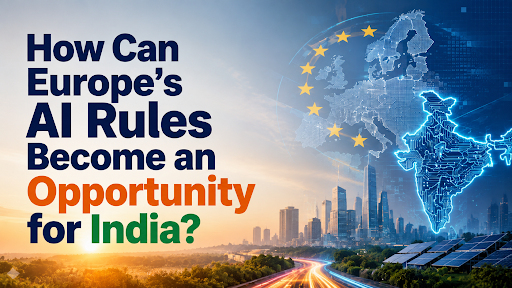
The European Union’s AI Act creates opportunities for India’s IT sector to export AI compliance and auditing services, driven by strict regulatory requirements.
What is the EU AI Act?
The EU AI Act, Regulation (EU) 2024/1689, is the EU’s first comprehensive AI law and adopts a risk-based regulatory model, linking regulatory intensity to potential harm to safety and fundamental rights.
Core Regulatory Architecture
-
Risk-based regulation: AI is regulated through prohibited practices, high-risk systems, transparency obligations and largely low-risk applications, rather than imposing one uniform compliance burden.
-
Unacceptable-risk AI: Certain manipulative AI, social-control practices, untargeted facial-image scraping, workplace/education emotion recognition and specified biometric categorisation are prohibited.
-
High-risk AI: Applications affecting employment, education, biometrics, critical infrastructure, migration and access to essential services face stringent risk-management, documentation, human-oversight and conformity requirements.
General-Purpose AI (GPAI)
-
GPAI providers must maintain technical documentation, follow EU copyright law and publish a sufficiently detailed summary of training content.
-
Models posing systemic risk face additional duties: model evaluation, adversarial testing, systemic-risk mitigation, incident reporting and cybersecurity safeguards.
Transparency and Deepfakes
-
Article 50 requires certain AI systems to inform users when they interact with AI and requires machine-readable marking of AI-generated/manipulated content.
-
Deployers must disclose exposure to deepfakes, certain AI-generated public-interest content, emotion-recognition and biometric-categorisation systems.
-
The Commission published the Code of Practice on marking and labelling AI-generated content in June 2026, providing a practical compliance mechanism for providers and deployers.
Penalties
-
Violating prohibited-AI rules can attract fines of up to €35 million or 7% of worldwide annual turnover, whichever is higher.
-
Other serious obligations can attract penalties up to €15 million or 3% of global turnover, while misleading information can attract up to €7.5 million or 1%.
Global Significance
|
How India Can Benefit from European AI Regulation
Compliance Services: A New Export Opportunity
-
The EU AI Act creates demand for risk assessment, technical documentation, model testing, incident reporting and cybersecurity, especially for systemic-risk GPAI models.
-
Systemic-risk GPAI providers must conduct adversarial testing, risk mitigation, serious-incident reporting and cybersecurity assessments, creating a specialised market for Indian AI auditors and testing firms.
Certification and AI Governance
-
India can build an AI certification ecosystem around IS/ISO/IEC 42001:2023, which BIS has adopted as an Indian Standard for Artificial Intelligence Management Systems.
-
BIS already identifies AI testing, governance, trustworthiness, ethics and certification/audit as important standardisation areas, creating institutional foundations for an AI-assurance industry.
India's Cost and Capability Advantage
-
India's technology industry had 5.80 million employees in FY2025, with net hiring of 126,000 during the year, providing a large base for AI compliance exports. (Source: NASSCOM)
-
India's advantage is not merely low-cost labour; its established IT services, cybersecurity, software engineering and enterprise-compliance ecosystem can be repurposed for AI assurance.
-
Prior experience of Indian IT firms in GDPR compliance since 2018 provides organisational familiarity with European regulatory workflows.
Startup and MSME Opportunities
-
Indian startups can develop automated AI-risk registers, model documentation, bias-testing tools, audit trails, AI-BOMs and compliance dashboards for European clients.
-
MSMEs can use shared compliance platforms to reduce the fixed cost of EU certification, documentation and continuous monitoring.
Building an Indian AI-Assurance Ecosystem
-
India should establish EU-focused AI testing laboratories capable of bias, robustness, safety, cybersecurity and adversarial testing for high-risk systems.
-
Certification capacity should combine BIS standards, ISO/IEC 42001 and EU AI Act requirements, creating interoperable assurance rather than separate compliance silos.
-
India's IndiaAI Mission has a ₹10,371.92 crore outlay and explicitly includes safe, trusted and ethical AI as a component, providing a domestic institutional base for this ecosystem.
India-EU Cooperation
-
The EU-India TTC has already committed to cooperation on trustworthy AI, LLMs, ethical AI tools, research and interoperable standards.
-
In July 2026, the third TTC meeting agreed to deepen cooperation on AI, semiconductors, HPC, quantum technologies and 6G, while moving towards India's association with Horizon Europe.
-
EU-India R&I cooperation already spans 142 European Framework Programme projects during 2015–2026, providing an existing research network that can be extended to AI safety and evaluation.
-
The EU's European Legal Gateway Office in New Delhi, launched in February 2026, can facilitate legal ICT-sector mobility across all 27 EU Member States.
Strategic Opportunity for India
India can move from “IT services exporter” to “AI assurance exporter” by combining its engineering workforce with EU-facing testing, certification, cybersecurity and regulatory-technology capabilities.
The strongest opportunity lies in building a trusted AI-compliance value chain:
AI testing → risk assessment → certification → continuous monitoring → cybersecurity → cross-border compliance.
This would convert the EU's regulatory burden into an exportable Indian professional-services ecosystem, while strengthening India's own responsible-AI architecture.

Challenges for India
Regulatory and Institutional Capacity: India has adopted principle-based AI governance rather than a standalone AI Act; the 2025 Guidelines recommend six pillars covering infrastructure, capacity building, regulation, risk mitigation, accountability and institutions.
-
The real gap is implementation capacity: India needs specialised model testing, red-teaming, impact assessment and AI-audit institutions rather than regulation alone.
Shortage of AI-Safety Expertise: India's AI governance challenge is also a skills-and-institution problem.
-
NITI Aayog estimates that AI talent demand could rise from 8–8.5 lakh to over 12.5 lakh by 2026, while existing talent is growing at only about 15% against 25% demand growth.
-
This shortage directly affects the availability of AI auditors, model evaluators, red-teamers, algorithmic-impact assessors and AI safety researchers.
Data Governance: The DPDP Rules, 2025 have operationalised data-protection framework, but AI creates additional issues around training datasets, consent, provenance, anonymisation and cross-border data flows.
Compute and Technology Dependence: IndiaAI Mission has onboarded 38,000+ GPUs, with another 20,000 GPUs being added, but advanced chips and frontier-model infrastructure remain globally concentrated.
-
India therefore needs sovereign compute + indigenous models + domestic evaluation capability, not merely access to foreign foundation models.
Fragmented Sectoral Regulation: AI applications cut across banking, healthcare, education, labour and elections, while regulatory responsibility remains distributed across existing institutions.
-
This creates risks of regulatory overlap, inconsistent standards and unclear accountability for cross-sector AI systems.
Way Forward for India
Move from Principles to Risk-Based Assurance: Operationalise the 2025 Guidelines through risk-tiered obligations, requiring stronger testing, documentation, human oversight and post-deployment monitoring for high-impact AI.
-
India should avoid mechanically copying the EU AI Act and instead build a proportionate framework suited to Indian startups and public-sector use cases.
Build National AI Testing Capacity: Make the India AI Safety Institute a national hub for red-teaming, model evaluation, bias testing and safety benchmarks.
-
Develop accredited AI assurance laboratories aligned with ISO/IEC 42001 so Indian firms can demonstrate internationally recognised AI-governance practices.
Create India-Specific AI Benchmarks: Evaluation must cover Indian languages, caste/gender bias, misinformation, public-service applications and cultural context, rather than relying entirely on Western benchmarks.
-
Emerging research such as Inspect India Evals demonstrates the need for India-specific multilingual, safety and cultural benchmarks.
Convert Compliance into an Export Capability: Train AI auditors, algorithmic-impact assessors, red-teamers and AI-governance professionals at scale.
-
India's existing technology-services ecosystem can evolve from software outsourcing towards AI assurance, certification and compliance services for global markets.
Link Regulation with Indigenous AI Development: IndiaAI has shortlisted 12 teams for indigenous foundation models, while more than 38,000 GPUs are available through shared compute infrastructure.
-
Connect this ecosystem with open safety benchmarks, secure datasets and public-interest AI, making safety a built-in design requirement rather than an afterthought.
Use Sandboxes for Controlled Innovation: Establish sector-specific AI sandboxes in healthcare, fintech, agriculture and governance, allowing controlled testing before full-scale deployment.
-
This can reconcile “innovation over restraint” with accountability, one of the core principles of India's AI Governance Guidelines.
Build Global Interoperability: India should participate in developing global AI standards, while aligning domestic assurance systems with ISO, OECD and emerging international frameworks.
-
This would reduce compliance duplication and allow Indian AI firms to treat trusted-AI certification as a market-access advantage, not merely a regulatory cost.
Conclusion
India's real opportunity lies in treating AI governance itself as an export industry — building world-class testing, auditing, and certification capacity now, while the EU AI Act's 2026-27 enforcement timeline is still creating fresh global demand.
Source: THEHINDU
|
PRACTICE QUESTION Q. India currently relies on non-binding AI governance guidelines rather than a comprehensive AI law. Discuss (150 words) |