Why In News?
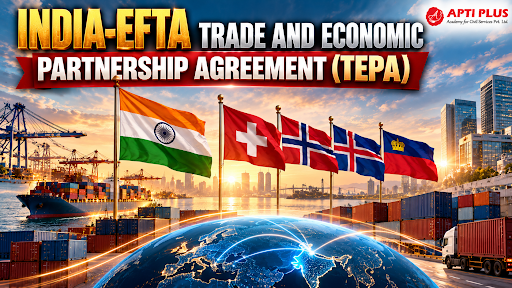
The Trade and Economic Partnership Agreement (TEPA) between India and the four-nation European Free Trade Association (EFTA)—which entered into force on October 1, 2025—has completed one year of operationalization.
What Is The European Free Trade Association (EFTA)?
Intergovernmental Economic Bloc: Established in 1960 under the Stockholm Convention as an alternative trade bloc for European nations that chose not to join the European Economic Community (now the EU).
Four Member States: Comprises Switzerland, Norway, Iceland, and Liechtenstein.
Global Economic Weight: Despite a combined population of just 14 million, EFTA states represent the world’s 10th largest trader in merchandise and the 5th largest in commercial services, boasting high per capita incomes, sovereign wealth reserves, and technological innovation.
Distinct from the European Union: EFTA countries participate in the European Single Market (via the European Economic Area agreement for Norway, Iceland, and Liechtenstein, and bilateral treaties for Switzerland) while maintaining sovereign, independent trade policies with non-European nations.

What Is The India-EFTA TEPA?
Signing and Enforcement Timeline: Formally signed in March 2024, after nearly 16 years of negotiations, and officially entered into force in October 2025, following domestic ratifications.
Comprehensive 14-Chapter Scope: Spans Trade in Goods, Rules of Origin, Trade Facilitation, Trade in Services, Investment Promotion, Intellectual Property Rights (IPR), Government Procurement, Trade and Sustainable Development (TSD), and Dispute Settlement.
The "Investment-Linked Trade" Paradigm: Represents the world’s first free trade agreement where tariff concessions are explicitly linked to binding, long-term foreign direct investment (FDI) commitments.

Why Is Switzerland A Critical Pillar Of The Partnership?
|
What Are The Key Commitments Under TEPA?
The $100 Billion Investment Commitment: EFTA nations have committed to facilitating $100 billion in foreign direct investment into India over a 15-year horizon:
-
$50 billion during the initial 10-year period (2025–2035);
-
An additional $50 billion over the subsequent five years (2035–2040).
One Million Direct Jobs: The investment framework is tied to the objective of generating one million direct employment opportunities in India across high-tech manufacturing, pharmaceuticals, green energy, and precision engineering.
Institutional Governance: Established a Joint Investment Sub-Committee and a dedicated "EFTA Desk" at Invest India to match EFTA capital with Indian greenfield and brownfield projects.
Calibrated Rebalancing Mechanism: If investment targets remain unfulfilled after 15 years, India retains the sovereign right to temporarily withdraw or calibrate tariff concessions, ensuring mutual accountability without traditional penalty litigation.
How Does TEPA Expand Market Access?
Unprecedented Coverage for Indian Exports: EFTA countries have extended tariff concessions on 92.2% of their tariff lines, covering 99.6% of India’s export value.
100% Tariff Elimination on Non-Agri Goods: Guarantees immediate zero-duty access for all Indian industrial and manufacturing goods, including textiles, garments, leather, gems and jewellery, pharmaceuticals, and engineering machinery.
India’s Concessions: India offers tariff reductions on 82.7% of its tariff lines, covering 95.3% of EFTA exports (primarily precision tools, medical diagnostic machinery, watches, and specialty chemicals).
Protection of Sensitive Domestic Sectors: India excluded sensitive agricultural and food security items—including dairy products, soybean, maize, and edible oils—from tariff cuts, shielding domestic farmers.
Services Mobility (Mode 4 Access): Guarantees streamlined visa and residence processes for Indian professionals (software engineers, accountants, nurses, and audiovisual professionals) into EFTA economies.
Which Key Sectors Stand To Benefit?
Pharmaceuticals & Healthcare: Fast-tracks regulatory approvals and clinical data sharing with Switzerland (home to Novartis and Roche) while preserving India's generic manufacturing leadership.
Precision Engineering & Industrial Automation: Integrates Swiss and Liechtenstein micro-technology, robotics, and advanced machine tooling into India's defense, aerospace, and electronics sectors.
Renewable Energy & Clean Tech: Transfers cutting-edge geothermal engineering from Iceland, offshore wind and carbon capture technology from Norway, and energy-storage solutions.
Sustainable Fisheries & Maritime Logistics: Taps Norwegian maritime technology, green shipping corridors, cold-chain automation, and sustainable aquaculture processing.
Financial Services & Institutional Capital: Channels sovereign capital from the Government Pension Fund Global of Norway (the world's largest sovereign wealth fund) and Swiss asset managers into Indian national infrastructure.

What Is The Significance For India's Economic Strategy?
Catalyst for Make in India and Atmanirbhar Bharat: Accelerates domestic value addition by substituting imported high-tech equipment with domestic manufacturing under joint ventures.
De-Risking Global Supply Chains: Aligns with Western efforts to diversify manufacturing hubs away from China ("China Plus One" strategy), anchoring global supply chains in India.
Benchmark for Future Western FTAs: Sets a positive precedent for ongoing negotiations with the European Union, the United Kingdom, and Canada.
Arctic and Polar Research Cooperation: Broadens India's engagement in Arctic research through Norway and Iceland, supporting the objectives of India's Arctic Policy.
What Are The Major Challenges In Implementation?
Translating Commitments into Tangible Capital Inflows: Mobilizing $100 billion requires overcoming domestic bureaucratic hurdles, land acquisition delays, and tax disputes.
-
Example: The 15-Year Horizon Delivery Risk, which requires sustaining an average annual FDI inflow of over $6.6 billion exclusively from four small nations.
Heavy Trade Asymmetry Driven by Gold Imports: India faces a persistent merchandise trade deficit with EFTA, heavily skewed by gold imports from Switzerland.
-
Example: Gold Accounting for over 70–80% of India's Imports from EFTA, masking real manufacturing trade imbalances.
Strict Non-Tariff Barriers (NTBs) in Europe: Stringent Sanitary and Phytosanitary (SPS) regulations, maximum residue limits (MRLs), and carbon standards across EFTA markets restrict agricultural exports from Indian MSMEs.
Logistics Costs and Geographic Distance: Higher maritime freight tariffs to Northern European ports challenge the price competitiveness of bulky Indian industrial goods against Eastern European suppliers.
Way Forward
Operationalize High-Level Investment Matching: Empower the dedicated EFTA Desk at Invest India to act as a single-window clearance interface, connecting sovereign funds with national infrastructure projects.
-
Example: National Infrastructure Pipeline (NIP) Portals, providing pre-cleared industrial land parcels for Swiss and Norwegian industrial clusters.
Enhance Quality Standards and Certification for MSMEs: Establish mutual recognition agreements (MRAs) for laboratory testing, organic certifications, and pharma audits to overcome European non-tariff barriers.
-
Example: Quality Council of India (QCI) Conformity Assessments, aligning Indian export testing with European conformity standards.
Leverage Clean Energy and Arctic Technologies: Form institutional partnerships between the Ministry of New and Renewable Energy and Icelandic consortia to commercialize geothermal energy in Ladakh and Himachal Pradesh.
-
Example: ONGC’s Puga Valley Geothermal Project, utilizing Icelandic deep-drilling expertise to tap clean baseload power.
Promote Collaborative Services Integration: Expand digital service exports by embedding Indian IT-BPM professionals into Swiss and Norwegian enterprise digitization and fintech pipelines.
Conclusion
Linking trade access to a $100 billion investment commitment, the India-EFTA TEPA shows that rules-based economic partnerships can boost domestic industrialization and build resilient global value chains.
Source: THEHINDU
|
PRACTICE QUESTION Q. With reference to the European Free Trade Association (EFTA), consider the following statements: 1. EFTA is a regional trade organization consisting of Switzerland, Norway, Iceland, and Liechtenstein. 2. All member states of EFTA are also full member states of the European Union (EU). 3. Under the India-EFTA Trade and Economic Partnership Agreement (TEPA), EFTA countries have committed to invest $100 billion in India over 15 years. Which of the statements given above are correct? (a) 1 and 2 only (b) 2 and 3 only (c) 1 and 3 only (d) 1, 2 and 3 Answer: (c) Explanation: Statement 1 is correct: The European Free Trade Association (EFTA) is an intergovernmental regional trade organization. Its current four member states are Switzerland, Norway, Iceland, and Liechtenstein. Statement 2 is incorrect: EFTA operates in parallel to the European Union (EU). None of the four EFTA member states are members of the EU. Instead, they maintain close economic ties and access the EU's single market through the European Economic Area (EEA) agreement (for Norway, Iceland, and Liechtenstein) and bilateral agreements (for Switzerland). Statement 3 is correct: Under the India-EFTA Trade and Economic Partnership Agreement (TEPA) signed in 2024, the EFTA nations have made a legally binding commitment to invest $100 billion in India and create one million direct jobs over a span of 15 years. |