Why In News?
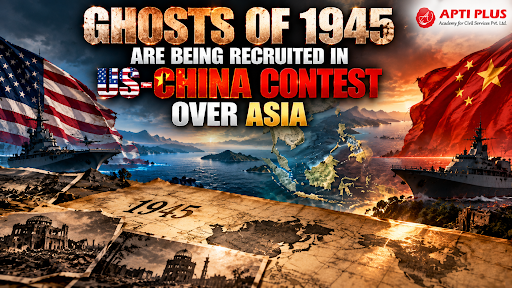
Amid growing Indo-Pacific tensions, the US and China use competing WWII (1945) historical narratives to legitimize current diplomacy, territorial claims, and military alliances.
What Is The Historical Context Of 1945?
Culmination of World War II: 1945 marked the unconditional surrender of Nazi Germany in May and Imperial Japan in August–September, ending decades of militarist expansionism across Eurasia.
Institutionalisation of the Post-War Order: Victorious Allied powers established the United Nations (UN) at the San Francisco Conference (June 1945), institutionalising the primacy of the "Big Five" permanent members of the UN Security Council (UNSC) equipped with veto power.
Bipolar Superpower Emergence: Devastation of European imperial powers (Britain and France) catalyzed the rise of the United States and the Soviet Union as ideological and military superpowers, dividing global geopolitics into competing spheres of influence.
What Was The US-China Wartime Relationship?
Allied Collaboration with Nationalist China: During World War II, Washington’s primary Asian ally was the Republic of China (ROC), headed by Generalissimo Chiang Kai-shek (Jiang Jieshi) of the Kuomintang (KMT).
Sustained Chinese Resistance: Chinese forces tied down hundreds of thousands of Imperial Japanese troops on the mainland, which earned China international recognition as one of the four principal Allied powers.
The 1949 Divergence: The post-war Chinese Civil War culminated in the defeat of the ROC government, which retreated to Taiwan in 1949, while Mao Zedong established the People's Republic of China (PRC) on the mainland.
Diplomatic Paradox: The United States originally recognized the ROC in Taipei as the legitimate representative of China (holding China’s permanent seat at the UNSC) until UN General Assembly Resolution 2758 of October 1971 transferred the seat to Beijing.

What Is The Yalta System Vs The San Francisco System?
Yalta System (February 1945)
-
Negotiated by Franklin D. Roosevelt, Winston Churchill, and Joseph Stalin in Crimea, dividing post-war Europe into recognized Western and Soviet spheres of influence.
-
In Asia, Soviet entry into the war against Japan was secured in exchange for territorial concessions in Sakhalin and the Kuril Islands.
The San Francisco System (September 1951)
-
The formal multilateral peace settlement signed between Japan and 48 Allied nations (boycotted by the Soviet Union, with neither the PRC nor ROC invited due to Western recognition disputes).
-
Laid the foundation for the US "Hub-and-Spoke" security architecture across the Asia-Pacific, anchoring regional stability through bilateral mutual defense treaties: the US–Japan Security Treaty (1951), US–South Korea Alliance (1953), US–Philippines Treaty (1951), and the ANZUS pact.
-
Designated Japan as the democratic economic and logistical anchor of American power projection in Asia.
How Is China Reinterpreting The Legacy Of 1945?
Transition from "Victimhood" to "Victor": For decades, Beijing’s nationalist legitimacy rested on the "Century of National Humiliation" (1839–1949) suffered at the hands of Western and Japanese imperialism. Today, Beijing emphasizes China’s identity as a victorious founding architect of the 1945 global order.
Claiming Co-Equal Hegemony: By framing itself as a core architect of the anti-fascist victory and an original drafter of the UN Charter, the Chinese Communist Party (CCP) asserts an equal sovereign entitlement with Washington to dictate Asian regional security.
Strategic Anti-Colonial Narrative: Deploys historical memory to delegitimize the presence of external naval powers (principally the US) in Asian waters, advocating an "Asia for Asians" Monroe-style doctrine.
Why Are Taiwan And Japan Central To This Historical Contest?
Disputed Legitimacy over Taiwan
Beijing’s Invocations: The PRC cites the Cairo Declaration (1943) and the Potsdam Proclamation (1945)—which stipulated that all territories seized by Japan (including Formosa/Taiwan and the Pescadores) be returned to "China"—to claim undisputed sovereignty over the island.
The Counter-Argument: Washington’s wartime pacts were negotiated with Chiang Kai-shek’s Republic of China (ROC), which has governed Taiwan continuously since 1945 and has evolved into a sovereign democracy, while the PRC never administered the island.
Weaponisation of History Against Japan
Targeting Japanese Defense Modernization: Beijing repeatedly invokes Imperial Japan’s wartime atrocities (such as the 1937 Nanjing Massacre) to frame Tokyo’s modern defense spending increases and joint naval patrols as a dangerous revival of "militarism".
The "Enemy State Clauses" of the UN Charter: China references Articles 53, 77, and 107 of the UN Charter, which permitted enforcement measures against World War II enemy states (Germany, Japan, and Italy) without explicit Security Council authorization.
What Was India’s Role In World War II And Why Was It Marginalised?
Unprecedented Material and Military Mobilisation
2.5 Million Volunteer Troops: The British Indian Army mobilized the largest all-volunteer fighting force in human history.
Decisive Battlefront Contributions: Indian formations turned the tide of the war across North Africa (Battle of El Alamein), the Italian Campaign (Battle of Monte Cassino), the Middle East (Iraq and Syria), and the Burma Campaign.
The "Stalingrad of the East": The ferocious defensive stands at the Battles of Imphal and Kohima (1944) halted the Japanese Imperial invasion, crippling Japan's land forces in Southeast Asia.
Industrial Backbone: Over 14 million Indian factory workers and agricultural laborers supplied munitions, steel, jute, and provisions that sustained the Allied theater.
Root Causes of Post-War Marginalisation
Colonial Subjugation: India participated in the war as an imperial dependency without an autonomous diplomatic agency.
Internal National Movement Cleavages:
-
The Indian National Congress opposed unilateral British participation without Indian consent, resigned from provincial ministries in 1939, and launched the Quit India Movement (1942).
-
The Communist Party of India (CPI) shifted from anti-war strikes to supporting Britain’s war effort as a "People's War" after Nazi Germany attacked the Soviet Union in 1941.
-
Netaji Subhas Chandra Bose forged the Indian National Army (INA), aligning with Axis powers (Germany and Japan) to achieve armed liberation from British imperialism.
The Trauma of Partition: Division of the subcontinent in August 1947 dissipated geopolitical capital, causing post-colonial Indian elites to view the World War through an ideological prism of colonial exploitation rather than strategic power projection.
What Are The Strategic Implications For India Today?
Correcting an "Historical Injustice": External Affairs Minister Dr. S. Jaishankar has repeatedly stated that India’s exclusion from the permanent membership of the UN Security Council in 1945 constitutes an uncorrected historical injustice that distorts contemporary global governance.
Countering China's Hegemonic Maritime Architecture: China’s efforts to dismantle the San Francisco alliance system threaten India’s security by facilitating Chinese naval dominance across the Malacca Strait and the broader Indian Ocean Region (IOR).
Preserving a Multipolar Indo-Pacific: A robust US-Japan security partnership directly benefits India by checking Chinese unilateralism along maritime sea lanes.
Transcending Abstract Rhetoric: Indian foreign policy discourse has historically over-relied on abstract moral concepts (such as non-alignment and universalism) while neglecting historical realism and hard geopolitical power.
What Are The Major Challenges In Reclaiming Historical Diplomacy?
Weak Domestic Historical Memory: Modern Indian public discourse pays less attention to the geopolitical realities of World War II, viewing it primarily as an alien imperial enterprise.
-
Example: Absence of Dedicated National WWII Memorials, where the sacrifice of 87,000 Indian soldiers was long overshadowed by post-colonial pacifist narratives.
Chinese Hegemonic Monopolisation of UN Narratives: Beijing actively uses its UNSC permanent seat and state-backed historical institutes to portray itself as Asia's sole victor of World War II, obscuring India's role in the Pacific and Burma theaters.
-
Example: Chinese State White Papers on the Anti-Fascist War systematically omit the contribution of Indian infantry in liberating Burma and Southeast Asia.
Institutional Rigidity of the P5 Veto: The formal mechanisms to amend the UN Charter (Article 108) remain blocked by existing permanent members—principally China—which opposes permanent UNSC status for India and Japan.
Way Forward
Reclaim India's Wartime Historiography: Systematically document, declassify, and publicize the operational history of the 2.5 million Indian soldiers who fought in World War II to establish an empirical foundation for India’s global governance claims.
Integrate Historical Contribution with UNSC Reform Diplomacy: Strategically link India's foundational status as an original signatory of the 1945 UN Charter and military sacrifices to legitimate claim for permanent membership in an expanded Security Council.
Deepen Indo-Pacific Minilateral Balancing: Strengthen strategic defense synergies with key democratic anchors of the San Francisco System—particularly through the Quad (India, US, Japan, Australia) and trilateral naval cooperation.
Calibrate Strategic Autonomy with Geopolitical Realism: Move beyond post-colonial ambivalence to engage assertively in regional balance-of-power diplomacy, pairing historical legitimacy with modern technological and naval capabilities.
Conclusion
Navigating the emerging US-China contest over Asia requires India to reclaim its forgotten World War II military heritage, translating historic sacrifice into contemporary geopolitical leverage to shape an open, multipolar Indo-Pacific.
Source: INDIANEXPRESS
|
PRACTICE QUESTION Q. The memory of World War II continues to influence the contemporary strategic order in Asia. Examine its significance for US-China rivalry and discuss the implications for India. 250 words |