A working professional does not fail UPSC because of the job. Most fail because their preparation leaks time in places they never see: a missed weekday class that turns into a two-week backlog, a current-affairs source that eats forty minutes a day, a revision cycle that keeps getting postponed, and an answer-writing habit that never starts because nobody is reading the answers.
This article is a working blueprint. It explains the real problems a 9-to-6 aspirant faces and the specific APTI PLUS mechanism that answers each one: what it is, how it works, when you use it, and which problem it removes. It also shows how candidates with demanding jobs at companies, banks, hospitals, a mining and metals company and state government departments went on to clear the exam.
In this article
|
Can I crack UPSC while working full-time?
Yes. Candidates have done it, and the pattern behind them is consistent. They did not find extra hours. They stopped wasting the hours they already had.
A full-time job removes the luxury of a flexible day, but it also removes three things that hurt full-time aspirants: financial pressure, isolation, and the habit of mistaking long hours at a desk for progress. What a working candidate needs is a structured UPSC preparation system where every session has a defined purpose, so that a tired 90 minutes after office still moves the preparation forward.
That is the problem APTI PLUS is built to solve for this group: reducing the number of decisions, the number of resources and the number of unsupported weeks in the preparation.
Do I need to quit my job for UPSC?
Not necessarily. The decision should rest on three questions, not on the popular belief that serious aspirants must resign.
- Can you protect four focused hours a day, five days a week, plus most of the weekend? If yes, the job is manageable.
- Is your preparation currently structured? If you are collecting resources and watching lectures without a PYQ-linked plan, quitting will not fix that. It will only give you more unstructured hours.
- Do you have a feedback loop? Candidates who leave a job and study alone often lose months without anyone checking their answers.
The journeys below show that the job and the exam can coexist when the system around the candidate is tight. If you do decide to quit later, you will do it from a position of data (test scores, answer feedback, syllabus coverage) and not from anxiety.
How many hours should a working professional study for UPSC?
Four hours of focused, consistent preparation every day can be sufficient when those hours are channelised properly. The operative words are focused and consistent.
Here is why the number holds up:
- A candidate who studies four hours daily for 11 months accumulates well over 1,200 hours. A candidate who studies in occasional 10 to 12 hour bursts and then crashes for a week almost never matches that, because retention drops across the gaps and every restart costs the first hour in re-orientation.
- UPSC rewards coverage of the syllabus, repeated revision, and answer quality. None of these needs 10 hours a day. All of them need a daily habit that survives a bad week at work.
- Four hours that include PYQ practice, active recall and answer writing beat eight hours of passive reading.
So the real question is not "how many hours." It is "what is each hour doing?" The rest of this article answers that.
Who cleared UPSC while working?
Here are a few of the hundreds of APTI PLUS students who successfully cleared the UPSC CSE while working. Read them for the pattern, not for inspiration.
Jubin Mohapatra (UPSC CSE, AIR 379). He cleared the exam while managing a full-time corporate job. He used the APTI PLUS weekend and hybrid learning ecosystem: face-to-face depth on weekends, recorded and online access on weekdays. The takeaway is structural. His weekdays were built around portable learning, and his weekends were built around faculty interaction.
Paramita Malakar (AIR 477). She cleared while working in the state government, after earlier professional experience with Tata Consultancy Services (TCS) and State Bank of India (SBI). Her career across IT services, banking and administration gave her three different lenses for Economy, Governance and Mains answers.
Sanjay Dahariya (AIR 946). He balanced preparation with the responsibilities of a bank job in Kolkata. Banking hours are rigid and often run late, which makes him a useful example for anyone who cannot reliably attend weekday evening classes.
Debabrata Pramanik (UPSC CSE 2025, AIR 467). He started as a Graduate Engineer Trainee at Vedanta BALCO in Korba, later became Assistant Director (Technical) at the Odisha Renewable Energy Development Agency (OREDA), and subsequently joined the Odisha Revenue Service. His technical and plant-level exposure fits directly into Science and Technology, Energy, Environment and Infrastructure answers.
Debojyoti Halder (UPSC CSE 2025). He worked as a Residential Housestaff in the Department of Chest Medicine at R.G. Kar Medical College and Hospital and later served as a Medical Officer in a COVID ward. Few candidates can write about public health, resource constraints and ethical dilemmas in healthcare with that kind of first-hand material.
What they have in common: a job that consumed the day, a preparation that did not depend on being physically present every weekday, and regular faculty contact that kept the plan honest. That combination is what the rest of this article unpacks.
The 14 pain points of a working aspirant and the APTI PLUS fix for each
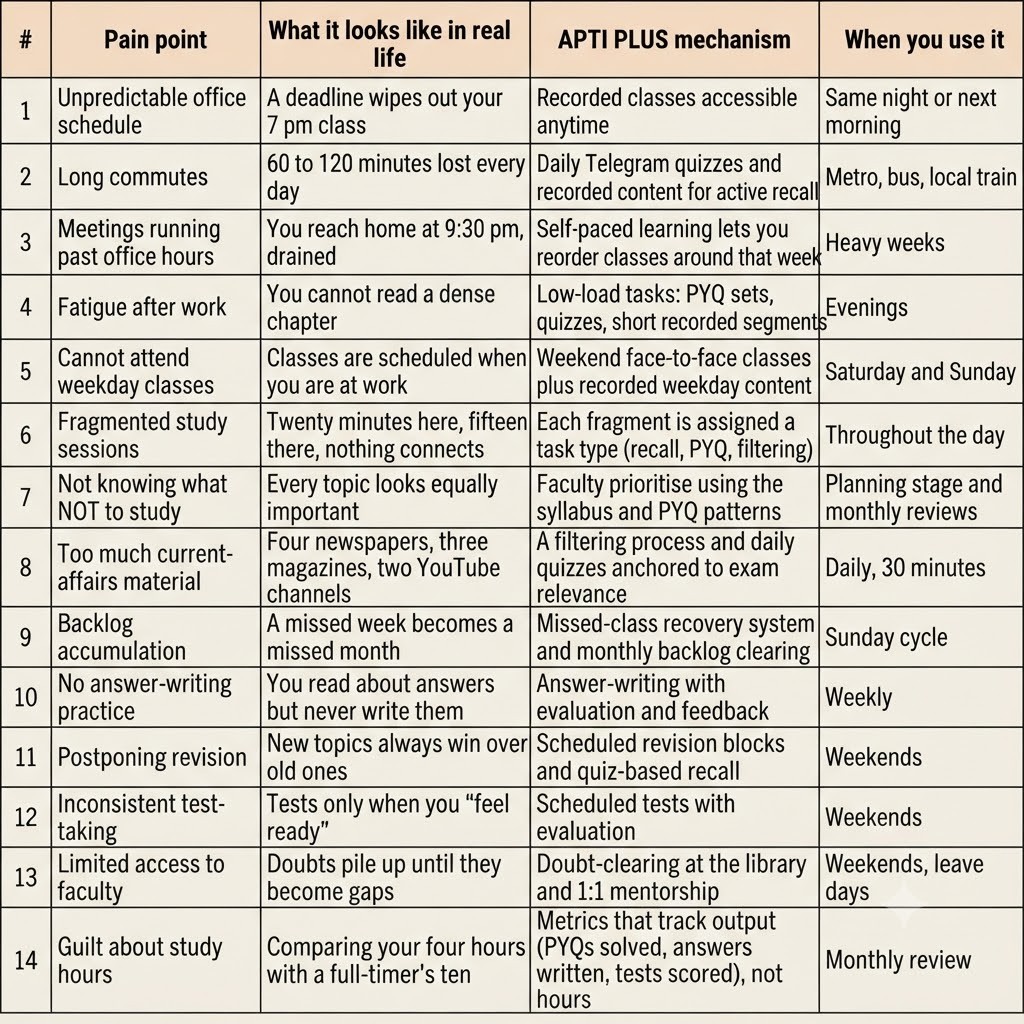
Pain point: "I missed the live class again"
What APTI PLUS does: Classes are available as online recorded lectures you can access anytime.
How: You are not expected to treat a missed live session as a lost session. The recording sits in the same learning cycle, so the sequence of class, practice and test is not broken.
When: The same evening if you have the energy, or on the weekend if the week was heavy.
Problem solved: The usual chain where one missed class creates guilt, guilt creates avoidance, and avoidance creates a backlog.
Pain point: "I do not know what to leave out"
What APTI PLUS does: Faculty help you read the syllabus and previous-year papers together.
How: Instead of treating every sub-topic as equal, you work from what UPSC has actually asked, how it has framed the question, and which areas keep recurring. The PYQ becomes the filter that tells you how deep to go.
When: At the start of each subject and again in the monthly review.
Problem solved: Resource overload, which is the single largest hidden time loss in UPSC preparation.
Pain point: "I never get my answers checked"
What APTI PLUS does: Answer-writing is connected to evaluation and feedback, and 1:1 mentorship gives a place to discuss patterns in your mistakes.
How: You write, you submit, you get specific feedback, and the next answer is written with that feedback in mind.
When: Weekly, with deeper review on weekends.
Problem solved: Reading-heavy preparation that collapses in the Mains hall.
The preparation architecture: classes to mentorship
Working aspirants fail when preparation is a pile of activities. APTI PLUS works as a loop, and every stage answers a specific working-professional problem.
1. Classes (live, recorded, weekend face-to-face).
They give you the structure of a subject without making you build it from scratch. The recorded option means the class adapts to your day, not the other way round.
2. Daily practice.
A short, fixed task every day, even on a heavy-work day. This is what protects consistency during the 10 to 12 months.
3. PYQs.
You solve questions based on UPSC's previous-year patterns while studying a topic, not after finishing the whole syllabus. Samiksha Prelims Workbook and Mains workbook helps you in building strong fundamentals. This tells you what the examiner cares about early and stops you from over-reading.
4. Daily Telegram quizzes.
Small, repeatable pockets of active recall. A quiz on the commute is more valuable than a re-read of notes you would never have opened on a crowded train.
5. Tests.
Regular test-taking replaces the vague feeling of "I think I am ready." Tests give you a number, and numbers are what a time-starved candidate needs for decisions.
6. Evaluation.
Your answers and scores are assessed by faculty, so mistakes are identified by someone who knows the exam.
7. Feedback.
Evaluation without feedback is only a mark. Feedback tells you what to change before the next attempt.
8. Revision.
Feedback feeds directly into what you revise. This is how faculty help you decide when to revise instead of reading something new: if the same concept is costing you marks in tests and quizzes, the next block is revision.
9. Mentorship.
1:1 Sahyog UPSC mentorship holds the whole loop together. It is the place where your actual work calendar, your test results and your syllabus coverage are looked at together.
For a weekend learner, there is one more piece: the physical centre as a preparation environment. You can study in the APTI PLUS library and clear doubts with faculty on the same visit, so a Saturday is not just two hours of class but a full working day with the people who can answer your questions.
Practical models for the working aspirant
These are templates built from the APTI PLUS tools described above. Adjust the timings to your shift, but keep the task types.
The 4-hour working-professional UPSC day
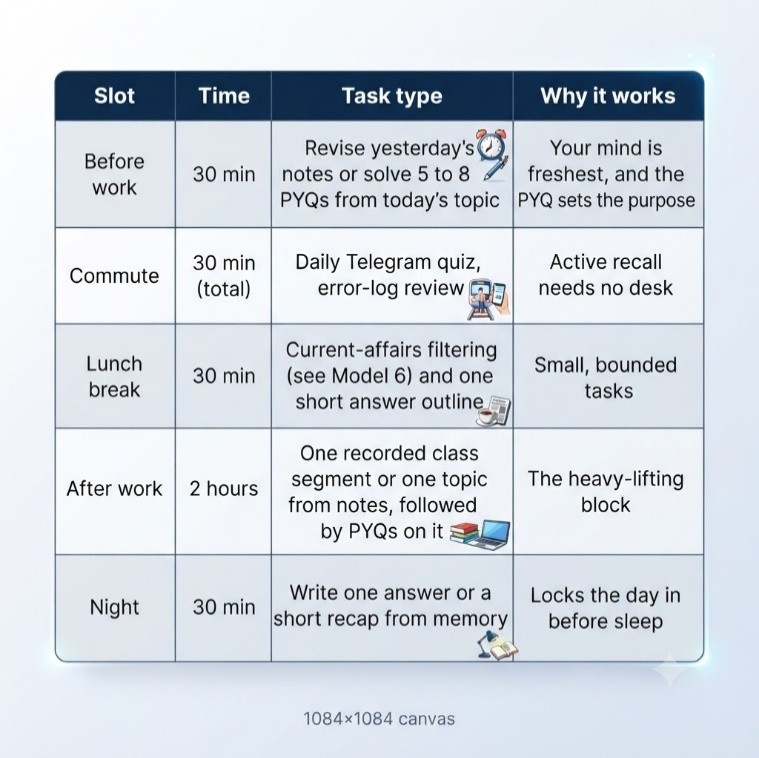
On a day when work runs late, drop the 2-hour block to 60 minutes, keep the quiz and the PYQs, and move the class to the weekend. The day still counts.
Weekday + weekend preparation architecture
- Weekdays: Portable, small-unit learning. Recorded classes in short segments, PYQs, quizzes, current-affairs filtering.
- Saturday and Sunday: Face-to-face class, followed by library time and doubt-clearing with faculty. Consolidation, test or answer-writing, and revision (see Model 4).
The principle: weekdays build volume and recall, weekends build depth and correction.
Sunday consolidation cycle
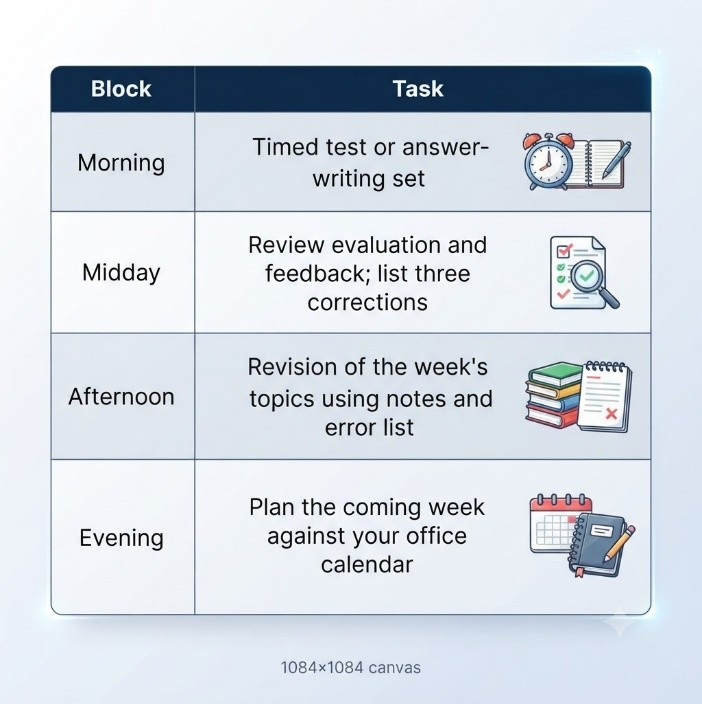
Sunday is where small gaps are caught before they grow.
Missed-class recovery system
- Same day: Tag the missed class and note its topic.
- Within 48 hours: Watch the recording at one sitting if possible, or in two segments.
- Immediately after: Solve PYQs on that topic so the class is converted into practice.
- Weekend: Raise any doubts with faculty at the centre or through mentorship.
The rule is that a missed class is never "deferred." It is scheduled.
Current-affairs filtering process
Working aspirants usually read too much because they fear missing something. A simple filter fixes this.
- Pick one primary source and the daily quiz as your base.
- For each item, ask: Does it connect to a syllabus topic? Has UPSC asked something similar in PYQs? Can I write a 150-word answer on it?
- If the answer to all three is no, skip it.
- Add only the filtered items to a single notebook or file, mapped to the syllabus.
Limit this to 30 minutes a day. Faculty help by showing what UPSC treats as relevant and what is noise.
PYQ-to-topic-to-notes workflow
- Start a topic by reading 8 to 10 PYQs on it.
- Note the pattern: factual, conceptual, analytical, current-affairs linked.
- Study the topic with those patterns in mind.
- Make short notes only for what the PYQs showed matters.
- Revisit the same PYQs after a week and check whether you can answer them.
This keeps your notes small, which is the only way revision stays possible on a job.
Prelims + Mains integrated preparation
Study each topic once with both papers in mind: facts and concepts for Prelims, and analysis, examples and dimensions for Mains. A working professional cannot afford two separate cycles. Pair a topic's Prelims MCQs with one Mains-style question on the same topic, and the second pass becomes lighter.
Answer-writing feedback loop
- Write an answer in the exam time limit.
- Submit for evaluation.
- Read faculty feedback and note the type of mistake (structure, content gap, no example, too long).
- Rewrite the weakest answer from scratch.
- Discuss recurring issues in your mentorship session.
Doing this weekly gives you 40 or more feedback cycles in a year.
Monthly backlog-clearing mechanism
Pick one weekend a month. List every missed class, untested topic and unrevised unit. Rank by PYQ relevance. Clear the top five. Archive the rest or fold them into the next month. A backlog list that is reviewed monthly stays small. One that is ignored becomes a reason to quit.
Leave-day utilisation strategy
Treat every casual or earned leave day as a mock exam day, not a reading day. Take a full-length test in the morning, evaluate it in the afternoon, visit the library for doubts, and end with a revision block. A single well-used leave day can do what three ordinary weekdays cannot.
Prioritisation: how faculty protect your limited hours
Time is the one resource a working aspirant cannot expand, so faculty intervention focuses on four decisions.
- What to study first. Faculty identify high-yield areas from the syllabus and PYQs so your first three months go to the topics with the greatest return.
- What to skip or skim. Not everything in a standard reference needs a full read. Faculty tell you where to stop.
- When to revise instead of reading something new. If test and quiz data show repeated errors, new reading pauses until the weak area is repaired.
- When to say no to another resource. Resource overload is a major cause of failed preparation. A single curated system, with a limited set of sources, is easier to finish.
Faculty intervention also prevents small gaps from turning into large backlogs. A candidate who misses two classes and has nobody to ask will usually quietly miss ten. A candidate with weekly feedback and 1:1 mentorship gets a correction in the first week.
How faculty turn your job into UPSC marks
Employment is often treated as a disadvantage. APTI PLUS faculty treat it as source material.
- Corporate professionals bring analytical ability. They are guided to use structured thinking in Mains answers, case-based reasoning in GS3 and clear frameworks in Essay.
- Engineers bring technical and problem-solving skills, which help with Science and Technology, Infrastructure, Energy and Environment answers and with precise, stepwise writing.
- Bankers understand finance and the economy. Faculty help them convert that into answers on banking, inflation, fiscal policy and financial inclusion with real operational examples.
- Doctors bring healthcare and social-sector perspectives, useful for health policy, public health, bioethics and Ethics case studies.
- Government employees bring administrative exposure, valuable for Governance, Polity and the Interview, where candidates are asked to reason like administrators.
How it works in practice:
Stage |
What faculty do with your experience |
|
Mains answers |
Show you where a real example can replace a generic one |
|
Essay |
Help you build arguments from lived evidence |
|
Ethics case studies |
Ask you to apply decisions you have actually faced |
|
Interview |
Prepare you to speak about your job, your department and your decisions with clarity |
This is why a candidate with a clinical posting, a plant posting or a state department posting can write answers a full-time aspirant simply cannot.
How to prepare for UPSC while working 9-to-6
A realistic, repeatable pattern for the typical office worker:
30 minutes before work: PYQs or a recap of yesterday's learning. Keep it short and finish it every day.
Commute: Telegram quiz, then error-list review. No new topics.
Lunch: Filtered current affairs plus one answer outline.
2 hours after work: The core learning block. One recorded class segment or one topic, then PYQs on it.
Night: A short recall or one written answer.
Weekend: Face-to-face class, library, doubt-clearing, test, evaluation and revision.
Candidates who treat each slot as a different type of preparation, and do not expect every session to look like a three-hour classroom sitting, are the ones who stay consistent.
Why consistency beats the occasional 10-to-12-hour burst
- Memory fades between bursts, so each burst begins with relearning.
- Bursts depend on energy and free days, which a job does not guarantee.
- A single missed weekend wipes out the entire week's progress, while a daily habit survives one bad day.
- Daily practice builds the answer-writing and recall skills the exam actually tests.
How to maintain momentum for 10 to 12 months
- Fix a minimum daily task (quiz + 5 PYQs) that you can complete even on your worst day.
- Track output metrics, not hours: PYQs solved, answers written, tests taken, revision cycles done.
- Hold a monthly review with a mentor: syllabus coverage, test trend, backlog list.
- Plan around your work calendar, such as quarter-end, audits, night shifts, travel, and shift your heavy study to lighter weeks.
- Keep one weekly non-negotiable session, such as the Saturday class or Sunday test.
Dealing with the guilt of comparing hours
A full-time aspirant may log eight to ten hours. If four of those are unstructured, your four focused hours are not far behind. Measure yourself by output, such as tests, answers and revision cycles, and compare only against your own previous month.
Why APTI PLUS matters to a working professional
Credential |
What it means for you |
|
25+ Delhi-based faculty |
Subject-specific teaching across GS papers and optionals, so you get specialist depth for each part of the syllabus without searching for outside teachers. |
|
1:1 mentorship |
A named point of contact who knows your work schedule and your test results, which cuts the time you lose deciding what to do next. |
|
450+ live classes |
A large recorded library of live-taught content. For someone who misses sessions, this means there is always a recording of the same quality to fall back on. |
|
2,000+ selections |
Evidence that the method has produced results across many exams and many candidate profiles, which helps you judge whether it fits your situation. |
|
60 to 70% UPSC-WBCS overlap |
A large share of the syllabus is shared with WBCS, so a Kolkata-based working candidate can prepare for UPSC and keep a state-services option open without doubling the workload. |
The common thread is time saved through reduced uncertainty: fewer resources to evaluate, fewer weeks without feedback and fewer decisions to make alone.
Best UPSC coaching for working professionals: what to check
When comparing options, ask these questions of any institute.
- Can I recover a missed class without losing the sequence?
- Is there a weekend or hybrid format with real faculty contact?
- Are daily practice and PYQs part of the system, or optional extras?
- Who evaluates my answers, and how fast does feedback come?
- Do I have a mentor who knows my work schedule?
- Can I study and clear doubts at a physical centre on weekends?
- Will the system reduce the number of resources I use?
- Do the toppers include candidates with jobs like mine?
If the answer to most of these is vague, you are buying classroom hours. If the answers are specific, you are buying a system.